Helping design and engineering professionals discover, evaluate and specify technologies and processes that shorten the design cycle and enable success.



May 2026 Special Focus: Artificial Intelligence in Design and Simulation
In this Special Focus Issue, learn about the latest developments in the integration of artificial intelligence into engineering workflows.

April 2026 Special Focus Issue: Generative Design
In this Special Focus Issue, Digital Engineering takes a look at how generative design solutions can be used across different types of design problems and with a variety of manufacturing approaches to accelerate design space exploration, and…
Most people have only become interested in additive manufacturing (AM) in the last couple of years, but interest in robotics has a long history. Like 3D printing, robotics is evolving more quickly than most people realize. While it may be true we can’t produce R2D2 quite yet, robotics has advanced in other, more subtle directions.
One area of the robotics field that has seen increased interest in the last decade is that of “soft” robotics. Harvard University’s School of Engineering and Applied Sciences hopes to simultaneously drive interest in soft robotics, and help newcomers to the field, with the Soft Robotics Toolkit. The toolkit is a site that offers how-to tips, open source materials, and tutorials on how to design and realize soft robotics.
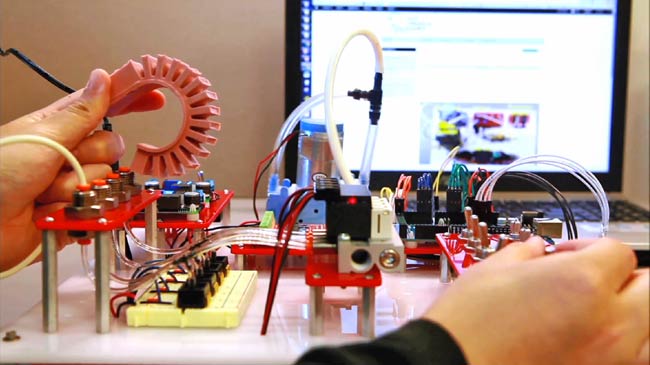 Harvard's Soft Robotic Toolkit is a research and educational resource. Courtesy of Harvard.
While the robotics might be soft, they still need to conform to a required shape, which is where AM enters the picture. Many of the soft robotics are built using elastomers, and making the desired shape requires building a mold. The need for accuracy has led researchers to use CAD and 3D printing to develop the molds used for building the shape for soft robotic design.
AM offers a number of design advantages for research purposes. 3D printing brings a freedom of design that would either be impossible or insanely expensive than other manufacturing processes. Generally, if you can design it in CAD, you can 3D print it. This kind of design freedom is a boon to researchers developing the biomimicry of soft robotics.
CAD designs are also easy to pass around, which help reinforce the open source emphasis of the toolkit. With each design step available to others within the research community, Harvard intends to stimulate creativity to develop new tools, devices, and methods. The toolkit will also act as an educational aid.
“One thing we’ve seen in design courses is that students greatly benefit from access to more experienced peers—say, postdocs in a research lab—who can guide them through their work,” said Dónal Holland, one of the lead developers of the toolkit. “But scaling that up is difficult; you quickly run out of time and people. The toolkit is designed to capture the expertise and make it easily accessible to students.”
Below you’ll find a short video about the Soft Robotics Toolkit.
Source: Harvard


John Newman is a Digital Engineering contributor who focuses on 3D printing. Contact him via [email protected] and read his posts on Rapid Ready Technology.
Follow DE
Join over 90,000 engineering professionals who get fresh engineering news as soon as it is published.






About Us · Contact Us · Editorial Team · Advertising · Privacy Policy · Subscriber Services · © 2026 Digital Engineering 24/7 · Peerless Media