Helping design and engineering professionals discover, evaluate and specify technologies and processes that shorten the design cycle and enable success.


Leveraging additive manufacturing (AM) in some capacity for production, not just prototyping, is a hallmark of Industry 4.0 and a goal of manufacturers across industries, from automotive to aerospace.
3D Systems just took a major step in turbocharging its AM production capabilities with the acquisition of dp polar GmbH, a German 3D printing company touting the first AM system designed for true high-speed mass production of customized components thanks to its patented continuous printing process.
At the heart of dp polar’s innovation is a large-scale, segmented rotating print platform that eliminates the unproductive start/stop operations common to competitive AM platforms. Traditional 3D printers employ a Cartesian Coordinate system on a square build plate that moves the print head sequentially from point-to-point throughout the production process. With tens of thousands of layer applications, this incurs considerable production time and accelerates machine wear, officials said.
In comparison, the dp polar technology and patented polar coordinate control is designed for serial production, supporting vastly enhanced productivity and the ability to integrate AM throughout the entire production chain. The AMpolar platform positions print heads and UV light to remain stationary above a rotating build platform, which creates a continuous print process better suited to production-scale output, officials claim. “This means the overall time is 100% equal to print time--the most important factor for increasing productivity and printing precision with minimal machine wear,” officials said.
The system is designed to support prototyping and mass production in the same system. The prototype print mode enables the output of sub-segments in a shorter time period with a seamless transition to production mode, enabling companies to scale up without risk because the quality of parts remains the same. Moreover, companies can flexibly adapt production based on dynamic market requirements.
Also unique to the AMpolar solution is support for multi-processing, which allows other machining processes to be integrated during the printing process. This modular approach ensures the rotating platform can be mated with other printing technologies—for example, pick-and-place robotic systems for embedding electronics or other features into the body of a printed component.
3D Systems plans to leverage its polymer materials portfolio and its Oqton AI-driven factory operating system software to bolster the AMpolar platform and help propel its push towards production-grade 3D printing.
“The acquisition in the next step in executing on our investment strategy to provide our customers with an industry-leading additive manufacturing solutions portfolio to address their critical applications challenges,” said Dr. Jeffrey Graves, president and CEO, 3D Systems. “The ability to print a broad range of materials, alongside the [AMpolar’s] modular design that enables multiple processes in one high-speed platform, not only increases productivity by orders of magnitude, but also reduces the total cost of ownership.”
To learn more about the dp polar technology, check out this video.

From digitization, design and simulation through manufacturing, inspection and management, our comprehensive portfolio of technologies provides a seamless, customizable workflow designed to optimize products and processes while accelerating…
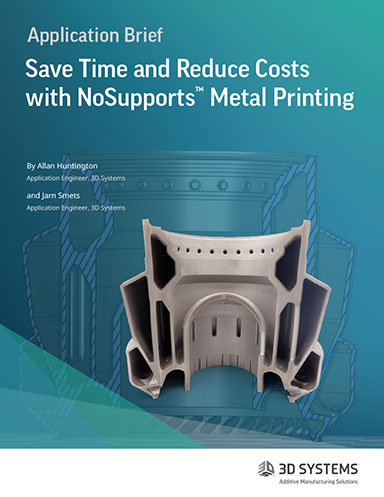
Save Time and Reduce Costs with NoSupports™ Metal Printing
Metal 3D printing is a high energy process in which it is possible for unmanaged heat and stress to build up and impact part quality, this guide presents a step-by-step methodology for how to apply NoSupports to a hot end section of a larger turbomachinery part.

Beth Stackpole is a contributing editor to Digital Engineering. Send e-mail about this article to [email protected].
Follow DE
Join over 90,000 engineering professionals who get fresh engineering news as soon as it is published.






About Us · Contact Us · Editorial Team · Advertising · Privacy Policy · Subscriber Services · © 2026 Digital Engineering 24/7 · Peerless Media