Helping design and engineering professionals discover, evaluate and specify technologies and processes that shorten the design cycle and enable success.


Sponsored
 Dear DE Reader:
If you drop the term “visual prosthesis” in conversation, some people may wonder if you meant specs or glass eyes rather than a bionic device. But many projects developing neural prosthesis devices that use electronic stimulation to enable the blind to see are underway worldwide, and the concept has been the subject of intense research for years. One such device is Wicab Inc.'s BrainPort V100, the focus of today's Check it Out read.
The V100 is a wearable device with technology that leverages the brain's knack for rewiring itself to use one sense in lieu of another. In this case, the V100 uses electronic stimulation to enable users to process visual images through their tongues. Yes, tongues. The case study “A Sense of Vision” from Proto Labs gives you a taste of how this technology came about, how it works and where it's heading. It is quite an interesting piece.Already available in Europe and Canada, the V100 consists of a video camera on a headset, a small electrode-embedded mouthpiece and a hand-held controller. It has a number of end-use polycarbonate injection-molded parts made by Proto Labs.
With the V100, users can gauge objects, their locations and motion. Some people even use it rock climbing. The US FDA recently approved it for use with other aids like a guide dog, and the company hopes that its new model, the BrainPort Vision Pro, will be FDA approved soon. It's the development of the hands-free Vision Pro that provides an intriguing twist to this report.
Wicab knows 3D prototyping and production well, but some of the Vision Pro's prototype parts were not cutting it for reasons like durability and limited materials. They tried cast urethane as a solution, but the costs for molds and small quantities made it prohibitively expensive.
Wicab got together with Proto Labs, and they collaborated to find the balance between production- and near-production quality injected-molded parts that solved these prototyping issues. Proto Labs' ability to quickly deliver small runs of on-demand parts helped reduce and contain costs, keeping the Vision Pro testing moving forward.
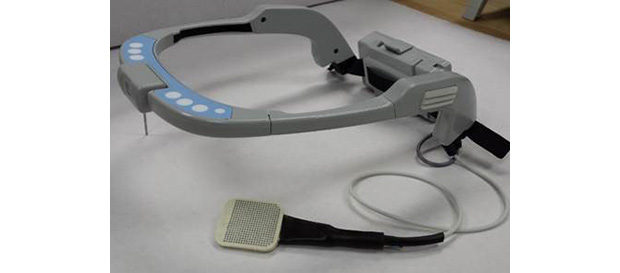 The BrainPort V100 from Wicab enables blind users to process visual images through their tongues. Image courtesy of Wicab Inc. and Proto Labs Inc.
People like Ben Franklin envisioned a role for electrical currents in visual prosthesis technologies, and “A Sense of Vision” proves they were onto something. This case study is onto something too: There’s lots to like and learn. You don't need to register or download it. Just hit today's Check it Out link and read it.
Thanks, Pal. – Lockwood
Anthony J. Lockwood
Editor at Large, DE


Anthony J. Lockwood is Digital Engineering's founding editor. He is now retired. Contact him via [email protected].
Follow DE
Join over 90,000 engineering professionals who get fresh engineering news as soon as it is published.






About Us · Contact Us · Editorial Team · Advertising · Privacy Policy · Subscriber Services · © 2026 Digital Engineering 24/7 · Peerless Media