Helping design and engineering professionals discover, evaluate and specify technologies and processes that shorten the design cycle and enable success.



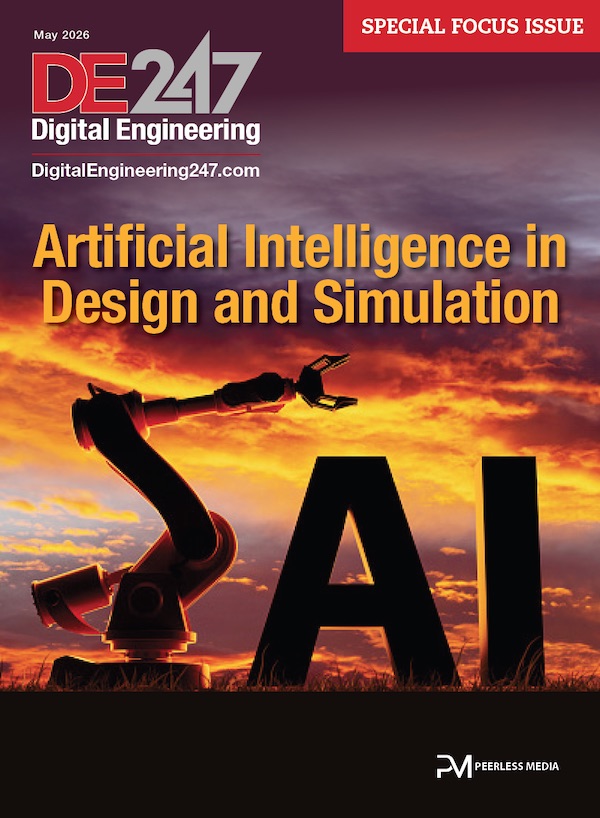
May 2026 Special Focus: Artificial Intelligence in Design and Simulation
In this Special Focus Issue, learn about the latest developments in the integration of artificial intelligence into engineering workflows.

Design & Simulation Software Guide 2025
In this Special Issue, Digital Engineering presents its second annual guide to design and simulation software vendors.
Artificial intelligence (AI) is increasingly being integrated into engineering workflows, and software vendor Altair was among the first to announce AI-based functionality in its suite of engineering tools. At the company’s virtual conference, Future.Industry 2025, AI was also a key focus of many of the presentations.
“We are working to integrate AI across our portfolio for our customers to be more efficient,” said Altair COO Stephanie Buckner. “Altair has always looked at simulation as more than just virtual validation. It’s not just about predicting performance, but optimizing it. We are one of the earliest to invest in AI technology. AI agents and automation are about creating efficiency and ROI. We have customers running tens of thousands of agents today to automate their business."
Altair offers a number of AI-enabled modules and products, including PhysicsAI, RapidMiner, romAI, DesignAI, shapeAI, HyperWorks Design Explorer, and HyperStudy.
“We are combining the power of simulation and compute with an AI fabric to turn all of our enterprise data into insights,” added Altair CTO Sam Mahalingam. “With the convergence of simulation, HPC, and AI, our customers are unlocking limitless innovation by empowering everyone within an organization of all skill levels to build and use AI models.”
Charles Wildig, vice president of vehicle engineering at Lucid Motors, explained how the EV manufacturer is using some of these products, along with traditional Altair engineering tools, to optimize vehicle design.
For example, the company has leveraged Altair PhysicsAI in some workflows, like modeling pedestrian protection impact. “It’s not a replacement for domain expertise on complex problems,” he emphasized. “The human in the loop is still vital.”
The company also uses Altair RapidMiner – a data analytics and machine learning tool – to help streamline some workflows. “We material test thousands of joint [material] coupons in house,” Wildig said. “Each time we have a variation in a design, we use RapidMiner to tell us whether a new test is required. We also build our own AI tools on the Altair platform. We’ve written a connection tool that assesses which spot welds or screws are most effective across load cases. We can confidently and accurately eliminate unnecessary connector points.”
He said that the company uses Altair HyperMorph to take existing full vehicle models and use them to fit different formats. “Before we’ve drawn any lines in CAD, we’ve gotten a sense of the constraints of the new form factor. This is CAE driving CAD,” Wildig said.
Engineers then take that output and run it through topology optimization via Altair OptiStruct and HyperMesh. “We take that output and make a manufacturable CAD model,” he said. “It can be done in a day and gives us a head start in arriving at the least compromised solution.”
While Wildig said that AI is unlocking a lot of capabilities at Lucid, “Progress is not linear,” he said. “I see fertile ground for these technologies with advancements in machine learning, but I also see fundamental constraints in the training set size. Maybe we will conquer these constraints, or maybe we will make a breakthrough in a hybrid approach in modeling and database methods. I’m really curious to see how it works out.”
His advice to other users was to avoid being misled by the output of AI tools. “Performance is jagged; they can confidently tell you the wrong answer,” he said. “If you want quality results from an AI tool, it’s more important to have a grasp of the engineering fundamentals.”

A panel discussion titled “From Idea to Impact: Leveraging AI Tools and Technologies for Engineering Success,” was moderated by the BBC’s Samantha Simmonds. Other panelists included
Himanshu Iyer, Marketing & Strategy Lead for the Manufacturing industry at NVIDIA; Dr. Yazan Qarout, MIET, senior research engineer, The Manufacturing Technology Centre; Newcastle University Prof. Paul Watson, FREng FBCS director at the National Innovation Centre for Data; and Dr. Natasha Mashanovich, director of data science at Altair.
“AI can be a challenge for engineers because it requires a deep understanding of business needs and technical capabilities,” Iyer said. “You should align AI solutions with priorities or opportunities that can drive significant value.”
Iyer outline a few key steps for preparing to integrate AI into engineering workflows:
Altair’s Mashanovich recommended starting small. “Start with something less complex, identify the use case and prove the business value,” she said. Mashanovich and Qarout both noted that early use cases showing real value included predictive maintenance, root cause analysis, inspection, object detection, and quality management.
But AI has a high ceiling in engineering. “Developers at engineering software companies are already working on the next-generation of AI-powered engineering simulation or CAE tools by combining simulation with immersive virtual environments,” Iyer said. “What this enables is real-time digital twins, where design changes are taking place and being almost instantly updated with simulation results. Previously you had to wait a long time to run simulations on design changes, but with the integration of AI tools, this can happen almost in real time.”
“This can help with reduced order modeling or surrogate models,” Iyer continued. “Developers can train surrogate models from scratch, or use existing models. Once the training is done, the simulation can run a thousand times or more faster than traditional simulation. You can innovate and explore more options. One example of this is the NVIDIA Real Time Physics-based Digital Twin AI blueprint that enables ISVs like Altair to incorporate AI technology such as Surrogate models in their applications.”
The panel also emphasized the importance of data quality and preparation for AI projects. “The very foundation of AI is the data your company has,” Iyer said. “What is the quality of that data? Start there by assessing data quality and quantity, refine that data, and that will lead to better results with AI.”


Altair transforms design and decision making by applying simulation, machine learning, and optimization throughout product lifecycles. Altair offers software in five categories related to Computer Aided Engineering (CAE) and High Performance…
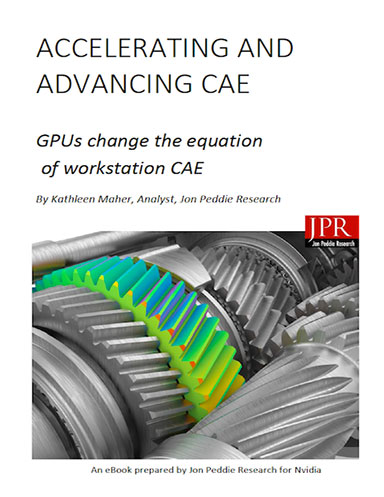
Accelerating and Advancing CAE
GPUs are changing the nature of engineering simulation, according to a new ebook from Jon Peddie Research (JPR). It explains how GPU acceleration is improving CAE workflows.

Brian Albright is the editorial director of Digital Engineering.
Contact him at [email protected].

Join over 90,000 engineering professionals who get fresh engineering news as soon as it is published.






About Us · Contact Us · Editorial Team · Advertising · Privacy Policy · Subscriber Services · © 2026 Digital Engineering 24/7 · Peerless Media