Helping design and engineering professionals discover, evaluate and specify technologies and processes that shorten the design cycle and enable success.



May 2026 Special Focus: Artificial Intelligence in Design and Simulation
In this Special Focus Issue, learn about the latest developments in the integration of artificial intelligence into engineering workflows.

Design & Simulation Software Guide 2025
In this Special Issue, Digital Engineering presents its second annual guide to design and simulation software vendors.
Most engineering organizations historically have not coupled tools or have insufficiently coupled them as an attempt to solve thermal dynamics problems. But increasingly, there’s recognition that through co-simulation of thermal and CFD, there’s the possibility of accounting for greater variations.
The process of coupling different physics typically involves a complex recipe of multiple software programs, customized scripts and other domain-specific tools for automation -- not easy stuff. Even when looking to do simplified analysis or multi-simulation tasks like sensitivity studies or design of experiments (DoE), the coupling of CAE tools can be a handful even for the most sophisticated analysis expert, let alone engineers simply looking to inject more analysis into his or her early design workflow.
That’s the problem ThermoAnalytics is trying to solve with its new CoTherm process automation software. Pitched as an ambassador that facilitates the flow of information between simulation products, CoTherm seems to be entering a relatively small pool of products, which includes capabilities within the dominant CAE vendors' suites along with specialized toolsets like those from ESTECO.
The genesis for CoTherm is to deliver a software platform that provides an efficient and intuitive way of putting together the coupling process, allowing the engineer to focus on the design problem at hand instead of the arduous process of learning scripting software. “Putting together processes for coupling requires knowledge of all of the pieces of analysis software and knowledge of customized scripts, along with the glue for automation,” explained Joshua Pryor, team leader for ThermoAnalytics’ thermal CFD services.
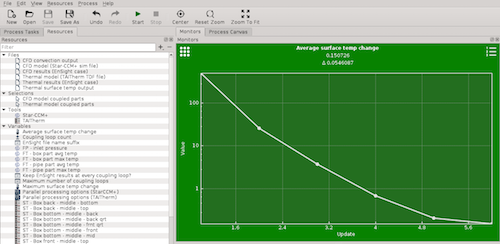
 CoTherm lets engineers customize their coupling workflows via an intuitive user interface. Image Courtesy of Thermo Analytics
Likening the platform to a “process canvas,” CoTherm enables engineers to construct complex CAE couplings using a graphical user interface (GUI), which provides a visual way to monitor and automate coupled simulations. The GUI also provides an easier way to customize the coupling workflow and automate processes by combining generic and process-specific tasks.
The software will serve two primary use cases: Process engineers responsible for developing the process flow and logic for simulation tasks, as well as the simulation analysts that oversee simulations and specific inputs. The software helps users monitor and interpret results via color-coded heat maps and graphs, which can be be expanded to display a more in-depth view. The GUI also simplifies the organization of tasks and resources used within the coupled simulation process.
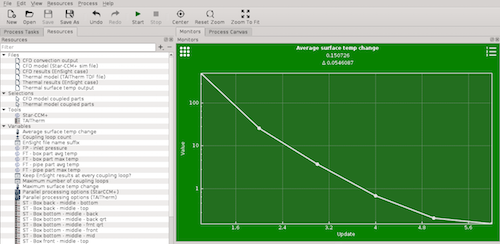 An example of a CoTherm heat map graph. Image Courtesy of Thermo Analytics
The early version of CoTherm focuses on Thermal-CFD coupling, supporting Therm0Analytics’ own TAITherm along with STAR-CCM+ (a CD-adapco product now owned by Siemens PLM Software) and ANSYS Fluent. Other couplings can be supported through use of the product’s API (application programming interface), and Therm0Analytics is planning subsequent capabilities that will support other couplings and CAE platforms.


Beth Stackpole is a contributing editor to Digital Engineering. Send e-mail about this article to [email protected].
Follow DE
Join over 90,000 engineering professionals who get fresh engineering news as soon as it is published.






About Us · Contact Us · Editorial Team · Advertising · Privacy Policy · Subscriber Services · © 2026 Digital Engineering 24/7 · Peerless Media