Helping design and engineering professionals discover, evaluate and specify technologies and processes that shorten the design cycle and enable success.


Sponsored
 Dear DE Reader:
It's not a good or efficient idea to use the almost right tool for critical component design. Today's Check it Out link has news on the right tool for a job that’s frequently designed with a nearly right tool.
“Generator Design Using MotorSolve v6” is a daily double. It's an on-demand webinar and it’s a PDF of slides from the webinar. It’s a good bet you'll want to consume both. Here’s why.
In October, Infolytica will roll out version 6 of its MotorSolve suite of electric machine design software. Version 6 will offer all sorts of enhancements, such as improvements to the winding diagrams that include animated MMF (magnetomotive force) plots. But the showstopper is that MotorSolve's BLDC (brushless DC) motor module can now be extended with a new generator analysis solver option.And that means you no longer have to try and optimize a generator using tools designed to optimize motors. With this specialized design tool, you can simulate various types of AC generators and motors operating in generate mode.
Of special interest to current MotorSolve users: You'll be able to simulate any electrical machine template in the BLDC module in motor mode or generator mode.
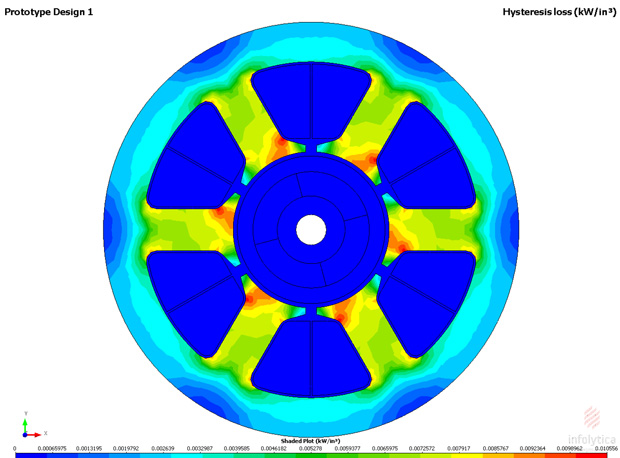 As part of the “Generator Design Using MotorSolve v6” on-demand webinar and complementary PDF, you're guided through a high-speed generator analysis example. This image depicts the simulation of time-averaged hysteresis losses in steel. Image courtesy of Infolytica Corp.
The thumbnail on the generator solver’s capabilities is that it handles five load types—open circuit, short-circuit, plain resistive/inductive loads, infinite bus (connection to a large AC system or grid) and diode rectifier. Analysis tools include voltage regulation, operating point analysis and power vs. speed curves. You can do motion, reduced order model and D-Q analyses, obtain displays of things like waveforms and phasor diagrams as well as produce a slew of performance charts such as voltage regulation or voltage vs. current.
“Generator Design Using MotorSolve v6” covers all of this in detail and includes a step-through example of a high-speed generator analysis. The PDF, of course, lacks the narrator’s fleshing out capabilities you get from the webinar. Still, it's terrific to have handy because you can see small details easily missed on screen. As a bonus, the one-hour webinar also includes the attendee’s Q&A.
If you're able to attend the Infolytica Engage 2016 user conference in November in Las Vegas, you can get the lowdown on all of MotorSolve v6's enhancements as well as the generator analysis solver option. For now, hit today's Check it Out link and download the PDF and watch the “Generator Design Using MotorSolve v6” on-demand webinar.
Thanks, Pal. — Lockwood
Anthony J. Lockwood
Editor at Large, DE


Anthony J. Lockwood is Digital Engineering's founding editor. He is now retired. Contact him via [email protected].
Follow DE
Join over 90,000 engineering professionals who get fresh engineering news as soon as it is published.






About Us · Contact Us · Editorial Team · Advertising · Privacy Policy · Subscriber Services · © 2026 Digital Engineering 24/7 · Peerless Media