Helping design and engineering professionals discover, evaluate and specify technologies and processes that shorten the design cycle and enable success.



May 2026 Special Focus: Artificial Intelligence in Design and Simulation
In this Special Focus Issue, learn about the latest developments in the integration of artificial intelligence into engineering workflows.

April 2026 Special Focus Issue: Generative Design
In this Special Focus Issue, Digital Engineering takes a look at how generative design solutions can be used across different types of design problems and with a variety of manufacturing approaches to accelerate design space exploration, and…
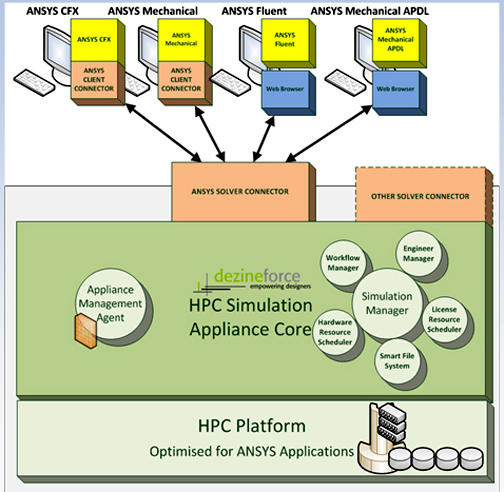
It measures roughly 28 x 30 x 47 inches, the size of a typical minibar in a hotel room. It's got an Intel Xeon X5570 processor, with 48-384 GB of memory and 0.5 to 4.0 TB of storage. It's HPC (high-performance computing) in a box, built specifically to run simulation jobs in ANSYS software, available in 16, 32, 64, or 128 cores configuration. According to its makers, you need not bother housing it in a server room; you can simply shove it under your desk or somewhere it fits.
On April 20, on-demand analysis and simulation solutions provider Dezineforce debut its HPC Appliance for ANSYS, assembled with hardware and software from Dell and Microsoft. In the webinar titled ANSYS Beyond the Workstation, Dezineforce's VP of technical services, Richard Harding, explained, "A television or a washing machine is a combination of many components, built for a single purpose, with a simplified interface, prepackaged, and in some instances may even be managed remotely. Modern televisions, for example, update their software remotely when they're on standby ... Essentially what we're delivering is a HPC solution that does what you ask of it -- and asks no more of you."
The HPC Appliance is designed to work with ANSYS Mechanical, ANSYS CFX, and ANSYS Fluent. If you happen to own parallel licenses of these products, "All of these could be traded back at 100% of their original list prices, and we will trade them back for HPC licenses," explained ANSYS sales manager Lionel Humphreys during the webinar's Q&A. "In certain instances, it may mean you get an increase of license count -- an increase in the number of parallel sessions you can run at no additional cost."
HPC licenses for the appliance can be purchased in bundles of 8. "The benefit of buying packs of 8 is that they're pre-discounted, so it's a lower cost option," explained Humphreys. "The other benefit is, when you add two 8 [packs] together, they multiply, so two 8 [packs] are not just 16 [cores]. They multiply up to 32 cores capability. It's a much lower cost option than buying 32 individual HPC licenses. The downside is ... if you just pick up one of those [license] keys, you tie up all 8 licenses."
Dezineforce offers remote, web-based analysis products too, but the HPC Appliance for ANSYS is a local solution (to be installed and used at the buyer's site). The appliance comes with software tools to manage access, job priorities, licenses, and resources. The company plans to deliver the units in approximately 4 weeks after order date.
According to the product brochure, the hardware is "covered by [Dezineforce's] Appliance Service Management Agreement providing total care for the appliance hardware, operating and application environment, with a single point of contact ... System management and software maintenance use the same secure tools and resources that monitor and manage the Dezineforce HPC Simulation On-Demand, 24x7."
Dezineforce press relations office verifies, "The appliance is sold ‘engineer ready,’ so it has operating system, Dezineforce Simulation Manager, Appliance Service Management Agent, and the ANSYS applications preinstalled and configured ... [The 32 core appliance's] cost would be around $56,000, which includes delivery and installation on site ... That doesn’t include the cost of the ANSYS licenses, which customers have to buy directly from ANSYS."
Dezineforce believes its HPC Appliance offers greater value compared to high-end workstations, in-house HPC clusters, and custom HPC setups from systems integrators.


Kenneth Wong is Digital Engineering's resident blogger and senior editor. Email him at [email protected] or share your thoughts or suggestions at digitaleng.news/facebook.
Follow DE
Join over 90,000 engineering professionals who get fresh engineering news as soon as it is published.






About Us · Contact Us · Editorial Team · Advertising · Privacy Policy · Subscriber Services · © 2026 Digital Engineering 24/7 · Peerless Media