Helping design and engineering professionals discover, evaluate and specify technologies and processes that shorten the design cycle and enable success.



Digital Engineering April 2026
In the latest issue of Digital Engineering, we take a look at the latest innovations in design for additive manufacturing, including the use of natural language inputs, social media cosplayers, and AI integration. The issue also includes a feature…

January Special Focus Issue: Design for Additive
In this Special Focus Issue of Digital Engineering, learn about the latest advancements in design for additive manufacturing, including new software tools, additive in automotive, custom medical devices, and more.
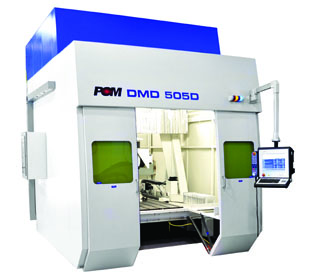
Swinburne Ph.D. graduate Khalid Imran and his supervisor Professor of Advanced Manufacturing at Swinburne's Industrial Research Institute, Syed Masood, have combined the use of a giant 3D printer from Precision Optical Manufacturing (POM) Group and layering metals to make a predominantly copper mold that is promising to significantly reduce waste and cut cooling times in high-pressure die-casting by 33%.
"In the competitive manufacturing industry, time equals money, particularly in Australia where wages and energy costs are high compared with countries such as China and India," Imran said. "If the production rate is high then you can produce millions of parts in a very short time and that will reduce the cost of manufacturing."
Imran said that while tooling steel tends to hold heat, another metal — copper — is quick to release it. But the problem he found with copper was that it had a lower melting point than tool steel and when used as a mould interacted with the molten metal injected inside.
Working closely with the POM Group, designers and builders of DMD additive manufacturing systems, and Jyoti Mazumder, director of the Center for Laser-Aided Intelligent Manufacturing (CLAIM) at the University of Michigan, Imran found a solution: sandwiching a third metal that mixes with both copper and steel in between. The make-up of the bonding metal is a closely guarded secret.
Imran used the additive manufacturing process of DMD to layer the three metals and produce a predominantly copper mold. The concept makes a mold directly from powder, ribbon or wire deposited in layers, without the need for casting, forging, rolling, cutting, machining, welding or drilling.
At Swinburne, DMD is produced using a machine manufactured by the POM Group that is fed by up to four different metal powders and builds 3D items from scratch.
"The process particularly lends itself to making molds for die-casting, as the die cavities tend to be very complex and DMD provides a true metallurgical bond," said Professor Masood.
"We have measured the quality of the parts produced and we have proven that the quality of the parts produced by bimetallic tooling is as good as the original tooling methods," he said.
As well as being able to lay down multiple metals in complex patterns, the process has a major advantage over traditional tool making — it creates little to no waste.
Professor Masood said the technology would provide opportunities for companies to address needs in tooling development, tool and metal component repair, surface modification and coating, new alloy development and direct metal prototypes.
Below is a video showing POM Group's DMD IC106 system in action.
Source: Swinburne University


Jamie Gooch is the former editorial director of Digital Engineering.
Follow DE
Join over 90,000 engineering professionals who get fresh engineering news as soon as it is published.






About Us · Contact Us · Editorial Team · Advertising · Privacy Policy · Subscriber Services · © 2026 Digital Engineering 24/7 · Peerless Media