Helping design and engineering professionals discover, evaluate and specify technologies and processes that shorten the design cycle and enable success.



May 2026 Special Focus: Artificial Intelligence in Design and Simulation
In this Special Focus Issue, learn about the latest developments in the integration of artificial intelligence into engineering workflows.

April 2026 Special Focus Issue: Generative Design
In this Special Focus Issue, Digital Engineering takes a look at how generative design solutions can be used across different types of design problems and with a variety of manufacturing approaches to accelerate design space exploration, and…
During its GTC event this week in San Jose, NVIDIA announced tha it is working with engineering software providers Cadence, Dassault Systèmes, PTC, Siemens and Synopsys to incorporate its artificial intelligence (AI), GPU and Omniverse technology into solutois for leading endusers around the world.
Specifically, the firms are offering NVIDIA CUDA-X, NVIDIA Omniverse and GPU-accelerated industrial software and tools to end users like FANUC, HD Hyundai, Honda, JLR, KION, Mercedes-Benz, MediaTek, PepsiCo, Samsung, SK hynix and TSMC to accelerate design, engineering and manufacturing. The software companies also introducing NVIDIA-powered agentic solutions to "prepare their customers for the next phase of the AI era," according to a press release.
In addition, the solutions are running on NVIDIA AI infrastructure across cloud service providers Amazon Web Services (AWS), Google Cloud, Microsoft Azure and Oracle Cloud Infrastructure (OCI) and original equipment manufacturers Dell, HPE and Supermicro for accelerated design and simulation.
“The dawn of a new industrial revolution has arrived, where physical AI and autonomous AI agents are fundamentally reinventing how the world designs, engineers and manufactures,” said Jensen Huang, founder and CEO of NVIDIA. “Uniting our global ecosystem of software giants, cloud providers and OEMs, NVIDIA is delivering a full-stack accelerated computing platform that empowers every industry to turn this vision into reality at a scale and speed never before possible.”
Cadence, Dassault Systèmes, Siemens and Synopsys are accelerating engineering workflows by bringing agentic AI into their platforms, using the NVIDIA NeMo platform, NVIDIA Nemotron open models, NVIDIA CUDA‑X libraries and NVIDIA accelerated computing to power autonomous design agents for complex chip and system workflows. These solutions include Cadence's ChipStack AI SuperAgent, which combines electronic design automation (EDA) with agentic orchestration; Dassault's role-based Virtual Companions on the 3DEXPERIENCE platform; Siemens' Fuse EDA AI Agent for semiconductor/PCB design and manufacturing; and Synopsys AgentEngineer for semiconductor and systems design.
NVIDIA also announced that major manufacturers were leveraging GPU-accelerated tools form its partners for simulation and design.
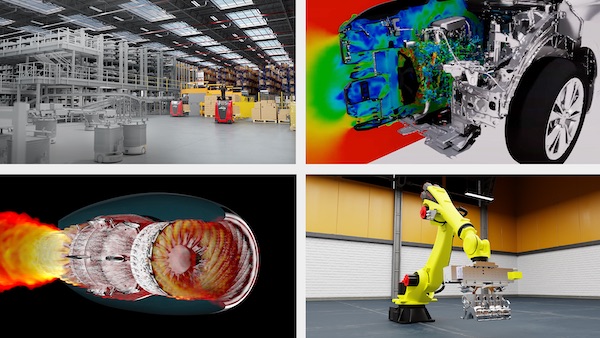
Honda is using Synopsys’ Ansys Fluent, accelerated by the NVIDIA Grace Blackwell platform, to run aerodynamic simulations 34x faster than using CPUs, contributing to shorter development cycles. JLR and Mercedes-Benz are harnessing Siemens’ Simcenter STAR-CCM+ software on NVIDIA-accelerated infrastructure to transform engineering workflows. JLR runs the platform on AWS to enhance vehicle aerodynamics. Dassault Systemès’ SIMULIA Abaqus and PowerFlow, accelerated by NVIDIA AI infrastructure, are used to support Rivian’s vehicle simulation testing.
Ascendance is using Cadence Fidelity on NVIDIA GPUs on Oracle Cloud to simulate hybrid electric propulsion and vertical takeoff and landing aircraft scenarios, enabling same-day full aerodynamic simulation campaigns that are not possible with large CPU-based high-performance computing. Solar Turbines is leveraging Fidelity on Dell infrastructure to complete 360-degree, billion-cell combustor simulations in just 14 hours, and Argonne uses the software on the Polaris supercomputer, built by HPE and accelerated by NVIDIA A100 GPUs, to enable high‑fidelity combustion simulations for advanced energy and propulsion research.
Samsung and SK hynix are using Cadence Pegasus, Synopsys PrimeSim and Siemens’ Calibre software on NVIDIA-accelerated Dell PowerEdge servers and HPE systems to streamline high-volume computational lithography and physical verification, accelerating DRAM and flash memory production. Astera Labs uses Synopsys PrimeSim B200 GPU-accelerated EC2 on AWS to speed chip design by 3.5x over CPU-only systems, accelerating validation and time to market for next-generation connectivity solutions. MediaTek is accelerating Cadence Spectre by 6x, with the power of NVIDIA H100 GPUs, to build its AI future with an on-premises AI factory powered by NVIDIA. TSMC is using Synopsys tools on HPE and Supermicro systems to accelerate critical workloads for advanced manufacturing. Micron is accelerating next‑generation high-bandwidth memory development by expanding its collaboration with Cadence, adopting NVIDIA GPU‑accelerated design tools and integrating agentic AI to boost efficiency across its complex memory design workflows.
NVIDIA is also enabling next-gen digital twin applications. Siemens’ newly launched Digital Twin Composer leverages NVIDIA Omniverse libraries to enable companies like Foxconn, HD Hyundai, PepsiCo and KION to build industrial metaverse environments at scale, empowering organizations to apply industrial AI, simulation and real-time physical data to make decisions virtually, at speed and at scale.
Krones is using Ansys Fluent on Microsoft Azure to power physics-accurate, AI-driven digital twins with NVIDIA Omniverse, CUDA-X and GPU-accelerated simulation to cut bottling-line simulation times from hours to minutes. PTC is also announcing a new robotics design-to-simulation workflow from its cloud-native Onshape CAD and product data management platform to NVIDIA Isaac Sim, creating a seamless CAD-to-OpenUSD bridge that will enable engineering teams like FANUC America Corporation and Fauna Robotics to design and validate their robotic systems within physically accurate digital twins.
KION is working with Siemens, NVIDIA and Accenture to advance autonomous warehouse solutions. Using NVIDIA Omniverse and a physical AI-powered digital twin and systems architecture pioneered by Accenture, KION engineers create large-scale, physics-accurate warehouse digital twins to train and test fleets of NVIDIA Jetson-based autonomous forklifts for GXO, the world’s largest pure-play contract logistics provider.
You can watch GTC keynote online.
Sources: Press materials received from the company and additional information gleaned from the company’s website.


DE's editors contribute news and new product announcements to Digital Engineering. Press releases may be sent to them via [email protected].
Follow DE
Join over 90,000 engineering professionals who get fresh engineering news as soon as it is published.






About Us · Contact Us · Editorial Team · Advertising · Privacy Policy · Subscriber Services · © 2026 Digital Engineering 24/7 · Peerless Media