Helping design and engineering professionals discover, evaluate and specify technologies and processes that shorten the design cycle and enable success.



Cut Retrieval-Augmented Generation (RAG) Hallucinations by 50%
Most teams hit the same wall with enterprise AI: LLMs that hallucinate, pipelines that don’t scale, and infrastructure that’s harder to design than the models themselves.

What Is Intelligent BOM Management? A Guide to Smarter Product Development
Learn how intelligent Bill of Materials (BOM) management helps teams collaborate, reduce errors, and bring innovative products to market faster with cloud-based PLM tools.
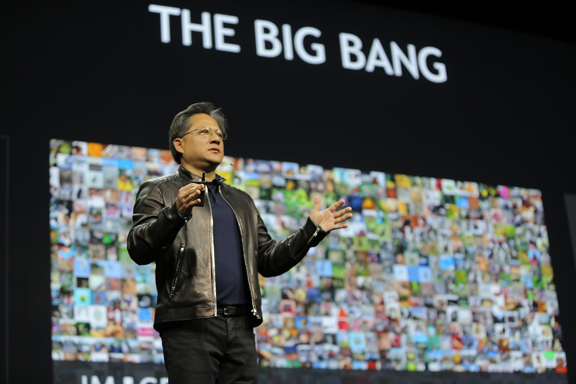
 NVIDIA CEO Jen-Hsun Huang ponders the dawn of the AI era, ushered in by GPU-accelerated neural networks.
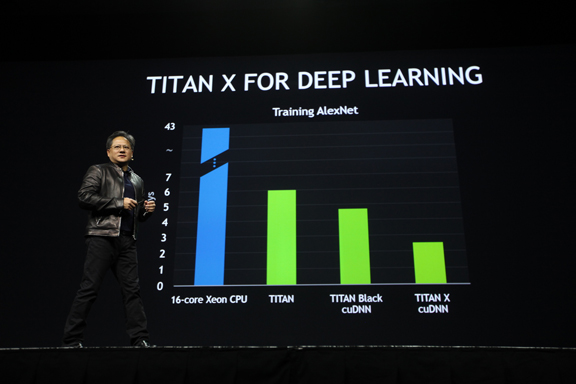 NVIDIA CEO Huang proposes the new GeForce TITAN X as the GPU for deep learning.
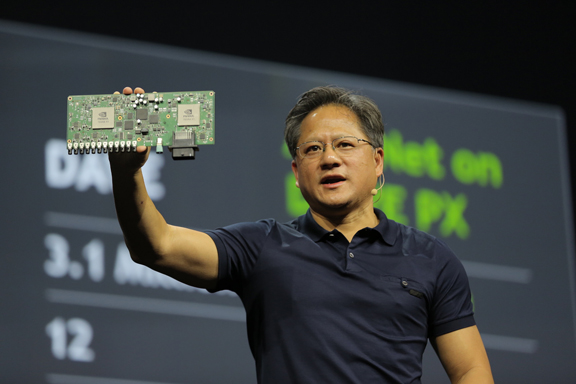 NVIDIA CEO Huang introduces Drive PX, a self-driving car developer kit.
On Tuesday, NVIDIA founder and CEO Jen-Hsun Huang strode onto the stage at San Jose Convention Center to greet the crowd assembled at the annual NVIDIA GPU Technology Conference (GTC).
He said, "I'm going to tell you about four things: We'll talk about a new GPU, and deep learning. We'll talk about a very fast box, and deep learning. I'll show you our road map, talk about the exciting things we're doing at NVIDIA, and deep learning. And I'll talk to you about self-driving cars, as it relates to deep learning."
Huang's talk focused on:
Deep learning or machine learning -- the theme that cuts across all four segments of Huang's talk -- is better known as artificial intelligence (AI). Once the stuff of speculative Utopian or Dystopian films, today AI hibernates in the form of algorithms. Self-driving cars, face-recognition software, and automatic-translation programs usher in what could very well be the dawn of AI.
Huang said, "Deep learning is as exciting as the invention of the Internet. I want to dedicate my entire talk to this topic, but surely that's not enough time ... I think we'll be talking about this for the next decade."
On Wednesday, Dr. Jeff Dean, a senior fellow in the Google Knowledge Group, picked up the same theme when he talked about Google's use of large-scale deep learning in language-related fields. He said, "You can't write algorithms for all individual tasks, so you write programs that can learn from observation."
The intense computation required in this specialized discipline is attractive to NVIDIA. Once known for its gaming and graphics hardware, NVIDIA now promotes the parallel processing power of its GPUs as a solution to the biggest high-performance computing (HPC) challenges. At this year's GTC, academics and data scientists stroll the corridors, talking about how GPU-outfitted appliances could accelerate different permutations of AI.
Meet the TITAN
Huang calls it "The most advanced GPU we have ever made." The TITAN X houses 8 billion transistors, running on more than 3,000 CUDA cores, capable of 7 TFLOP single precision calculation. The GeForce product line may have originated as the ultimate gaming hardware, but the TITAN X, according to NVIDIA, is a good fit for researchers tackling deep learning. In building neural networks to ingest and understand large volumes of data, TITAN X's sheer horsepower may offer an advantage.
A Box to Train Your Machines
Few CEOs would go on stage to introduce a product, then explain that they intend to sell only a small volume of it. But Huang did. "The [DIGITS DevBox] is a box that we like not to sell in high volumes," he said. "The reason is, it's really developed for the developers. It only comes with Linux, only comes with four GPUs, only in one configuration ... It's priced at a level that hopefully all researchers can afford. It's not meant to be a business; it's meant to help you."
Intelligent systems need to be trained on massively parallel supercomputers. A language-processing system, for example, would first have to be exposed to a database consisting audio samples. An image-recognition system would learn from a database of photos to classify and identify what it sees. A self-driving car's decision-making program will need to master thousands of scenarios in every conceivable driving conditions.
Well-funded universities and enterprises won't have difficulty acquiring the data centers they need to conduct these training sessions. NVIDIA hopes it can capture smaller research teams with its modestly priced ($15,000) NVIDIA DIGITS DevBox.
The Self-Driving Car Starter Kit
"Driving is not about detecting. It's a learned behavior," Huang observed. Eyeing at this market's potentials, NVIDIA came up with the NVIDIA Drive PX, described as "a platform is based on the NVIDIA Tegra X1 processor, enabling smarter, more sophisticated advanced driver assistance systems (ADAS)." The Tegra X1's 1.3 gigapixels/second processing speed, the company points out, is "enough to handle 12 two-Megapixel cameras at frame rates up to 60 fps for some cameras" -- an important consideration for the autonomous cars that would rely on sensor data and camera-fed computer vision to make navigation decisions.
A Peak at PASCAL
Haung said, PASCAL, the next generation GPU architecture from NVIDIA, benefited from "a billion dollars' worth of refinement in R&D over the last three years." Pascal is expected to be the first GPU in NVIDIA's history capable of mixed precision. Designed with 3D memory (a new method of packaging memory in stacks), PASCAL promises to deliver more capacity and bandwidth than its predecessor Maxwell. (Haung quipped, "Getting more capacity is easy. Getting more bandwidth is easy. Getting more capacity and bandwidth is really hard.)
According to Huang, PASCAL will offer 32GB memory (instead of the predecessor's 12GB). In Haung's estimates, PASCAL will be "ten times faster than Maxwell." But he cautioned that the number is based on "very rough estimates." (Read more about PASCAL in last year's GTC report.)
Haung believes this is the beginning of a whole new universe -- "The Big Bang of self-driving cars," as he put it. And if it were up to him, the GPUs will be an integration part of this AI evolution.
In Part II of GTC report, DE will cover the following:
Though the GPU was historically regarded as a graphics-boosting hardware, some users have successfully harnessed its parallel-processing capacity to redefine its use. GPU-accelerated visualization today drives decision-making design review among automakers, sales activities with online product configurators, and, in some exceptional case, exposes design flaws that have catastrophic consequences.
Two years ago, NVIDIA hailed the introduction of the virtual GPU. The technology, branded as NVIDIA Grid, paved the way for GPU-accelerated virtual machines, prompting a flurry of commercial activities among virtualization vendors like VMware and Citrix. OEMs like Dell, HP, Lenovo, Supermicro, RAVE, and others have also begun offering appliances built to support virtual workstations.
Click below to watch Jen-Hsun Huang's keynote presentation:


Kenneth Wong is Digital Engineering's resident blogger and senior editor. Email him at [email protected] or share your thoughts or suggestions at digitaleng.news/facebook.
Follow DE
Join over 90,000 engineering professionals who get fresh engineering news as soon as it is published.






About Us · Contact Us · Editorial Team · Advertising · Privacy Policy · Subscriber Services · © 2026 Digital Engineering 24/7 · Peerless Media