Helping design and engineering professionals discover, evaluate and specify technologies and processes that shorten the design cycle and enable success.


Sponsored
 Dear Desktop Engineering Reader:
To borrow a convention from Martha Stewart, 3D printing is a good thing. Good thing, however, doesn't mean you don’t need to learn anything to use it. See, the additive manufacturing (AM) process is as different from other manufacturing processes as milling is from injection molding. Its differences carry over to materials. Today's Check it Out link takes you to a paper naming and explaining materials for 3D printing and how to work with them that's, well, a good thing.
“Selecting the Right Material for 3D Printing” focuses on the materials commonly used in the DMLS (direct metal laser sintering), SLS (selective laser sintering) and SL (stereolithography) 3D printing processes. It's produced by Proto Labs, the prototype and low-volume production parts service provider that deploys each of these technologies and the 18 or so major material types explored. In this paper, Proto Labs shares their from-the-trenches expertise so that you can make informed decisions on fabrication processes and materials to get the results you need.
Different isn't worse or better. Rather, the material properties and characteristics of 3D-printed parts are not quite the same as nearly identical alloys or thermoplastics. For example, 3D-printed parts have anisotropic properties where the values differ for the X, Y and Z axes. And, for many good reasons the paper explains, material data sheets tend to provide limited amounts of performance data.
None of this implies insurmountable obstacles. But it means that AM processes and materials inherently present many unique design considerations. Addressing these matters is what makes this paper shine. It can help you keep your expectations in sync with reality.
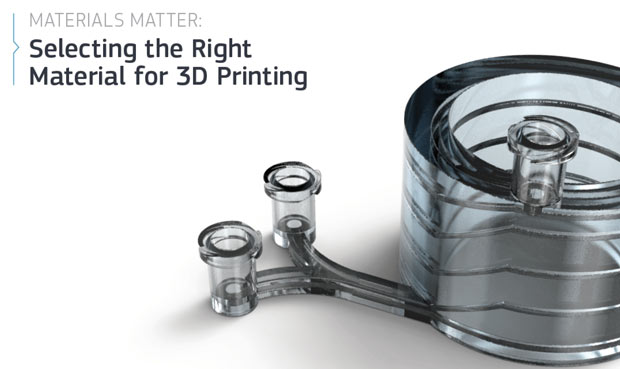 Proto Labs' new white paper “Selecting the Right Material for 3D Printing” explores the properties of thermoplastic and metal materials used in 3D printing in a way that can help you choose the right process and material grade. Image courtesy of Proto Labs Inc.
The paper's format is to step you through each 3D system type and its material options. It discusses the machinery and named materials in terms of key characteristics, pros and cons as well as ideal usage scenarios. Charts providing visual comparisons of material properties like elongation at break, hardness, heat deflection and tensile strength complement each AM process. Handy decision trees for each AM system and its materials provide a visual of everything covered.
Proto Labs consistently delivers high-quality papers like “Selecting the Right Material for 3D Printing.” You'll find that there's not a single slice of baloney in it. It's all data that engineers need. Hit today's Check it Out link to download your complimentary copy. It's a good thing you'll want around for a long time.
Thanks, Pal. – Lockwood
Anthony J. Lockwood
Editor at Large, Desktop Engineering


Anthony J. Lockwood is Digital Engineering's founding editor. He is now retired. Contact him via [email protected].
Follow DE
Join over 90,000 engineering professionals who get fresh engineering news as soon as it is published.






About Us · Contact Us · Editorial Team · Advertising · Privacy Policy · Subscriber Services · © 2026 Digital Engineering 24/7 · Peerless Media