Helping design and engineering professionals discover, evaluate and specify technologies and processes that shorten the design cycle and enable success.




May 2026 Special Focus: Artificial Intelligence in Design and Simulation
In this Special Focus Issue, learn about the latest developments in the integration of artificial intelligence into engineering workflows.

Design & Simulation Software Guide 2025
In this Special Issue, Digital Engineering presents its second annual guide to design and simulation software vendors.
As Additive Manufacturing (AM) systems improve in speed and output quality, many are considering it as a method for mass production. The technology's evolution from a prototyping to manufacturing mechanism is not exactly straight forward. The transformation is fraught with unanswered questions, ranging from the regulatory bodies' willingness to certify AM parts for flight-critical components to the consistency of output.
Jacob Brunsberg, Senior Vice President of Product, Marketing, and Strategic Relationships at Sigma Labs, discussed these issues with DE in this podcast.
AM for mass production is already "a reality today for a number of users and large companies," producing thousands of parts ranging "from implants to jet-engine and rocket components," he pointed out. "That number of people, though, is not extremely high today. It takes incredible knowledge and a lot of experimental work today to understand windows of operation."
The approach is currently limited to aerospace, automotive, and medical equipment makers with deep pockets, he noted. But, due to the flexibility of AM, the practice has also spawned parts with topology previously unimaginable. "There are lattice structures and implants for bone and growth. There are complex heat exchangers with thin walls holding fluids, in some cases," he pointed out.
In aerospace, parts with new design made with new technology are subject to stringent regulatory approvals. The more flight-critical the part, the longer it takes to certify. This is a hurdle 3D-printed parts must also face. "Creating standards and following those standards is a huge part of what is going to take our industry from where it's at today to qualifying and certifying those components faster," Brunsberg reasoned.
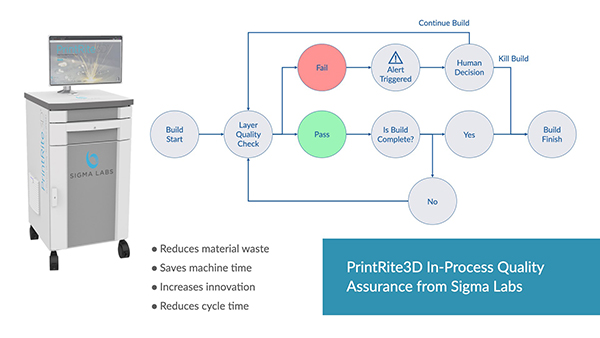
Sigma Labs provides in-process QA software for additive manufacturing. Its flagship product PrintRite3D "detects and classifies defects and anomalies real-time during the manufacturing process, enabling significant cost-savings and production efficiencies," according to the company.
For more, listen to the podcast above. (Intro and end music courtesy of Bensound.)

About this podcast
Sigma Labs on Metal AM's Maturity for Mass Production
October 26, 2021 at 10:00 am
8:14 hr/min/sec
Media file
Latest podcasts
Find us
Tune in to Digital Engineering 24/7's podcast and get engineering news, products and analysis from industry experts delivered in real time. Follow us on these popular platforms:

Kenneth Wong is Digital Engineering's resident blogger and senior editor. Email him at [email protected] or share your thoughts or suggestions at digitaleng.news/facebook.
Follow DE
Join over 90,000 engineering professionals who get fresh engineering news as soon as it is published.






About Us · Contact Us · Editorial Team · Advertising · Privacy Policy · Subscriber Services · © 2026 Digital Engineering 24/7 · Peerless Media