Helping design and engineering professionals discover, evaluate and specify technologies and processes that shorten the design cycle and enable success.



Digital Engineering April 2026
In the latest issue of Digital Engineering, we take a look at the latest innovations in design for additive manufacturing, including the use of natural language inputs, social media cosplayers, and AI integration. The issue also includes a feature…

January Special Focus Issue: Design for Additive
In this Special Focus Issue of Digital Engineering, learn about the latest advancements in design for additive manufacturing, including new software tools, additive in automotive, custom medical devices, and more.
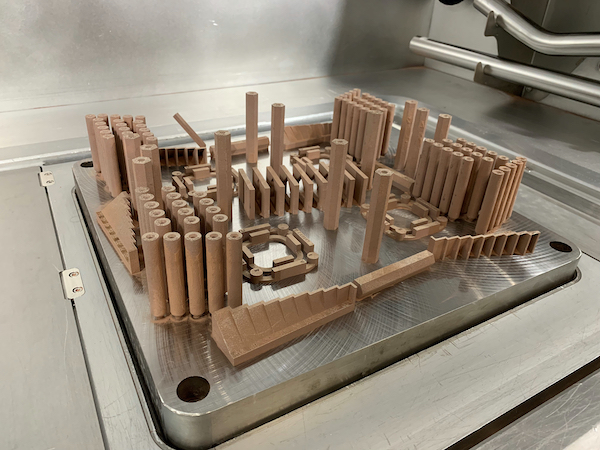
Sintavia, a designer and 3D printer of flight and launch components, has developed proprietary printing technology for GRCop-42, the preferred copper alloy used by NASA and private space flight companies for rocket thrust chamber assemblies. The new technology, which is a combination of a proprietary parameter set and post-processing heat treatment, was developed on an EOS GmbH M400-4 printer, and results in GRCop-42 components with minimum density of 99.94%, minimum tensile strength of 28.3 ksi, minimum ultimate yield strength of 52.7 ksi, and minimum elongation of 32.4%, the company says. The technology avoids the use of a hot isostatic press in post-processing steps, thereby reducing the time, complexity, and cost of production, according to Sintavia.
“Today’s announcement marks the first time we have publicly disclosed Sintavia’s ongoing material development efforts,” said Pavlo Earle, Sintavia’s Vice President of Engineering. “As a company, we are uniquely positioned to unlock the potential of printing difficult materials cost-effectively and with excellent mechanical properties. The fact that we were able to achieve these levels of performance on GRCop-42—by all indications a very difficult metal for additive manufacturing—further cements Sintavia’s role as the global leader in the application of AM within the Aerospace, Defense, and Space industry.”
Earle added that Sintavia is currently developing proprietary standards for other materials, including refractory alloys, for use across the aerospace, defense, and space industry.
Sources: Press materials received from the company and additional information gleaned from the company’s website.

EOS enables their customers to produce innovative and high quality products based on industrial 3D printing technologies. EOS is a global technology and quality leader for high-end solutions in the field of additive manufacturing (AM). Founded in…

Industry Focus: Designing for Industrial Machinery and Heavy Equipment
The articles compiled in this special digital issue focus on how vendors are reacting to the need to digitize the factory floor and connect it all the way back through the enterprise to front-end product design and development.

DE's editors contribute news and new product announcements to Digital Engineering. Press releases may be sent to them via [email protected].
Follow DE
Join over 90,000 engineering professionals who get fresh engineering news as soon as it is published.






About Us · Contact Us · Editorial Team · Advertising · Privacy Policy · Subscriber Services · © 2026 Digital Engineering 24/7 · Peerless Media