Helping design and engineering professionals discover, evaluate and specify technologies and processes that shorten the design cycle and enable success.



Digital Engineering April 2026
In the latest issue of Digital Engineering, we take a look at the latest innovations in design for additive manufacturing, including the use of natural language inputs, social media cosplayers, and AI integration. The issue also includes a feature…

January Special Focus Issue: Design for Additive
In this Special Focus Issue of Digital Engineering, learn about the latest advancements in design for additive manufacturing, including new software tools, additive in automotive, custom medical devices, and more.
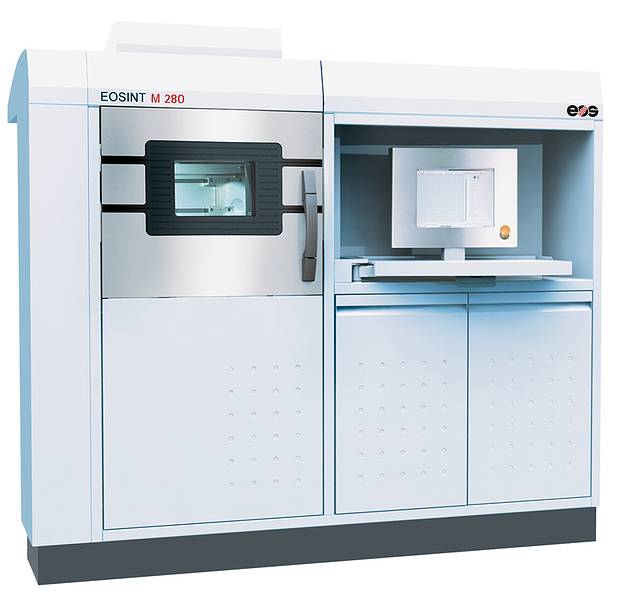
The researchers recently fabricated a laser-sintered, titanium-alloy prototype fuel collector for Austrian aircraft manufacturer Diamond Aircraft Industries GmbH.
"Using laser sintering, we were able to reduce the number of components from five down to one," said Gerhard Pramhas, managing director of FOTEC. "Along with that went a weight reduction of 77% as well. This was made possible through the unique manufacturing technique."
According to the press release:
Until now, the part had consisted of five individual pieces produced on a lathe that subsequently were customarily welded together. The pieces are partly hollow to facilitate fuel flow. And in addition, one of the components is threaded, which requires a separate step during production. With laser sintering of metal, the entire fuel collector with galleys and threads is able to be fabricated in one step. The production accuracies are in the range of hundreds of a millimeter and, in addition to the weight, the volume of the fuel collector could be reduced by almost 60%.
The researchers were able to replicate the milled part exactly, but they're most excited about the design flexibility AM provides.
"The real leap is creating completely new construction designs for work pieces that utilize all of the advantages of 3D laser sintering," said Pramhas. "Because this opens up options that can never even be realized for metallic work pieces using traditional manufacturing methods such as milling, turning and drilling. A simple example of this is a drill hole that previously could only run straight, but can now be led around a corner with any arc you want."
Diamond Aircraft Industries is just one manufacturer who is realizing the promise of laser sintering. Airbus worked with Altair Engineering to use optimization technology in Altair HyperWorks to drive a new aircraft wing rib design. Altair ProductDesign, the company's product development services team, studied each of the wing ribs and suggested a new material layout that required less raw material to produce. In the final design the weight of the A380 wing rib package was reduced by 40% by using AM technologies to fabricate the new design.
On a smaller scale, the unmanned aerial vehicle (UAV) industry is also relying on laser sintering.
“Laser sintering provides a competitive business advantage that is helping us find new customers,” says Alexander Graham Dick, vice president of Operations and technical sales manager of Northwest Rapid Manufacturing. “It offers high quality, rapid turnaround and the ability to create efficient, integrated components.”
One example is the company’s generator set, which made use of their EOS plastic laser-sintering system. The set, which consists of a combustion engine that drives an electrical generator, increases fuel capacity through a plastic tank design that takes maximum advantage of available space and incorporates the fuel tank and its enclosure in one part.
“Nearly every day someone recognizes a new use for UAVs for which the vehicle or payload needs to be adapted,” says Udo Behrendt, EOS’ global business development manager, Aerospace. “That means re-thinking designs and quickly remaking components—which is where the manufacturing capabilities of laser sintering are invaluable.”
As we've reported before, NASA is also investing in 3D printing and AM technologies.


Jamie Gooch is the former editorial director of Digital Engineering.
Follow DE
Join over 90,000 engineering professionals who get fresh engineering news as soon as it is published.






About Us · Contact Us · Editorial Team · Advertising · Privacy Policy · Subscriber Services · © 2026 Digital Engineering 24/7 · Peerless Media