Helping design and engineering professionals discover, evaluate and specify technologies and processes that shorten the design cycle and enable success.


Alert!
Digital Engineering ceased publication on July 1, 2026. This website remains available as an archive of engineering content.
For inquiries or information, please email [email protected].

Digital Engineering April 2026
In the latest issue of Digital Engineering, we take a look at the latest innovations in design for additive manufacturing, including the use of natural language inputs, social media cosplayers, and AI integration. The issue also includes a feature…

January Special Focus Issue: Design for Additive
In this Special Focus Issue of Digital Engineering, learn about the latest advancements in design for additive manufacturing, including new software tools, additive in automotive, custom medical devices, and more.
You know the saying: Go big or go home. Berlin-based BigRep, though still under five years old, has already made its mark with the BigRep ONE filament 3D printer, offering a 1-cubic-meter build volume, as well as the slightly smaller BigRep STUDIO. Next week, the company will be announcing two more systems that offer that same cubic-meter build size but at a 5X print-speed increase – thanks to its new MXT technology.
From its founding, BigRep set out to revolutionize design, prototyping and industrial production “from the ground up.” The new systems are aimed at taking extrusion printing into real manufacturing. They do so by combining highly regulated extrusion-flow characteristics with state-of-the-art motion controls that manage acceleration without vibration.
BigRep has already set new standards for capacity and efficiency with its large-scale fused-filament fabrication (FFF) extrusion 3D printers. Moshe Aknin, BigRep chief technology officer, says the MXT technology continues the company’s focus on integrated applications, materials and systems with improved speed and reliability.
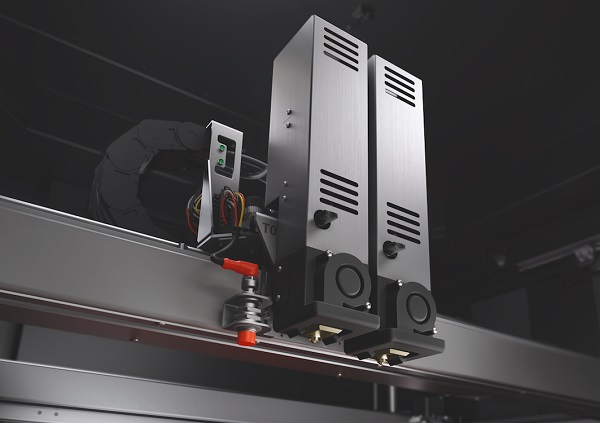
Two key concepts are at the core of MXT technology: motion control and precision material flow. Both are enabled through BigRep’s engineering partnership with Bosch Rexroth. Expertise in CNC controls (e.g., linear motion controls and electric drive/control technology) lets Bosch Rexroth create precise, closed-loop feedback on multiple subsystems of the new printers. Improved motion-control technology supports increased acceleration of the extruder while eliminating vibrations, and a metering system on the extruder head controls melting, feeding and extrusion.
“Currently, there is an assumption that filament diameter is known and constant, but due to tolerances, you really don’t know the diameter at any given time," says Aknin. “This is the main reason FFF parts are not repeatable. Now, we have a metering device that controls how much molten material is getting out of the tip, separating the melting from the extrusion. No other FFF system is doing that.”
Working with Bosch over the past year, he adds, BigRep has developed 3D printing systems that extrude while moving at 600 mm per second — speeds that you usually only see during the brief moments when an extruder enters its rapid “homing” mode. Next generation systems will achieve 1 meter per second, according to the company. All of this adds up to fast, repeatable part production.
In addition, because Bosch develops not just components but complete systems, the MXT approach includes IoT capabilities built-in for two-way communications. Aknin says that not only can users send commands to the machine but in turn the machine will collect and send back data, monitoring conditions in real time. “For example,” he says, “You can set your desired parameters that mean ‘this is healthy behavior,’ and if something is ‘off’ - for example, this motor is drawing more current than it should – it will tell you.”
This IoT connectivity is key to BigRep’s expansion into true manufacturing. Frank Marangell, who came on board as chief business officer and president of BigRep America a little over a year ago, enlarges on this topic. “If you walk into any progressive manufacturing facility,” he explains, “you’ll find that everything is linked into their data system except for their 3D printers. That’s great if you’re making tooling or prototypes, but if you want to be part of low-volume manufacturing, you need to be integrated, and that’s what MXT does besides adding speed. It’s going to make a reliable, repeatable extruder, and solve the limitations of today’s systems.”
BigRep systems work with open-source materials; Marangell notes, “Proprietary material doesn’t cut it.” The company does produce its own plug-and-play materials but has also been working with multiple suppliers such as BASF to qualify other materials. These include true nylon, true ABS, and eventually filled versions of both (carbon and glass) as well as BASF’s own version of Ultem.
Aknin’s motto is “applications-materials-systems,” stresses Marangell. “If you wake him up in the middle of the night, he says that – it’s that important! Don’t just make a system and try to figure out where it goes.” They have worked with many companies to identify needs targeted to engineering materials and designed the machines to work with those materials.
Marangell sums up where BigRep is headed by saying, “Tooling is the low-hanging fruit but for real end-use parts, people are starting to get creative. There’s a lot of interest in qualifying parts as an alternative to the injection-molding or forming or milling they’re doing today; they’ll be low volume or custom or spare parts, but still real manufacturing. BigRep has the investors, the backers and now the technology to be a player in that game.” Plans for next-generation system performance already include speeds of four times the current impressive rates.
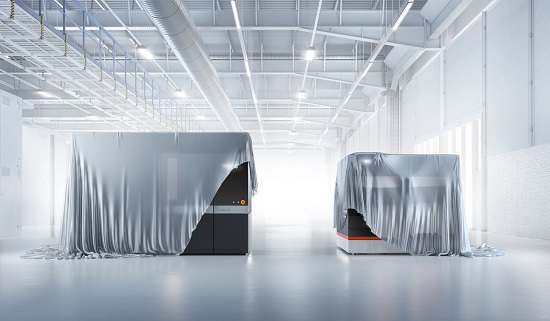
The MXT technology will be unveiled in BigRep’s new machines at FORMNEXT 2018 (November 13-16, Frankfurt Germany). BigRep will be taking orders; the first substantial batch of systems is already being built.


Never compromise on size, reliability, or performance. Our complete line of large industrial 3D printers are flexible, intelligent, and automated, delivering functional parts backed by our commitment to lifetime productivity.

Pamela Waterman worked as Digital Engineering's contributing editor for two decades. Contact her via DE-Editors@ digitaleng.news.
Follow DE






About Us · Contact Us · Editorial Team · Advertising · Privacy Policy · Subscriber Services · © 2026 Digital Engineering 24/7 · Peerless Media