Helping design and engineering professionals discover, evaluate and specify technologies and processes that shorten the design cycle and enable success.


Alert!
Digital Engineering ceased publication on July 1, 2026. This website remains available as an archive of engineering content.
For inquiries or information, please email [email protected].

Digital Engineering April 2026
In the latest issue of Digital Engineering, we take a look at the latest innovations in design for additive manufacturing, including the use of natural language inputs, social media cosplayers, and AI integration. The issue also includes a feature…

January Special Focus Issue: Design for Additive
In this Special Focus Issue of Digital Engineering, learn about the latest advancements in design for additive manufacturing, including new software tools, additive in automotive, custom medical devices, and more.
A new light-based 3D printing technique developed at the University of California at Berkeley can create objects from a viscous liquid in just a few minutes. The technique avoids layering, and can create flexible object as well as encasing existing objects in the material.
“I think this is a route to being able to mass-customize objects even more, whether they are prosthetics or running shoes,” said Hayden Taylor, assistant professor of mechanical engineering at UC Berkeley and senior author of a paper describing the printer, which appeared in the journal Science. “The fact that you could take a metallic component or something from another manufacturing process and add on customizable geometry, I think that may change the way products are designed.”
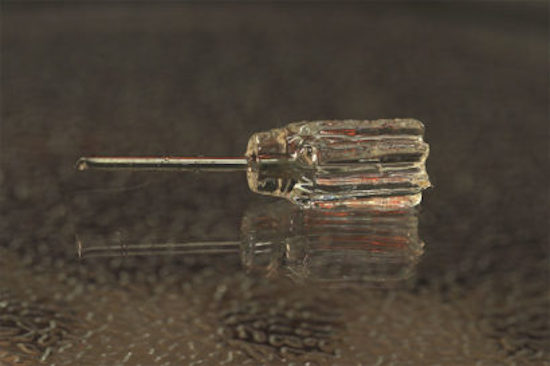
UC Berkeley researchers used a new light-based 3D printing technique to add a handle onto a screwdriver shaft. Image courtesy of UC Berkeley/Stephen McNally
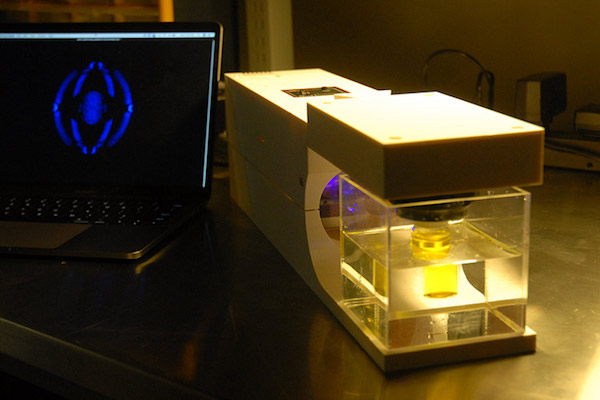
The printer (nicknamed “the replicator”) the researchers have developed is based on a liquid material that solidifies when exposed to light. By projecting light patterns on the material, the liquid can solidify into an object all at once.
“Basically, you’ve got an off-the-shelf video projector, which I literally brought in from home, and then you plug it into a laptop and use it to project a series of computed images, while a motor turns a cylinder that has a 3D printing resin in it,” Taylor said. “Obviously there are a lot of subtleties to it—how you formulate the resin, and, above all, how you compute the images that are going to be projected, but the barrier to creating a very simple version of this tool is not that high.”
The printer can create objects up to four inches in diameter, and can encase existing objects in the material—including printing a screwdriver handle onto a metal screwdriver shaft.
The material is a mixture of liquid polymers, photosensitive molecules, and dissolved oxygen. The unused resin can be recycled, and the process generates almost no waste materials.
“This is the first case where we don’t need to build up custom 3D parts layer by layer,” said Brett Kelly, co-first author on the paper. “It makes 3D printing truly three-dimensional.”
Source: UC Berkeley


Brian Albright is the editorial director of Digital Engineering.
Contact him at [email protected].






About Us · Contact Us · Editorial Team · Advertising · Privacy Policy · Subscriber Services · © 2026 Digital Engineering 24/7 · Peerless Media