Helping design and engineering professionals discover, evaluate and specify technologies and processes that shorten the design cycle and enable success.


Sponsored
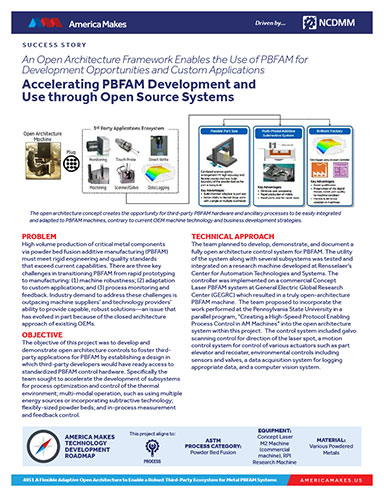
High volume production of critical metal components via powder bed fusion additive manufacturing (PBFAM) must meet rigid engineering and quality standards that exceed current capabilities.
There are three key challenges in transitioning PBFAM from rapid prototyping to manufacturing: (1) machine robustness; (2) adaptation to custom applications; and (3) process monitoring and feedback.
Industry demand to address these challenges is outpacing machine suppliers’ and technology providers’ ability to provide capable, robust solutions—an issue that has evolved in part because of the closed architecture approach of existing OEMs.
The objective of this project was to develop and demonstrate open architecture controls to foster thirdparty applications for PBFAM by establishing a design in which third-party developers would have ready access to standardized PBFAM control hardware.
Specifically the team sought to accelerate the development of subsystems for process optimization and control of the thermal environment; multi-modal operation, such as using multiple energy sources or incorporating subtractive technology; flexibly-sized powder beds; and in-process measurement and feedback control.

As the national accelerator for additive manufacturing (AM) and 3D printing (3DP), America Makes is the nation’s leading and collaborative partner in AM and 3DP technology research, discovery, creation, and innovation. Structured as a…
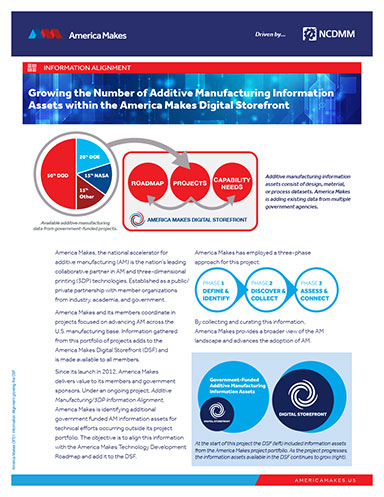
Additive Manufacturing/3DP Information Alignment
Growing the number of additive manufacturing information assets within the America Makes digital storefront.




About Us · Contact Us · Editorial Team · Advertising · Privacy Policy · Subscriber Services · © 2026 Digital Engineering 24/7 · Peerless Media