Helping design and engineering professionals discover, evaluate and specify technologies and processes that shorten the design cycle and enable success.


Alert!
Digital Engineering ceased publication on July 1, 2026. This website remains available as an archive of engineering content.
For inquiries or information, please email [email protected].

Digital Engineering April 2026
In the latest issue of Digital Engineering, we take a look at the latest innovations in design for additive manufacturing, including the use of natural language inputs, social media cosplayers, and AI integration. The issue also includes a feature…

January Special Focus Issue: Design for Additive
In this Special Focus Issue of Digital Engineering, learn about the latest advancements in design for additive manufacturing, including new software tools, additive in automotive, custom medical devices, and more.
Prior to a vehicle entering production, the Audi Pre-Series Center in Ingolstadt builds physical models and prototypes for the brand to evaluate new designs and concepts thoroughly. This requires allocation of most parts of the vehicle in an early stage of product development, such as wheel covers, door handles and radiator grills. The use of plastics 3D printing has become an integral part of the automotive design process at the Audi Pre-Series Center, enabling the team to overcome limitations of conventional processes and accelerate design verification.
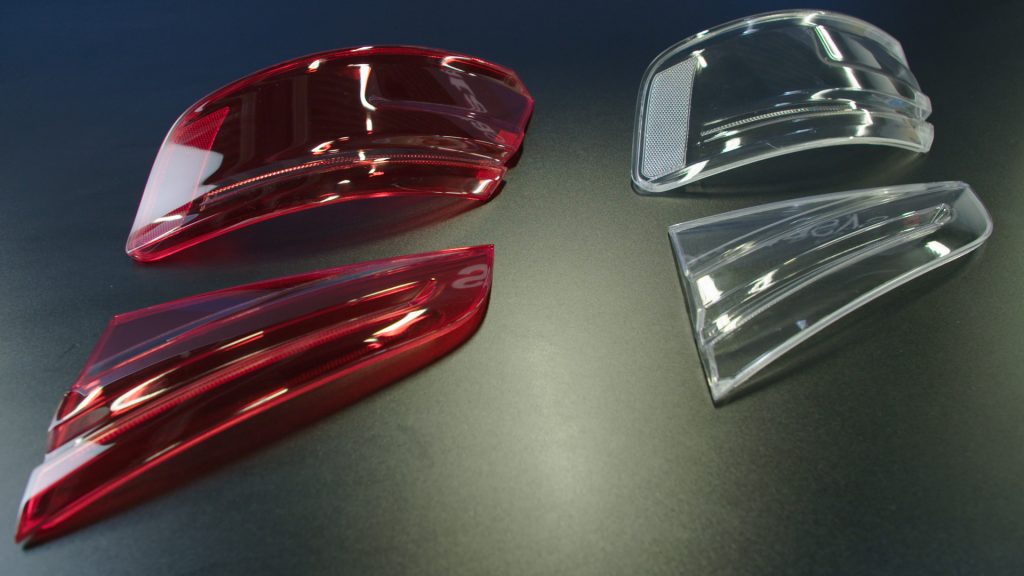 The vivid colors of the Stratasys J750 3D Printer enable Audi to generate transparent, multi-colored parts that meet the texture and color-matching requirements of Audi's design approval process. Image courtesy of Stratasys.
In the case of tail light covers, the team traditionally used milling or molding to produce individual parts. The main challenge with these production techniques is the multi-colored covers of the tail light housing. These individual color parts must be assembled, because they cannot be produced in one piece. This time-consuming process increases lead times for design verification and delays time to market.
“Design is one of the most important buying decisions for Audi customers, therefore it’s crucial we adhere to supreme quality standards during the design and concept phase of vehicle development,” explains Dr. Tim Spiering, head of the Audi Plastics 3D Printing Center. “As a result, we need prototypes to have exact part geometries, no distortion and extremely high quality, as well as true-to-part color and transparency. The Stratasys J750 3D Printer will offer us a significant advantage, as it allows us to print the exact textures and colors our design defines.
“Using the J750 for the prototyping of tail light covers, we will be able to accelerate our design verification process,” continues Spiering.
Dr. Spiering and his 24-member team are responsible for providing all plastics 3D printing expertise, advice and production at Audi. Having invested in its first Stratasys FDM 3D Printer in 2002, the division has since grown its portfolio to ten polymer 3D printers, including a range of Stratasys FDM and PolyJet 3D Printers.


DE's editors contribute news and new product announcements to Digital Engineering. Press releases may be sent to them via [email protected].
Follow DE
Join over 90,000 engineering professionals who get fresh engineering news as soon as it is published.






About Us · Contact Us · Editorial Team · Advertising · Privacy Policy · Subscriber Services · © 2026 Digital Engineering 24/7 · Peerless Media