Helping design and engineering professionals discover, evaluate and specify technologies and processes that shorten the design cycle and enable success.


Alert!
Digital Engineering ceased publication on July 1, 2026. This website remains available as an archive of engineering content.
For inquiries or information, please email [email protected].

Cut Retrieval-Augmented Generation (RAG) Hallucinations by 50%
Most teams hit the same wall with enterprise AI: LLMs that hallucinate, pipelines that don’t scale, and infrastructure that’s harder to design than the models themselves.

What Is Intelligent BOM Management? A Guide to Smarter Product Development
Learn how intelligent Bill of Materials (BOM) management helps teams collaborate, reduce errors, and bring innovative products to market faster with cloud-based PLM tools.
AMD introduces the AMD Radeon Pro W5700, described as the world’s first 7nm professional PC workstation graphics card. AMD says the W57090 delivers “new levels of performance and advanced features” enabling 3D designers, architects and engineers to visualize, review and interact with designs in real time, “dramatically accelerating decision-making processes and product development cycles.”
At the forefront of the new Radeon Pro W5700 is the 7nm production technology, allowing the graphics processing unit (GPU) to do more work per watt and to do it faster than the previous generation technology. System power consumption at idle is approximately 37 watts, and 90 watts for CAD solid modeling.
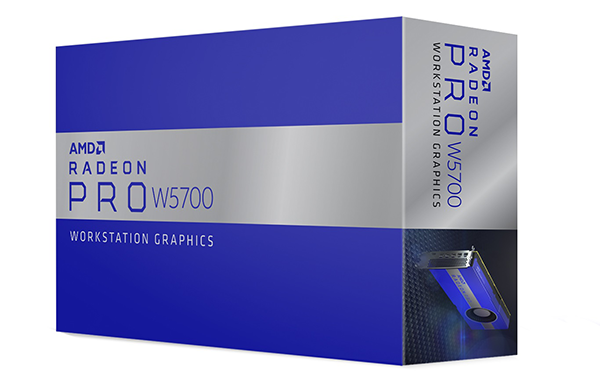
AMD tested the Radeon Pro W5700 using SPECviewperf 13, the industry standard for graphics performance testing. It found the W5700 accelerated multitasking workloads 5.6x faster than its competitive model. AMD claims the increased throughput makes the W5700 suitable for untethered VR development.

AMD is using a combination of high-bandwidth PCIe 4.0 internal bandwidth connectivity and GDDR6 memory, a duo AMD says will improve handling of large engineering models and datasets, including for VR.
The revised onboard architecture includes a new geometry engine that AMD says delivers 25% higher performance per clock unit and 41% higher average performance per watt than AMD’s previous Graphics Core Next technology. New drivers promote accelerated CPU/GPU multitasking performance and increased speed for remote workstation applications.
New ReLive for VR is bundled software in the Radeon Pro W5700 supporting wireless VR production on selected headsets including the HTC Vive Focus Plus7.
AMD says the Radeon Pro W5700 is the first professional GPU to include USB-C connection, supporting a growing list of USB-C monitors and head-mounted displays.
The AMD Radeon Pro W5700 graphics card is available for an average price of $799 from a variety of retailers.
For more information, click here.
See why DE’s Editors selected the AMD Radeon Pro W5700 as their Pick of the Week.
Sources: Press materials received from the company and additional information gleaned from the company’s website.


AMD, or Advanced Micro Devices, has driven innovation in high-performance computing, graphics and visualization technologies. They develop high-performance computing and visualization products to solve some of the world’s toughest and most…

Accelerating Electric Vehicle Development with Multidisciplinary Simulation and High-Performance Computing
In this new Making the Case guide, learn how a unified approach to design and multidisciplinary simulation from Dassault Systèmes, combined with high-performance computing powered by AMD EPYC™ processors, can accelerate EV design.

DE's editors contribute news and new product announcements to Digital Engineering. Press releases may be sent to them via [email protected].
Follow DE






About Us · Contact Us · Editorial Team · Advertising · Privacy Policy · Subscriber Services · © 2026 Digital Engineering 24/7 · Peerless Media