Helping design and engineering professionals discover, evaluate and specify technologies and processes that shorten the design cycle and enable success.


Alert!
Digital Engineering ceased publication on July 1, 2026. This website remains available as an archive of engineering content.
For inquiries or information, please email [email protected].
Sponsored

 Simulation-based optimization involves traversing a high-dimensional design space in search of design parameters that can maximize one or more objectives while satisfying a set of constraints. In engineering systems, this optimization can become quite complex.
In airplane wing aerodynamic design, for example, the objective function might be fuel economy while constraints may include operational considerations such as airport density altitude, or minimum runway length, payload, range and cruising speed. Structural considerations may include minimum wing thicknesses and maximum loads. At each potential optimal point in the design space, which contains parameters describing the wing geometry, these constraints must be satisfied. This can add up to dozens of dimensions that must be modeled and can yield many thousands of points in the design/operational space that must be evaluated.
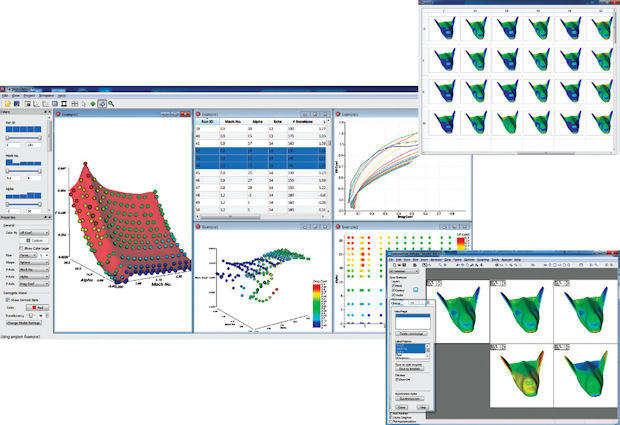
Because simulations like computational fluid dynamics (CFD) are so expensive, surrogate-based optimization is often used. Surrogate models are functions that estimate the variation of integrated aerodynamic quantities, such as forces and moments, between the simulation points. They are cheaper to evaluate and can dramatically reduce the cost of the constraint optimization.
Tecplot Chorus can help identify the cause of problems encountered during simulation-based constraint optimization, including simulations that are insufficiently converged, inaccurate solutions, and insufficient operational space coverage in the simulation experimental design. Engineers can use it to visually analyze the distribution of cases and output variables in N-dimensional design/operational space. When results look suspicious, the problem is frequently in the setting of boundary conditions, turbulence models, or fluid properties and can often be detected by a quick examination of the field data from individual simulations using the 3D visualization capabilities in Tecplot Chorus.
Finally, Tecplot Chorus can be used to create surrogate models. Engineers can use it to evaluate the uncertainty inherent in the surrogate models and identify regions where additional simulation cases would be helpful. Ultimately, these surrogate models can be used in future optimizations.






About Us · Contact Us · Editorial Team · Advertising · Privacy Policy · Subscriber Services · © 2026 Digital Engineering 24/7 · Peerless Media