Helping design and engineering professionals discover, evaluate and specify technologies and processes that shorten the design cycle and enable success.


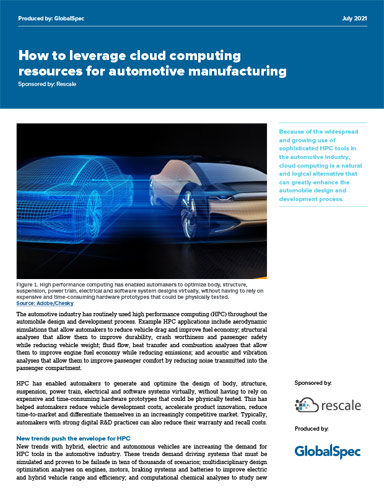
The automotive industry has routinely used high performance computing (HPC) throughout the automobile design and development process. Example HPC applications include aerodynamic simulations that allow automakers to reduce vehicle drag and improve fuel economy; structural analyses that allow them to improve durability, crash worthiness and passenger safety while reducing vehicle weight; fluid flow, heat transfer and combustion analyses that allow them to improve engine fuel economy while reducing emissions; and acoustic and vibration analyses that allow them to improve passenger comfort by reducing noise transmitted into the passenger compartment.
HPC has enabled automakers to generate and optimize the design of body, structure, suspension, power train, electrical and software systems virtually, without having to rely on expensive and time-consuming hardware prototypes that could be physically tested. This has helped automakers reduce vehicle development costs, accelerate product innovation, reduce time-to-market and differentiate themselves in an increasingly competitive market. Typically, automakers with strong digital R&D practices can also reduce their warranty and recall costs.
Download this paper to learn more.

Rescale empowers engineers and scientists to automate and optimize their workflows on the latest specialized HPC infrastructure available. Governed by best in class security and reliability, the Rescale platform was built to enable global teams to…

Rescale’s Spotlight on Engineering Excellence
Leading organizations are turning to Rescale’s digital engineering platform to modernize, reduce costs, and accelerate development. This interactive eBook highlights how global enterprises and high-growth innovators are transforming simulation, harnessing AI, and optimizing HPC to drive better outcomes.




About Us · Contact Us · Editorial Team · Advertising · Privacy Policy · Subscriber Services · © 2026 Digital Engineering 24/7 · Peerless Media