Helping design and engineering professionals discover, evaluate and specify technologies and processes that shorten the design cycle and enable success.


Alert!
Digital Engineering ceased publication on July 1, 2026. This website remains available as an archive of engineering content.
For inquiries or information, please email [email protected].

Digital Engineering April 2026
In the latest issue of Digital Engineering, we take a look at the latest innovations in design for additive manufacturing, including the use of natural language inputs, social media cosplayers, and AI integration. The issue also includes a feature…

January Special Focus Issue: Design for Additive
In this Special Focus Issue of Digital Engineering, learn about the latest advancements in design for additive manufacturing, including new software tools, additive in automotive, custom medical devices, and more.
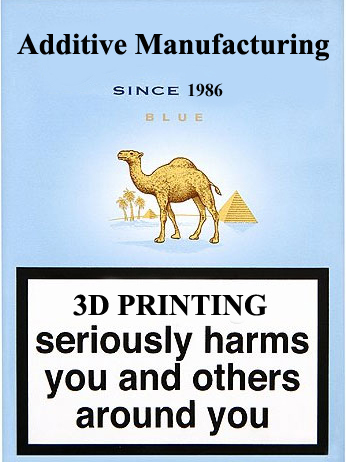
Additive manufacturing systems may be the next product to end up with a warning label. According to a study produced by the Illinois Institute of Technology, running a 3D printer that uses plastic as its material may be as dangerous to your health as smoking cigarettes.
"Because most of these devices are currently sold as standalone devices without any exhaust ventilation or filtration accessories, results herein suggest caution should be used when operating in inadequately ventilated or unfiltered indoor environments. Additionally, these results suggest that more controlled experiments should be conducted to more fundamentally evaluate particle emissions from a wider arrange of desktop 3D printers."
The culprit here is the ultrafine particle (UFP) emissions produced by a 3D printer when it builds an object from plastic. According to the study, the printers release approximately 20 billion particles/minute while building with PLA at low temperatures and upwards of 200 billion/minute when working at higher temperatures and with other materials. By way of comparison, this presents the same sort of health risk as smoking indoors, or working with a gas stove in an enclosed area.
Most people will hardly be surprised that standing around sniffing melting plastic is bad for your health. The same precautions that allow you to use any potentially toxic product at home can reduce the risks when using a 3D printer. Make sure you work in a well-ventilated area, and procure and use safety equipment. It's also worth noting that most industrial AM systems already come with safeguards.
Will this study have an impact on home 3D printer sales? If it does, I wouldn’t expect much of a drop. It isn’t really all that difficult to work around the potential hazards. I fully expect the industry, or some enterprising inventor, to rise to this new challenge and design filters to reduce UFP emissions. In the meantime, make sure you open a window.
Lacking any kind of 3D printer safety video, below you’ll find an interesting look at AM from CNN.
Source: Atmospheric Environment


John Newman is a Digital Engineering contributor who focuses on 3D printing. Contact him via [email protected] and read his posts on Rapid Ready Technology.
Follow DE






About Us · Contact Us · Editorial Team · Advertising · Privacy Policy · Subscriber Services · © 2026 Digital Engineering 24/7 · Peerless Media