Helping design and engineering professionals discover, evaluate and specify technologies and processes that shorten the design cycle and enable success.


Alert!
Digital Engineering ceased publication on July 1, 2026. This website remains available as an archive of engineering content.
For inquiries or information, please email [email protected].

May 2026 Special Focus: Artificial Intelligence in Design and Simulation
In this Special Focus Issue, learn about the latest developments in the integration of artificial intelligence into engineering workflows.

April 2026 Special Focus Issue: Generative Design
In this Special Focus Issue, Digital Engineering takes a look at how generative design solutions can be used across different types of design problems and with a variety of manufacturing approaches to accelerate design space exploration, and…
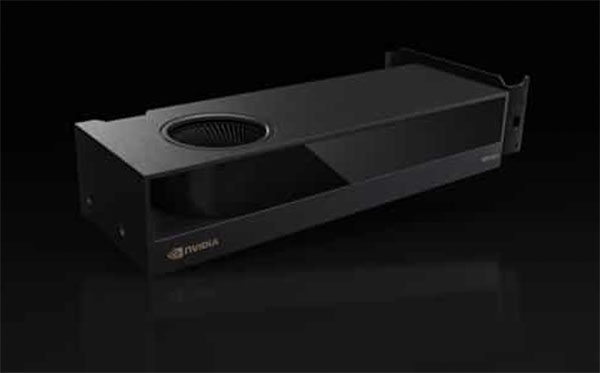
The new NVIDIA RTX 2000 Ada Generation GPU delivers the latest artificial intelligence (AI), graphics and compute technology to compact workstations, offering increased performance compared to previous-generation RTX A2000 12GB in professional workflows, NVIDIA notes.
With 16GB of memory in the RTX 2000 Ada, professionals can tap the latest technologies and tools to work faster and better with their data, according to NVIDIA.
Powered by NVIDIA RTX technology, the new GPU delivers realism in graphics with NVIDIA DLSS, delivering photorealistic ray-traced images. In addition, the RTX 2000 Ada enables an immersive experience for enterprise virtual-reality workflows, such as for product design and engineering design reviews.
With the new RTX 2000 Ada, product designers and engineers using industrial PCs can iterate rapidly on product designs with fast, photorealistic rendering and AI-powered generative design. Content creators can edit high-resolution videos and images, and use AI for realistic visual effects and content creation assistance.
In embedded applications and edge computing, the RTX 2000 Ada can power real-time data processing for medical devices, optimize manufacturing processes with predictive maintenance and enable AI-driven intelligence in retail environments.
“The new NVIDIA RTX 2000 Ada—with its higher-efficiency, next-generation architecture, low power consumption and large frame buffer—will benefit SOLIDWORKS users,” says Olivier Zegdoun, graphics applications research and development director for SOLIDWORKS at Dassault Systèmes. “It delivers excellent performance for designers and engineers to accelerate the development of innovative product experiences with full-model fidelity, even with larger datasets.”
The NVIDIA RTX 2000 Ada features the latest technologies in the NVIDIA Ada Lovelace GPU architecture, including:
16GB of GPU memory: An expanded canvas enables users to tackle larger projects, along with support for error-correction code memory to deliver greater computing accuracy for critical applications.
DLSS 3: Delivers AI-powered graphics.
AV1 encoder: Eighth-generation NVIDIA Encoder, aka NVENC, with AV1 support is more efficient than H.264.
Sources: Press materials received from the company and additional information gleaned from the company’s website.


Since its founding in 1993, NVIDIA (NASDAQ: NVDA) has been a pioneer in accelerated computing. The company’s invention of the GPU in 1999 sparked the growth of the PC gaming market, redefined computer graphics, ignited the era of modern AI and…

Cut Retrieval-Augmented Generation (RAG) Hallucinations by 50%
Most teams hit the same wall with enterprise AI: LLMs that hallucinate, pipelines that don’t scale, and infrastructure that’s harder to design than the models themselves.

DE's editors contribute news and new product announcements to Digital Engineering. Press releases may be sent to them via [email protected].
Follow DE






About Us · Contact Us · Editorial Team · Advertising · Privacy Policy · Subscriber Services · © 2026 Digital Engineering 24/7 · Peerless Media