Helping design and engineering professionals discover, evaluate and specify technologies and processes that shorten the design cycle and enable success.




Digital Engineering April 2026
In the latest issue of Digital Engineering, we take a look at the latest innovations in design for additive manufacturing, including the use of natural language inputs, social media cosplayers, and AI integration. The issue also includes a feature…

January Special Focus Issue: Design for Additive
In this Special Focus Issue of Digital Engineering, learn about the latest advancements in design for additive manufacturing, including new software tools, additive in automotive, custom medical devices, and more.
Desktop Metal has qualified the use of 4140 low-alloy steel for the Production System platform, which leverages Single Pass Jetting (SPJ) technology designed to achieve the fastest build speeds in the metal additive manufacturing industry, company says. Desktop Metal qualifies 4140 low-alloy steel for use with metal binder jetting systems, enabling its use in mass production end-use part applications.
Considered a versatile low-alloy steels, 4140 is characterized by its toughness, high tensile strength and abrasion and impact resistance, Desktop Metal reports. It is an all-purpose and heat-treatable steel used extensively in various automotive, oil and gas, and industrial applications, such as gears, downhole tool components, couplings, spindles, bolts and nuts, and other mechanical parts.
“4140 has been a challenging material for metal binder jetting because of its low alloyed content, tight carbon control requirements, and low ignition energy, which together require advanced binder chemistry, as well as extensive printing and sintering optimization and atmospheric controls for safe processing,” says Jonah Myerberg, co-founder and CTO of Desktop Metal.
“With the speed of the Production System, businesses can now use binder jetting to print complex 4140 parts at competitive costs while maintaining the strength and mechanical properties of traditionally manufactured alternatives," Myerberg adds. "This is a game-changing solution for manufacturers who have been tied to time-consuming and expensive machining and conventional tool-based manufacturing processes.”
Desktop Metal’s materials science team has validated that 4140 low-alloy steel printed on Production System technology and sintered by Desktop Metal meets MPIF 35 standards for structural powder metallurgy parts set by the Metal Powder Industries Federation. 4140 parts printed on the Production System platform eliminate the use of tooling and minimize material waste, and represent a decrease in production time and part cost compared to conventional manufacturing methods, Desktop Metal says.
This joint is used for power transfer between an electric power steering motor and the steering shaft in an automobile. 4140 provides strength and hardness, essential for the spline teeth that connect this part to the rest of its assembly. While production using a conventional press and sinter process would require a mold, the Production System P-50 enables production with no tooling, reducing lead times and enabling more flexible design for quantities up to 1.2 million per year at a fully burdened part cost as low as $2.45.
Herringbone gears, in a variety of industrial machinery applications, benefit from the hardness of 4140 low-alloy steel and can be lightweighted using complex lattice designs made possible by additive manufacturing, reducing material cost and reducing wear on external components, such as motors and bearings. This part can be mass produced on the Production System P-50 in quantities up to 200,000 per year with 120 parts nested in each build.
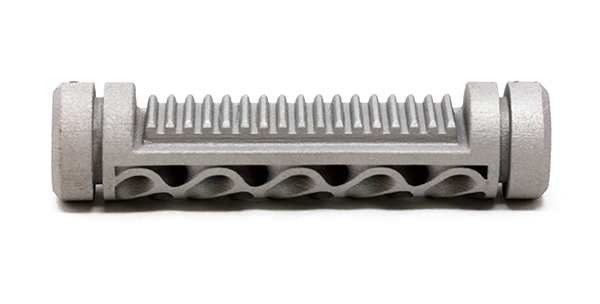
Linear pneumatic pistons are used to convert air pressure into rotary motion through a rack and pinion with 4140 providing the toughness and wear resistance required for this application. These parts are traditionally assembled from multiple components due to the geometry and cost limitations of conventional manufacturing processes. The Production System P-50 enables production of up to 690,000 parts per year at a cost as low as $0.28 per cubic centimeter of sintered 4140 low-alloy steel.
Lever drives are often used in machine design to linearly adjust the location of components in a machine. Binder jetting easily facilitates features such as the precise grooves critical for locating the correct position of external components. While producing a mid-volume run of 10,000 parts would not be cost-effective with conventional manufacturing given the upfront tooling costs or the labor costs associated with machining, the Production System P-50 can print the required quantities in a day with sintered parts ready in less than a week.
The Production System is an industrial manufacturing platform powered by Desktop Metal’s SPJ technology. The Production System platform consists of two printer models: the P-1, a solution for process development and serial production applications, and the P-50, a large form factor mass production solution for end-use parts, scheduled to begin commercial shipments in the second half of 2021. For more details about the Production System, click here.
The Production System platform materials library includes 17-4 PH stainless steel, 316L stainless steel and 4140 low-alloy steel, each of which have been qualified by Desktop Metal. The platform also supports several customer-qualified materials, including silver and gold, and Desktop Metal plans to add additional metals to its portfolio, including tool steels, stainless steels, superalloys, copper and more. To learn more about 4140 and the Production System materials portfolio, click here.
Sources: Press materials received from the company and additional information gleaned from the company’s website.


Desktop Metal was started to address a problem—how to make metal 3D printing accessible for engineering teams. In 2013, CEO Ric Fulop began collaborating with world-leading experts in materials science, engineering, and 3D printing. Their work…

DE's editors contribute news and new product announcements to Digital Engineering. Press releases may be sent to them via [email protected].
Follow DE
Join over 90,000 engineering professionals who get fresh engineering news as soon as it is published.






About Us · Contact Us · Editorial Team · Advertising · Privacy Policy · Subscriber Services · © 2026 Digital Engineering 24/7 · Peerless Media