Helping design and engineering professionals discover, evaluate and specify technologies and processes that shorten the design cycle and enable success.



Cut Retrieval-Augmented Generation (RAG) Hallucinations by 50%
Most teams hit the same wall with enterprise AI: LLMs that hallucinate, pipelines that don’t scale, and infrastructure that’s harder to design than the models themselves.

What Is Intelligent BOM Management? A Guide to Smarter Product Development
Learn how intelligent Bill of Materials (BOM) management helps teams collaborate, reduce errors, and bring innovative products to market faster with cloud-based PLM tools.
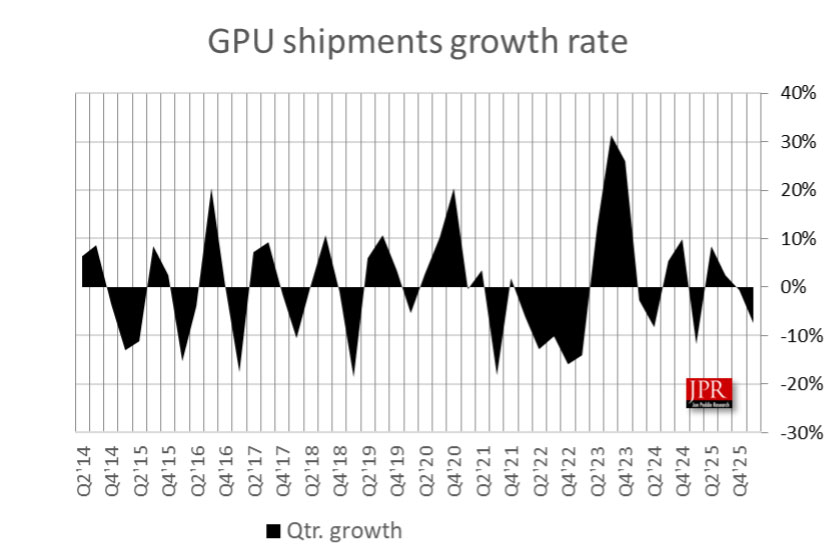
Jon Peddie Research reports the global PC-based graphics processor unit (GPU) market reached 70.3 million units in Q1 2026 and PC CPU shipments decreased to 57.6 million units.
Overall, GPUs will have a compound annual growth rate of -3% from 2025 to 2029 and reach an installed base of 3 billion units at the end of the forecast period. In the next 5 years, the penetration of discrete GPUs (dGPUs) in the PC will be 12%.
Year-to-year total GPU shipments, including all platforms and all types of GPUs, increased 2%, desktop graphics increased by 11%, and notebooks decreased by -1.5%.
AMD's overall GPU market share increased 2% from last quarter, Intel's market share decreased -4%, and NVIDIA's market share increased 2.3%.
Overall, CPU unit shipments decreased -14% from last quarter; AMD’s decreased -3%, and Intel’s decreased -15%.
The first quarter is traditionally flat to down. This quarter's GPU shipments were down from the 10-year average of 2.2%.
“The PC companies were caught in a downdraft that hit the broader market as the war with Iran took hold, memory cost spiked, and the continuation of special cutout, as well as changing import/export rules. As part of the turmoil, some PC suppliers have pulled back or held orders, while a few have increased orders hoping to lock in prices,” sayw Dr. Jon Peddie, president of Jon Peddie Research. “Pre-ordering to lock in prices is a short-term measure that has never been a good idea because it suppresses future quarter sales. We expect overall PC sales and, consequently, client PC GPU sales, to decline for the year."
Sources: Press materials received from the company and additional information gleaned from the company’s website.

Jon Peddie Research (JPR) is a technically oriented computer graphics marketing and management-consulting firm based in Tiburon, CA. We provide specialized services to senior and middle management in computer companies and companies that are major…
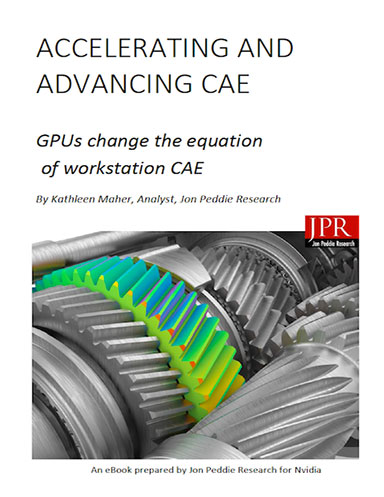
Accelerating and Advancing CAE
GPUs are changing the nature of engineering simulation, according to a new ebook from Jon Peddie Research (JPR). It explains how GPU acceleration is improving CAE workflows.

DE's editors contribute news and new product announcements to Digital Engineering. Press releases may be sent to them via [email protected].
Follow DE
Join over 90,000 engineering professionals who get fresh engineering news as soon as it is published.






About Us · Contact Us · Editorial Team · Advertising · Privacy Policy · Subscriber Services · © 2026 Digital Engineering 24/7 · Peerless Media