Helping design and engineering professionals discover, evaluate and specify technologies and processes that shorten the design cycle and enable success.


Sponsored

Digital Engineering April 2026
In the latest issue of Digital Engineering, we take a look at the latest innovations in design for additive manufacturing, including the use of natural language inputs, social media cosplayers, and AI integration. The issue also includes a feature…

January Special Focus Issue: Design for Additive
In this Special Focus Issue of Digital Engineering, learn about the latest advancements in design for additive manufacturing, including new software tools, additive in automotive, custom medical devices, and more.
By Ashley Eckhoff
Manufacturing has, in general, moved toward more streamlined and optimized manufacturing operations for decades. Modern manufacturing requires large volumes of complex parts to be manufactured. This often requires a multitude of discrete manufacturing steps to be applied on multiple pieces of machinery. But that dynamic has been changing with the adoption and growth of additive manufacturing (AM) technologies, which allow for complex geometries to be created on a single machine with a single print.
Unfortunately, the relatively small workable volume associated with most printing technologies has been a limiting factor in certain industries. However, the evolution of additive beyond planar printing may completely change what’s considered normal for manufacturing.
Many printing technologies have been limited by size, the final part had to fit within the footprint of enclosed manufacturing machines. This has limited the industries that might benefit from AM. That is not to say large-format 3D printing does not exist, but the complexities associated with scaling up planar printing has restricted it to niche applications. Many of the applications for large-format additive have been limited to marine, construction and architectural projects while precision operations were still left to other manufacturing processes.
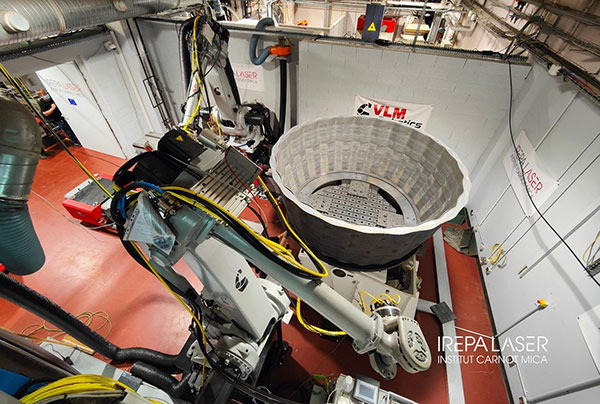
But multi-axis breaks away from the limitation of printing within a box while still providing all the previous benefits of the technology. Rather than creating an enclosed printer large enough to contain the largest print, robotic arm-based machines can provide a more flexible printing area with better cost scaling compared to standard planar printing machines.
Use of robotics to print at larger scales requires complex software to drive the hardware processes. Not only are the part sizes quite different compared to enclosed printing operations, but also robotic arms produce a vastly different printing area. When large-format printing is combined with multi-axis machining, the parts produced can even compete with more traditional processes with regards to precision. That precision is derived from the much lighter loads at the ends of industrial robotics—rather than moving large components or counteracting the torques of milling operations, printing is a low-intensity process. The ability of a software package to define deposition paths that work with, rather than against, the part geometry combined with the proper hardware controls is what allows for printing to be scaled to large formats while retaining the necessary precision.
The extraordinarily complex deposition paths for multi-axis printing can include a full 6 degrees of motion, requiring precision in the path definition, but also precision in the ability of the hardware to follow that path. A small deviation that is within tolerance in a normal 3D printer can become a large deviation that is far outside of allowable tolerance when scaled to large-format machines. Therefore, special software packages have been created to ensure that the deposition paths for large format multi-axis printing are exact. From that point it is the responsibility of the hardware to replicate those deposition paths accurately, and many large-format printers use industrial controls for this reason.
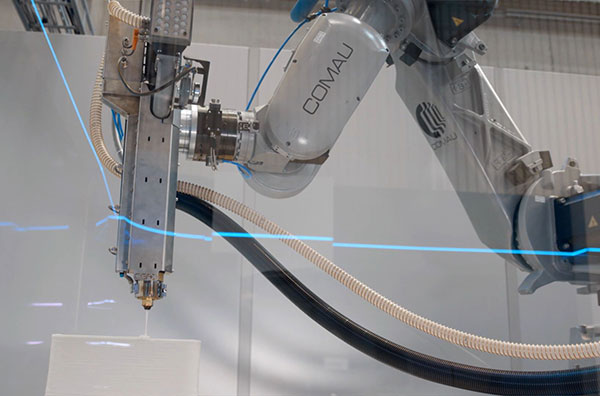
Starting with an off-the-shelf robotic arm has financial benefits for businesses already deploying robotics, and for OEMs looking to diversify their industrial offerings. Rather than developing a new machine from the ground up specifically for additive manufacturing, some OEMs are creating modular printer heads for robotic arms.
Figure 2 - Printing module attached to industrial robotic arm
Multi-axis printing is what might open the floodgates for investment in AM technologies on a larger scale. Printing larger parts than previously possible will provide additive manufacturing access to a greater number of industries. However, capitalizing on this shift requires a digital solution to utilize, optimize, and innovate through the complexity that comes with the added degrees of manufacturing freedom.
.jpg)
Ashley Eckhoff has a background in engineering and has been with Siemens for over 20 years in various capacities. He has spent the past few years deep-diving into additive manufacturing in both product design and marketing roles.


Simcenter™ software, from Siemens Digital Industries Software, uniquely combines system simulation, 3D CAE and test to help you predict performance across all critical attributes earlier and throughout the entire product lifecycle. By combining…
Making the Case for Artificial Intelligence and Machine Learning in Engineering
In this paper, Siemens Digital Industries Software and Digital Engineering will provide an overview of how AI/ML-enabled software can improve design workflows, while also addressing common questions and concerns around implementing this technology in an engineering organization.

Join over 90,000 engineering professionals who get fresh engineering news as soon as it is published.






About Us · Contact Us · Editorial Team · Advertising · Privacy Policy · Subscriber Services · © 2026 Digital Engineering 24/7 · Peerless Media