Helping design and engineering professionals discover, evaluate and specify technologies and processes that shorten the design cycle and enable success.


Alert!
Digital Engineering ceased publication on July 1, 2026. This website remains available as an archive of engineering content.
For inquiries or information, please email [email protected].
Sponsored

May 2026 Special Focus: Artificial Intelligence in Design and Simulation
In this Special Focus Issue, learn about the latest developments in the integration of artificial intelligence into engineering workflows.

Design & Simulation Software Guide 2025
In this Special Issue, Digital Engineering presents its second annual guide to design and simulation software vendors.
How often do you find yourself sitting twiddling your thumbs waiting for a simulation to complete?
Annoying, isn’t it?
And it’s not just you who’s waiting. Everyone else in the project pipeline needs the data from your simulation before they can do their bit. Delays at this point ultimately lead to a delay of the final product design.
Is it time to review the budget and purchase more processing power to move things along? Unfortunately, it’s not as simple as that. A high-performance computing (HPC) system isn’t cheap, and once you’ve got one, you often can’t expand it easily. You need to make the right choice.
Simulation has always required powerful hardware. And as software like Simcenter STAR-CCM+ improves and users run even more demanding multiphysics Computational Fluid Dynamics (CFD) simulations, more power is needed to keep up.
But it’s not only a case of adding more and faster CPU cores.
The way simulation software works, more cores and higher clock rates are not enough on their own to deliver high performance for all workloads. Simcenter STAR-CCM+ needs as much low-latency bandwidth as possible which a computer provides in the form of an L3 cache. Even if the CPU packs a serious processing punch, if the L3 cache they’re trying to retrieve data from isn’t big enough, they’ll have to go all the way to the RAM to get it instead. This takes roughly an order of magnitude longer to retrieve than if it were available in the cache. Factor in the vast amounts of data being processed during a simulation, and you can see why it takes much longer to complete.
To complement a select few of their powerful new EPYC™ 7003 processors, AMD has used 3D lithography technology to pack three times as much L3 cache into them as their standard 3rd Gen EPYC CPUs. 768 MB to be exact. Simcenter STAR-CCM+ needs to regularly grab data to solve flow equations, so this helps ensure there’s less waiting around as it’s more likely to be available in the cache.
What does that mean in terms of the time it takes to complete a simulation?
Let’s take a look at benchmark tests from different industries run on multiple server nodes. The following chart illustrates the performance difference between the EPYC 7763 and the new EPYC 7773X with 3D V-Cache™ technology.
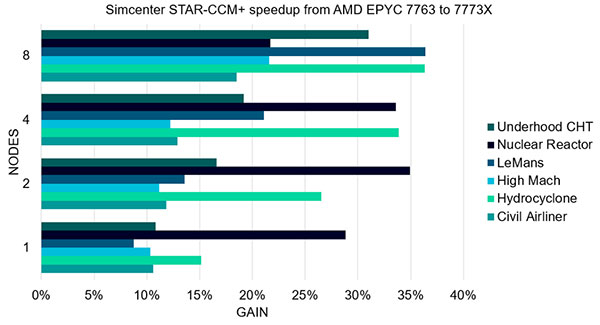
That’s right, with this new technology, simulations complete up to 35% faster.
However, a new HPC system is not something that everyone can afford. Even those that can are likely to be hesitant if they don’t need all that power all of the time. And when management does sign off on a new cluster, you need to keep using it for years to maximize your investment. This means building around the average job, not the maximum one.
That’s not what business leaders want to hear though. New products need to be developed as quickly as possible to stay ahead of the curve. And where simulation is a key part of the development process, speeding it up will ultimately lead to getting the product to market sooner—gaining a crucial edge on the competition.
What if there was an alternative solution where companies could only pay for the extra power when they need it? What if the simulation phase could be speeded up without exceeding project budgets?
Advanced simulation shouldn’t be limited only to those companies who can afford the biggest and best HPC systems. Siemens wants Simcenter STAR-CCM+ to be accessible to all, so that everyone can benefit from the innovations it delivers.
Cloud services to rapidly run CFD can provide an answer to this challenge.
Virtual machines powered by 3rd Gen AMD EPYC processors with AMD 3D V-Cache technology have all the cores and RAM you need, combined with a high-bandwidth, low-latency network backbone to deliver true HPC-class performance and scalability.
Instead of millions of dollars in hardware purchase, users rent resources on a service as and when they need them. So even the smallest consulting firm can afford to run massive and complex simulations at the same speed as the world’s largest companies.
Simcenter STAR-CCM+ relies on technological innovations to keep up with its demands. As we improve the multiphysics CFD capabilities with every release, advances are needed in the hardware it runs on to allow users to get the most out of it.
Without innovations like these new processors from AMD, simulation times would likely continue to get longer and longer the more complex models become. And without cloud platforms, it’s difficult for many companies to take full advantage of what AMD is offering.
This collaboration between Siemens and AMD is pushing the possibilities of simulation to the limit and beyond. Because the more users who have access to fast, powerful simulation, the better engineering innovations can be discovered and realized, and the more people across the world can benefit from them.


Simcenter™ software, from Siemens Digital Industries Software, uniquely combines system simulation, 3D CAE and test to help you predict performance across all critical attributes earlier and throughout the entire product lifecycle. By combining…
Making the Case for Artificial Intelligence and Machine Learning in Engineering
In this paper, Siemens Digital Industries Software and Digital Engineering will provide an overview of how AI/ML-enabled software can improve design workflows, while also addressing common questions and concerns around implementing this technology in an engineering organization.






About Us · Contact Us · Editorial Team · Advertising · Privacy Policy · Subscriber Services · © 2026 Digital Engineering 24/7 · Peerless Media