Helping design and engineering professionals discover, evaluate and specify technologies and processes that shorten the design cycle and enable success.



April 2026 Special Focus Issue: Generative Design
In this Special Focus Issue, Digital Engineering takes a look at how generative design solutions can be used across different types of design problems and with a variety of manufacturing approaches to accelerate design space exploration, and…

Electrum utilizes the 3DEXPERIENCE platform on the cloud to develop their new electric motorcycle
Electrum, a new brand of electric motorcycles, utilizes the 3DEXPERIENCE platform. Their mission is to support Indonesia’s shift to low-carbon, sustainable transport and to ultimately help the country’s government achieve its vision of net…
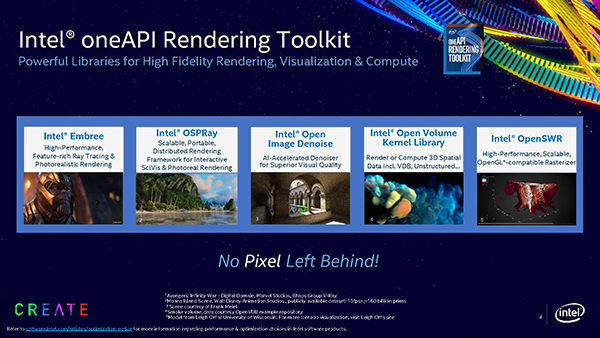
This week, as SIGGRAPH kicks off, Intel makes a move on the GPU-dominated rendering market with the introduction of oneAPI Tool Kit, a scalable HPC platform.
"The toolkit is designed to accelerate workloads with large data sets and high complexity that require built-in artificial intelligence (AI) through a set of open-source rendering and ray-tracing libraries to create high-performance, high-fidelity visual experiences," according to the product home page, now marked as Beta.
It's a "unified standard-based programming modem" that works with all "XPUs, including CPUs, GPUs, FPGAs (field programmable gate arrays), and other accelerators," Intel states.
In the online press briefing with industry press, James Jeffers, Sr. Principle Engineering and Sr. Director for Advanced Rendering and Visualization, Intel, said, "Our focus isn’t on just the CPUs or just the GPUs. The goal is, no transistor left behind."
Intel introduces oneAPI Tool Kit as SIGGRAPH 2020 virtual kicks off. Image courtesy of Intel.There is, of course, no such thing as an Intel XPU, but by Intel's definition, all CPUs and GPUs are XPUs -- microprocessors with the potential to accelerate workloads. Positioning the new oneAPI Tool Kit as XPU-friendly sidesteps the long-standing CPU-GPU rivalry in rendering and visualization.
"oneAPI is an open specification and we are willing to work with and encourage vendors to apply that. We believe the market will ask them to do that as well," said Jeffers.
Intel is inviting early users to give the product a try. "Develop, run, and optimize your Intel oneAPI solution in the Intel DevCloud -- a free development sandbox with access to the latest hardware from Intel and Intel oneAPI software," says Intel on its site.
Rendering or machine-learning code that relies on GPU acceleration (for example, CUDA-based solutions running on NVIDIA GPUs) will likely require rework and revision to be oneAPI-compatible. Therefore, the success of oneAPI depends on the ease of converting existing codes, and the following and adoption it attracts over time.
"The Intel DPC++ Compatibility Tool is a new tool that will assist developers in migrating some portion of their existing code written in CUDA [programming language for NVIDIA GPUs] to the newly developed DPC++ language. Our experience has shown that this can vary greatly, but on average, about 80-90% of CUDA code in applications can be migrated by this tool. Completion of the code and verification of the final code is expected to be manual process done by the developer," explained Jeffers.
Early adopters of Intel's oneAPI include Bentley (for its online real-time car configurator) and Chaos Group (makers of the V-Ray renderer).
"We have fairly close relationships with CAD vendors. Autodesk is one of them. Dassault Systemes is a close partner," said Jeffers.
Intel plans to release OSPRay Studio, a raytracing and photorealistic rendering environment, into the oneAPI Tool Kit in the near future.


Intel's innovation in cloud computing, data center, Internet of Things, & PC solutions is powering the smart and connected digital world we live in.
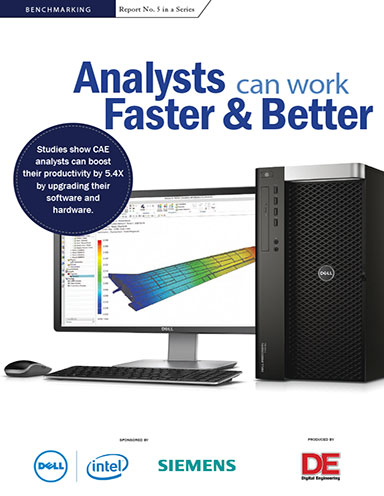
Benchmarking Report 5: Analysts Can Work Faster & Better
As the benchmarking results in this report show, you can slash the time spent on certain simulation runs by more than 81% when you upgrade to the latest Dell workstation technology and Siemens Simcenter simulation software, compared to using older hardware and software.

Kenneth Wong is Digital Engineering's resident blogger and senior editor. Email him at [email protected] or share your thoughts or suggestions at digitaleng.news/facebook.
Follow DE
Join over 90,000 engineering professionals who get fresh engineering news as soon as it is published.






About Us · Contact Us · Editorial Team · Advertising · Privacy Policy · Subscriber Services · © 2026 Digital Engineering 24/7 · Peerless Media