Helping design and engineering professionals discover, evaluate and specify technologies and processes that shorten the design cycle and enable success.



Digital Engineering April 2026
In the latest issue of Digital Engineering, we take a look at the latest innovations in design for additive manufacturing, including the use of natural language inputs, social media cosplayers, and AI integration. The issue also includes a feature…

January Special Focus Issue: Design for Additive
In this Special Focus Issue of Digital Engineering, learn about the latest advancements in design for additive manufacturing, including new software tools, additive in automotive, custom medical devices, and more.
The ProJet 7000 series is an upscaled version of the ProJet 6000. A build envelope of 15 x 15 x 10 in. (380x380x250 mm) should give users the room to create larger objects, using the ubiquitous VisiJet material. The ProJet 7000 series offers three versions: the SD, the HD and the MP.
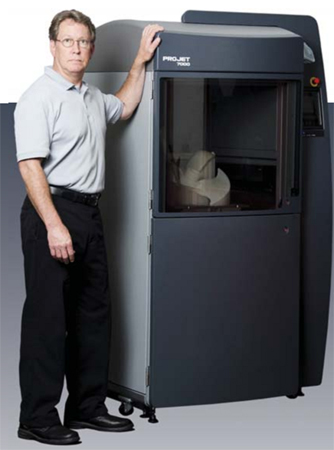
The SD offers 0.125 mm resolution with 0.100 mm layers and is the entry level option. According to the company, the HD is for, “ultra-high definition precision part manufacturing” with a resolution of 0.075 mm and 0.050 mm layers. The MP offers the same layer and resolution features as the HD, but has been designed for use in dental and medical industries.
“The powerful combination of push button simplicity and SLA printability makes the ProJet 7000 value very compelling to our professional and production users,” stated Buddy Byrum, vice president Product & Channel Management for 3D Systems. “Customers asked us for larger and more part printing capacity, and our ProJet 7000 delivers. Its expanded print format delivers both larger models and more parts in a single print for enhanced overall productivity.”
3D Systems is billing the ProJet 7000 as a crossover system. As expected from a 3D printer, it can create prototypes and parts using stereolithography, but it can also be used to create molds for RTV casting of plastic parts and investment casting for metal parts.
To someone who has been wondering if the future of additive manufacturing is really just bigger and bigger machines, this crossover potential seems like a solid idea. The more uses a customer can get out of a machine, the better ROI.
Below you’ll find the first of a seven-video tour of the 3D Systems booth at Euromold 2011.
Source: 3D Systems


John Newman is a Digital Engineering contributor who focuses on 3D printing. Contact him via [email protected] and read his posts on Rapid Ready Technology.
Follow DE
Join over 90,000 engineering professionals who get fresh engineering news as soon as it is published.






About Us · Contact Us · Editorial Team · Advertising · Privacy Policy · Subscriber Services · © 2026 Digital Engineering 24/7 · Peerless Media