Helping design and engineering professionals discover, evaluate and specify technologies and processes that shorten the design cycle and enable success.



May 2026 Special Focus: Artificial Intelligence in Design and Simulation
In this Special Focus Issue, learn about the latest developments in the integration of artificial intelligence into engineering workflows.

Design & Simulation Software Guide 2025
In this Special Issue, Digital Engineering presents its second annual guide to design and simulation software vendors.
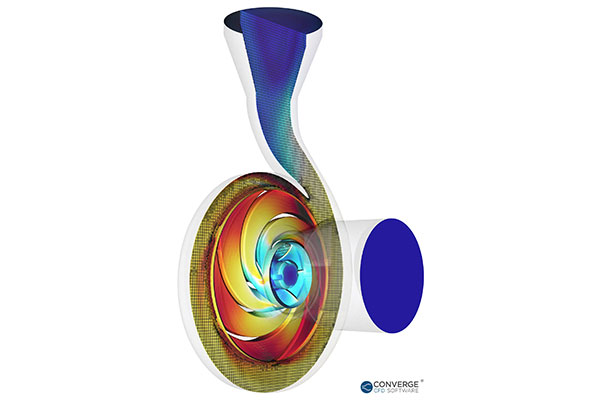
Convergent Science has released CONVERGE 4, a new major version of its computational fluid dynamics (CFD) software. CONVERGE 4 expands on the modeling capabilities of previous versions and includes new solver options offering enhanced simulation speed and accuracy, the company reports.
Among the new features is the Under-Relaxation Steady (URS) solver, which has demonstrated a speedup of up to 100 times for certain steady-state simulations compared to the previous solver. Various CONVERGE’s chemistry and combustion models have been enhanced, enabling engineers to simulate alternative fuels such as hydrogen and ammonia. For more accurate battery pack modeling, the electric potential solver has been upgraded and a newelectrochemical model has been added in this release.
Version 4 also introduces multiphase models for boiling and cavitation, as well as new tools for wind and wave specification—all for modeling applications in the marine and energy sectors. Furthermore, the pre- and post-processing capabilities in CONVERGE 4 have been expanded, including the implementation of a customized version of ParaView in CONVERGE Studio, providing users a solution for data analysis and visualization.
Version 4 also includes a new technique called cross-stream synchronization that can accelerate transient simulations in which the time-scales are very different for different regions of the domain, for example, in some conjugate heat transfer cases.
The SAGE detailed chemistry solver can now be used to solve liquid-phase chemistry, applicable to problems including carbon sequestration and ocean acidification, and solid-phase chemistry, useful for modeling wildfires and battery reactions during thermal runaway.
In version 4, a variety of tools for wind and wave specification—crucial for conducting realistic offshore simulations—have also been integrated into the software.
CONVERGE 4 additionally contains a variety of new discrete phase models for phenomena including condensation and urea deposit growth in aftertreatment systems, along with the capability to model parcels in multiple reference frame simulations. The electric potential solver has been enhanced in version 4 to allow you to solve for a pair of coupled electric potential fields, which is valuable for battery simulations.
For additional product details, click here.
Sources: Press materials received from the company and additional information gleaned from the company’s website.

CONVERGE is a multipurpose computational fluid dynamics (CFD) code with innovative features including a fully coupled automated mesh created at runtime and Adaptive Mesh Refinement (AMR).

DE's editors contribute news and new product announcements to Digital Engineering. Press releases may be sent to them via [email protected].
Follow DE
Join over 90,000 engineering professionals who get fresh engineering news as soon as it is published.






About Us · Contact Us · Editorial Team · Advertising · Privacy Policy · Subscriber Services · © 2026 Digital Engineering 24/7 · Peerless Media