Helping design and engineering professionals discover, evaluate and specify technologies and processes that shorten the design cycle and enable success.


Sponsored

Digital Engineering April 2026
In the latest issue of Digital Engineering, we take a look at the latest innovations in design for additive manufacturing, including the use of natural language inputs, social media cosplayers, and AI integration. The issue also includes a feature…

January Special Focus Issue: Design for Additive
In this Special Focus Issue of Digital Engineering, learn about the latest advancements in design for additive manufacturing, including new software tools, additive in automotive, custom medical devices, and more.
3D Systems introduces its new Application Innovation Group (AIG), a set of consulting and manufacturing resources and services for the optimization of fluid flow part designs.
3D Systems says additive manufacturing (AM) offers the ability to achieve unprecedented improvements in fluid dynamics applications, impacting the performance, reliability and economics of fluid flow parts and systems. These improvements come from a thorough understanding of how processes change when moving from traditional designs and manufacturing processes to workflow based on a Design for Additive Manufacturing (DfAM) mindset.
AM makes it possible to isolate and solve challenging aspects of part performance without the limitations of conventional manufacturing. 3D Systems says this new ability to match design intent with manufacturability brings new functionality to parts and systems in the form of reduced assembly for production lines, less weight in components, greater reliability due to reduced connection points and organic channel designs.
To help manufacturers move to the DfAM mindset, 3D Systems is now offering its 30+ years of experience as a consultancy, the Application Innovation Group. The company offers a systematized protocol and extensive application engineering resources.
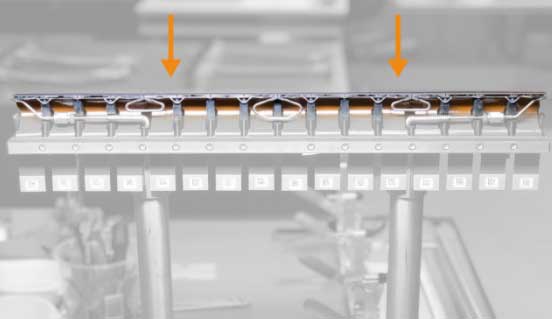
Consider the example from CERN, the European Organization for Nuclear Research. CERN worked with 3D Systems to develop and produce 3D printed titanium cool-bars for Large Hadron Collider experiments in advanced particle detection. The research team needed to preserve particle reactions for study, which required a way to cool the detection area to -40C.
The goal was complicated by four special factors. First, the cool-bars had to fit in limited space. Second, there was a great deal of heat dissipation required in a short space. Third, there was a need for temperature uniformity over the length of the photo-detection strip. And fourth, there were flatness requirements to preserve detector efficiency and resolution.
The CERN team began with its ideal part design.
“This design was so beautiful, but it was not producible in the usual ways,” says Antonio Pellegrino, a leader on the LHCb SciFi tracker project at CERN. Wall thinness was a particular challenge, as the thinness required could not be machined for the length (263 mm) of the part.
The CERN team did not have experience with 3D printing, so it partnered with 3D Systems' AIG, who helped to ensure the 0.25-mm wall thickness was attained with reliable leak-tightness, and flatness with 50-micron precision. 3D Systems also assisted with final production of more than 300 units using additive manufacturing.
Another recent AIG project helped the German Aerospace Center (Deutsches Zentrum für Luft- und Raumfahrt) integrate propulsion system cooling channels for increased performance, and reduce parts count for reduced weight, increased reliability and improved fuel efficiency. A parts count reduction from 30 to 1 led to a final weight reduction of 10% and removed known points of failure at fastening sites to alleviate related quality control measures and improve system performance.
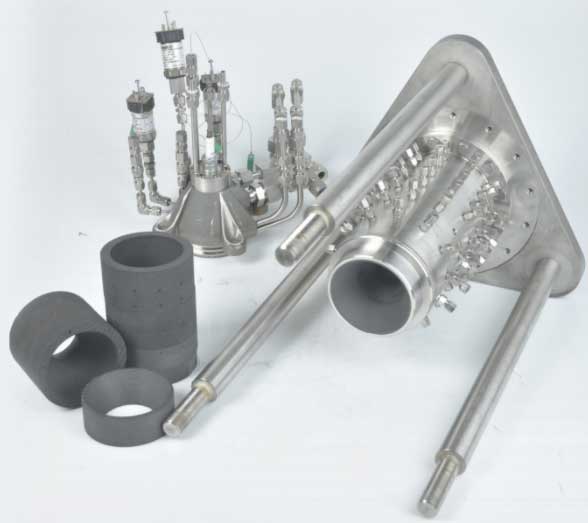
3D Systems says the benefits of using additive manufacturing for fluid flow applications are “numerous, intertwined and frequently motivated by a combination of enhancements to performance, economics and reliability.”
The 3D Systems Application Innovation Group offers engineering and manufacturing services including AM parts manufacturing on demand in ISO 13485 and EN/AS9011 certified facilities; training to help companies integrate design for additive manufacturing and portfolio screening into their operations; and various technology transfer services for projects at any stage.
The services of the 3D Systems Application Innovation Group are now available to all manufacturers, whether or not they are an existing 3D Systems customer.
Sources: Press materials received from the company and additional information gleaned from the company’s website.

From digitization, design and simulation through manufacturing, inspection and management, our comprehensive portfolio of technologies provides a seamless, customizable workflow designed to optimize products and processes while accelerating…
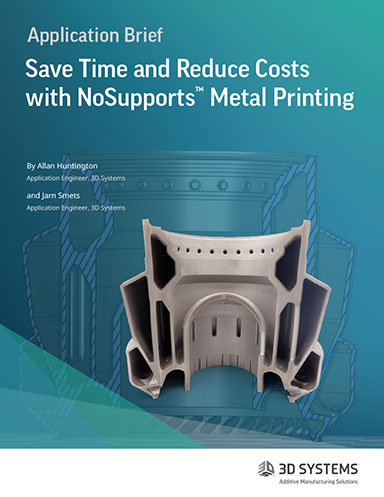
Save Time and Reduce Costs with NoSupports™ Metal Printing
Metal 3D printing is a high energy process in which it is possible for unmanaged heat and stress to build up and impact part quality, this guide presents a step-by-step methodology for how to apply NoSupports to a hot end section of a larger turbomachinery part.

DE's editors contribute news and new product announcements to Digital Engineering. Press releases may be sent to them via [email protected].
Follow DE
Join over 90,000 engineering professionals who get fresh engineering news as soon as it is published.






About Us · Contact Us · Editorial Team · Advertising · Privacy Policy · Subscriber Services · © 2026 Digital Engineering 24/7 · Peerless Media