Helping design and engineering professionals discover, evaluate and specify technologies and processes that shorten the design cycle and enable success.



Digital Engineering April 2026
In the latest issue of Digital Engineering, we take a look at the latest innovations in design for additive manufacturing, including the use of natural language inputs, social media cosplayers, and AI integration. The issue also includes a feature…

January Special Focus Issue: Design for Additive
In this Special Focus Issue of Digital Engineering, learn about the latest advancements in design for additive manufacturing, including new software tools, additive in automotive, custom medical devices, and more.
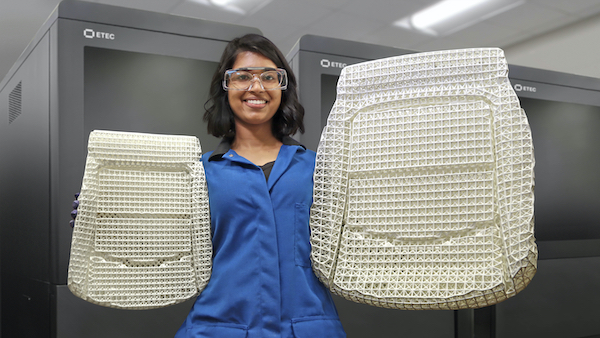
Desktop Metal has released FreeFoam, a new family of photopolymer resins that produces durable and dimensionally accurate closed cell foam parts without tooling.
According to the company, parts made with FreeFoam are already being manufactured with companies in the automotive and furnishing markets, with broad commercial availability of FreeFoam material slated for 2023. You can see a vide of the printing process here.
“FreeFoam is one of the most exciting and commercially significant photopolymer solutions to come to market in the industrial printing space in years,” said Ric Fulop, Founder and CEO of Desktop Metal. “The market for conventionally manufactured foam has many challenges – from expensive molds that limit designs, to dense and heavy foams that absorb water and are expensive to ship and drive, to the inability to easily dial in strength and Shore hardness values in specific foam designs.
“We’re especially excited to reveal our FreeFoam innovation in Metro Detroit, where our new foam material can help lightweight cars and trucks while preserving the performance and comfort expected in foam seating. With FreeFoam, Desktop Metal is ready to liberate the foam market from its many challenges.”
FreeFoam was invented and developed by Texas-based Adaptive3D, a subsidiary of Desktop Metal that was acquired in 2021.
FreeFoam resins are 3D printed similar to other photopolymer resins using DLP. After 3D printing, FreeFoam parts can be expanded on-demand during a brief heating cycle in an oven at approximately 160-170°C (320-340°F). The printed parts contain dispersed heat-activated foaming agents that create closed cell pores inside the material. This process causes FreeFoam resins to consistently expand 2 to 7 times their as-printed sizes depending on the grade of resin, achieving final parts within desired tolerances, the company said.
This allows 3D printers to produce much larger final foam parts than the printers’ original build areas and will enable foam products to be shipped at compact sizes and expanded at the final point of assembly or commercial use.
While preliminary specifications for FreeFoam are now available, Desktop Metal plans to offer several grades of FreeFoam resins enabling different Shore hardness values and other specific materials properties such as water resistance for the outdoor furnishing market.
FreeFoam is part of the recently launched DuraChain category of one-part, one-pot photopolymers that leverage a Photo Polymerization-Induced Phase Separation process. When illuminated during DLP printing, these materials phase separate at the nano level into a material that cures into a resilient, high-performance polymer network. DuraChain enables FreeFoam parts to be foamed with control in an oven without a mold.
FreeFoam will initially be 3D printable exclusively on the ETEC Xtreme 8K top-down DLP system from Desktop Metal’s polymer 3D printing brand. You can learn more here.
Sources: Press materials received from the company and additional information gleaned from the company’s website.


Desktop Metal was started to address a problem—how to make metal 3D printing accessible for engineering teams. In 2013, CEO Ric Fulop began collaborating with world-leading experts in materials science, engineering, and 3D printing. Their work…

DE's editors contribute news and new product announcements to Digital Engineering. Press releases may be sent to them via [email protected].
Follow DE
Join over 90,000 engineering professionals who get fresh engineering news as soon as it is published.






About Us · Contact Us · Editorial Team · Advertising · Privacy Policy · Subscriber Services · © 2026 Digital Engineering 24/7 · Peerless Media