Helping design and engineering professionals discover, evaluate and specify technologies and processes that shorten the design cycle and enable success.



Digital Engineering April 2026
In the latest issue of Digital Engineering, we take a look at the latest innovations in design for additive manufacturing, including the use of natural language inputs, social media cosplayers, and AI integration. The issue also includes a feature…

January Special Focus Issue: Design for Additive
In this Special Focus Issue of Digital Engineering, learn about the latest advancements in design for additive manufacturing, including new software tools, additive in automotive, custom medical devices, and more.
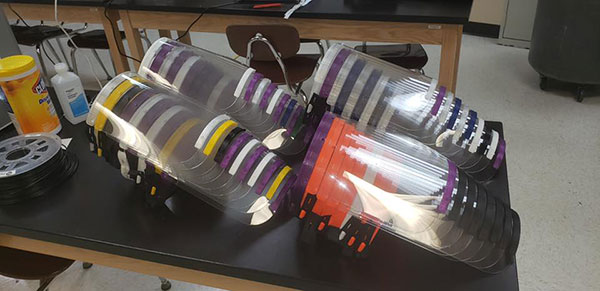
Students at Camdenton High School are using 3D printers to help produce hundreds of face shields for healthcare workers at Lake Regional Hospital in Osage Beach, MO. The printers were provided by nearby Camdenton Middle School, which received them as part of a $16 million grant from the MU College of Education’s eMINTS National Center.
“To see the face shields being used by medical professionals is encouraging and the reaction has been super positive,” says Zane Foulk, a senior at Camdenton High School and member of the Camdenton For Inspiration and Recognition of Science and Technology (FIRST) Robotics team. “We have been making roughly 40 face shields a day and will keep going until we run out of material or the hospitals get what they need.”
What started as a simple ask from Lake Regional Hospital for 150 face shields quickly snowballed into additional requests from first responders, dentist offices and even U.S. troops serving overseas in Afghanistan.
The grant project, which started in 2018, trains middle school teachers to incorporate technology, such as 3D printing, into their classrooms. Michelle Kendrick, program coordinator for eMINTS, Enhancing Missouri’s Instructional Networked Teaching Strategies, collaborated with Johannes Strobel, a professor in the College of Education, to partner with 27 middle schools throughout rural Missouri and Kansas.
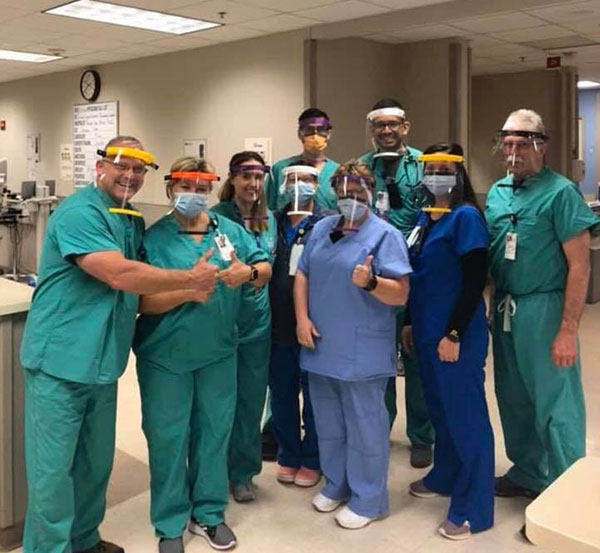
“We are teaching students that they are not just consumers of new technologies, but they can use it to produce something that is helpful and can save lives,” Strobel says. “This is a time to organize and mobilize our resources to support the health care workers in our communities.”
Strobel has been working with 16 3D printers in the College of Education to prototype new designs and produce face shields locally for MU Health Care, Boone Hospital and nursing homes. He and Kendrick are working with the Department of Education to share the 3D printing experiences in Camdenton with other eMINTS partner middle schools throughout rural Missouri and Kansas. Printers for the project were provided by Kansas City Audio-Visual.
In addition, Kendrick and Strobel are developing curriculum for middle school teachers that highlight the coronavirus pandemic response in relation to its impact on science, technology, engineering and math (STEM), as well as skills like problem-solving, teamwork and empathy.
“By tying this health crisis into the students’ curriculum, they are able to see that the work they are doing with 3D printers is having an immediate and direct impact on a real-world situation,” Kendrick said. “In addition to sparking interest in science and making schoolwork more engaging, we hope this experience teaches young students about empathy by asking them to consider the needs of health care workers and the sacrifices they have made to protect us all.”
Funding for this project was provided by the eMINTS National Center and Kansas City Audio-Visual. The content is solely the responsibility of the authors and does not necessarily represent the official views of the funding agencies.
Sources: Press materials received from the company and additional information gleaned from the company’s website.


DE's editors contribute news and new product announcements to Digital Engineering. Press releases may be sent to them via [email protected].
Follow DE
Join over 90,000 engineering professionals who get fresh engineering news as soon as it is published.






About Us · Contact Us · Editorial Team · Advertising · Privacy Policy · Subscriber Services · © 2026 Digital Engineering 24/7 · Peerless Media