Helping design and engineering professionals discover, evaluate and specify technologies and processes that shorten the design cycle and enable success.



Digital Engineering April 2026
In the latest issue of Digital Engineering, we take a look at the latest innovations in design for additive manufacturing, including the use of natural language inputs, social media cosplayers, and AI integration. The issue also includes a feature…

January Special Focus Issue: Design for Additive
In this Special Focus Issue of Digital Engineering, learn about the latest advancements in design for additive manufacturing, including new software tools, additive in automotive, custom medical devices, and more.
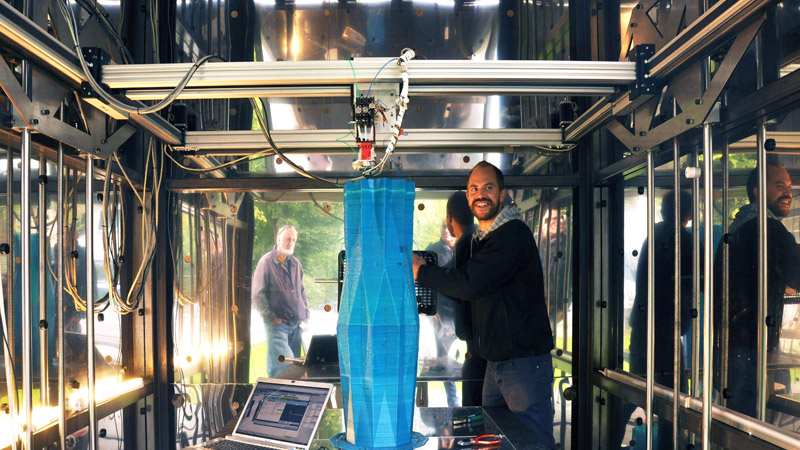
Let’s begin today’s Roundup by building on past work. The era of 3D printed homes may soon be upon us. Innovators have taken a number of different approaches to the idea, and Netherlands-based KamerMaker is another process looking to provide you with shelter.
KamerMaker is essentially a giant material deposition AM system, which uses plastic to build objects, or in this case, houses. The KamerMaker team wants to use recycled plastic as fuel, and has a goal of being able to print a room each day when the project is complete. DUS, the company backing the system, intends to begin construction on a building within the next six months and expects finish construction over the next three years.
Next up, Organovo has been hard at work developing new organic processes for AM. The company’s newest success is the printing of very small functional human livers. By small, I mean half a millimeter by 4 millimeters. While obviously not useful for transplants, the organs have potential for various medical applications, including drug research and development.
"We've combined three key features that set our 3D tissues apart from 2D cell-culture models,” said Dr. Sharon Presnell, CTO and executive vice president of research and development. First, the tissues are not a monolayer of cells; our tissues are approximately 20 cell layers thick. Second, the multi-cellular tissues closely reproduce the distinct cellular patterns found in native tissue. Finally, our tissues are highly cellular, comprised of cells and the proteins those cells produce, without dependence on biomaterials or scaffold for three-dimensionality. They actually look and feel like living tissues."
Moving on to less weighty matters, have you ever wanted custom speakers to match your PC or décor? Autodesk has been playing around with an Objet Connex 500 and built some shiny new speakers at the low cost of $2,200. For added fun, an audioreactive LED system (by LumiGeek) was added to the speakers to give them extra pop. While not everyone might want to spend that much for a set of what are probably mediocre speakers, this is the sort of customizability that may yet make 3D printers a household item.
Finally, how about a new tonearm to go along with your AM-built speakers? VPI Industries has begun to experiment with using 3D printing to build low-cost tonearms. For those of you without a vinyl fixation, a tonearm is the thing that holds the needle for playing actual records. The company’s first trial tonearm required 24 hours to print and held up well under use.
Companies in niche markets such as VPI Industries, which is pretty much dedicated to providing record playing equipment, may well come to love AM for the technology’s power to keep them up and running at reduced overhead costs. Any industry that doesn’t require huge runs of product can offer custom goods, and, outside of hand crafted items, AM is king of customization.
Below you’ll find a bonus video featuring a 3D printed gear cube with 28 moving parts.
Sources: Wired, Digital Trends, Organovo, KamerMaker


John Newman is a Digital Engineering contributor who focuses on 3D printing. Contact him via [email protected] and read his posts on Rapid Ready Technology.
Follow DE
Join over 90,000 engineering professionals who get fresh engineering news as soon as it is published.






About Us · Contact Us · Editorial Team · Advertising · Privacy Policy · Subscriber Services · © 2026 Digital Engineering 24/7 · Peerless Media