Helping design and engineering professionals discover, evaluate and specify technologies and processes that shorten the design cycle and enable success.



Digital Engineering April 2026
In the latest issue of Digital Engineering, we take a look at the latest innovations in design for additive manufacturing, including the use of natural language inputs, social media cosplayers, and AI integration. The issue also includes a feature…

January Special Focus Issue: Design for Additive
In this Special Focus Issue of Digital Engineering, learn about the latest advancements in design for additive manufacturing, including new software tools, additive in automotive, custom medical devices, and more.
Stratasys Ltd., a company focused on polymer 3D printing solutions, has introduced three new 3D printers that address a large portion of the multibillion-dollar market opportunity in additive manufacturing of end-use parts. The systems collectively are aimed at accelerating the shift from traditional to additive manufacturing for low-to-mid-volume production applications underserved by traditional manufacturing methods.
“We are accelerating into the additive manufacturing 2.0 era, in which we see global manufacturing leaders move beyond prototyping to fully embrace the agility that 3D printing brings to the entire manufacturing value chain,” says Stratasys CEO Dr. Yoav Zeif. “The disruptions we are seeing today on both the supply and demand side of global supply chains are a clear sign that the status quo isn’t working. Additive manufacturing gives companies the total flexibility to decide when, where, and how to produce parts. That’s why we’re committed to being the complete provider of polymer 3D printing solutions for our world-class customer base.”
Last year, Stratasys accrued more than 25% of its revenue from manufacturing-related applications. With an integrated portfolio of 3D printing hardware, software, materials and services solutions, Stratasys estimates that its manufacturing revenue growth will outpace other segments, growing at an annual rate of over 20% starting in 2022.
Illustrating Stratasys’ ability to quickly execute on integrating its acquisition of Origin, Stratasys introduces the Stratasys Origin One 3D printer, designed for end-use manufacturing applications. The new 3D printer uses proprietary P3 technology and a software-first architecture to produce parts at volume in a wide range of open, certified third-party materials with accuracy, detail, finish, repeatability and time to part. That technology combined with hardware upgrades enabled Stratasys to optimize virtually all aspects of the system in the new version of the product.
“We have been laser-focused on meeting stringent accuracy and repeatability criteria for 3D-printed connectors that require double-digit micron accuracy,” says Mark Savage, Global Center of Excellence leader for additive manufacturing at TE Connectivity, a company involved in connectors and sensors and customer of both Stratasys and Origin. “Stratasys and Origin have been great partners in helping us achieve these targets and demonstrating the possibilities of using additive manufacturing at the scale of tens of thousands of parts. Today, we’re seeing the hardware, the software and the materials from Stratasys really come together to begin making production scale a reality for us.”
Internal Stratasys estimates suggest a $3.7 billion market opportunity by 2025 for the production-oriented segments suited to the Origin One, including automotive, consumer goods, medical, dental and tooling applications. Stratasys plans to begin taking orders for the printer, post-processing and related software through its worldwide channel beginning in May.
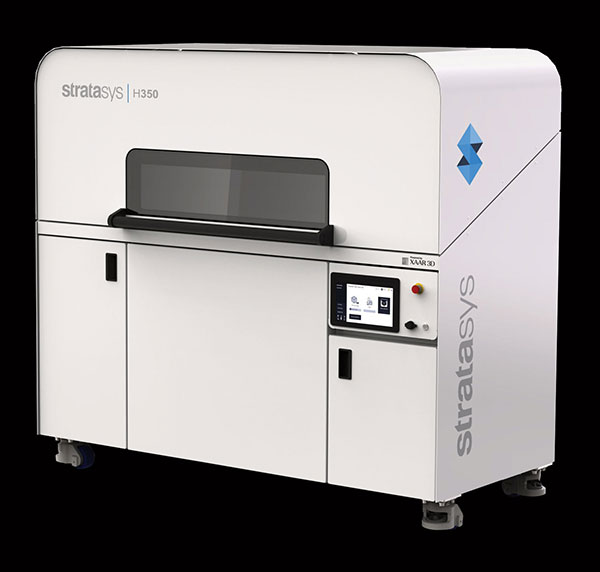
Stratasys also introduced today the Stratasys H350 3D printer, the first 3D printer in Stratasys’ new H Series Production Platform. Powered by SAF technology, the new H350 printer delivers production-level throughput for end-use parts. It’s designed to give manufacturers production consistency, a predictable cost per part, and complete control for the production of thousands of parts. The H350 printer includes about a dozen different parts 3D-printed with SAF technology.
The H350 printer has been in beta testing since early 2021 with service bureaus and contract manufacturers in Europe, Israel and the United States, including Stratasys Direct Manufacturing, which is now selling parts on demand using the system. It is expected to ship more broadly to customers in Q3 of this year. Applications include end-use parts such as covers, connectors, hinges, cable holders, electronics housings and ducting.
“We have ambitious plans to grow our business and we believe adding a Stratasys H350 can be a key component of that growth,” says Philipp Goetz, owner of Goetz Maschinenbau, a Germany-based service bureau. “We have fulfilled orders for both large parts as well as up to several hundred smaller parts. We have been impressed with the performance of the system and SAF technology, with consistent parts throughout the build volume. The system has also been remarkably reliable.”
Stratasys is using certified third-party materials for H Series systems. The initial material is Stratasys High Yield PA11, which is a bio-based plastic made from sustainable castor oil.
The third new system announced is the Stratasys F770 3D printer, which builds on Stratasys’ capabilities with reproducibility via industrial-grade FDM technology. Ideal for big parts, this newest FDM 3D printer features the longest fully heated build chamber on the market and a generous build volume of over 13 cubic feet (372 liters).
The new system, priced under $100,000, is designed for prototyping, jigs and fixtures, and tooling applications requiring standard thermoplastics. Soluble support material simplifies post processing, while GrabCAD Print software streamlines workflow and enterprise connectivity is enabled through the MTConnect standard and the GrabCAD SDK.
Sources: Press materials received from the company and additional information gleaned from the company’s website.


Every day, our customers find simpler, smarter approaches to stubborn design problemsand greater confidence to confront towering human and technological challenges. Less hindered by the usual constraints, they can imagine, design, iterate and…
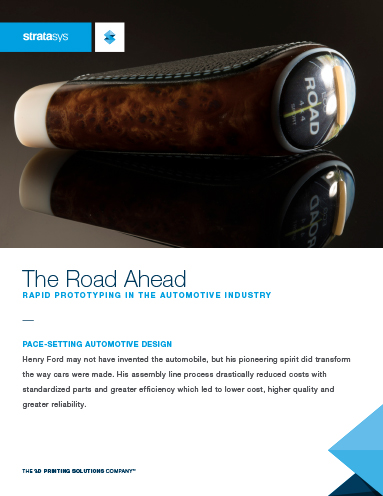
Rapid Prototyping in The Automotive Industry
Henry Ford may not have invented the automobile, but his pioneering spirit did transform the way cars were made. His assembly line process drastically reduced costs with standardized parts and greater efficiency which led to lower cost, higher quality and greater reliability.

DE's editors contribute news and new product announcements to Digital Engineering. Press releases may be sent to them via [email protected].
Follow DE
Join over 90,000 engineering professionals who get fresh engineering news as soon as it is published.






About Us · Contact Us · Editorial Team · Advertising · Privacy Policy · Subscriber Services · © 2026 Digital Engineering 24/7 · Peerless Media