Helping design and engineering professionals discover, evaluate and specify technologies and processes that shorten the design cycle and enable success.


Alert!
Digital Engineering ceased publication on July 1, 2026. This website remains available as an archive of engineering content.
For inquiries or information, please email [email protected].

Cut Retrieval-Augmented Generation (RAG) Hallucinations by 50%
Most teams hit the same wall with enterprise AI: LLMs that hallucinate, pipelines that don’t scale, and infrastructure that’s harder to design than the models themselves.

What Is Intelligent BOM Management? A Guide to Smarter Product Development
Learn how intelligent Bill of Materials (BOM) management helps teams collaborate, reduce errors, and bring innovative products to market faster with cloud-based PLM tools.
AMD announces a 6-gigawatt agreement to power Meta’s next generation of AI infrastructure across multiple generations of AMD Instinct GPUs.
This agreement expands on the companies’ existing strategic partnership and aligns roadmaps across silicon, systems and software to deliver AI platforms built for Meta’s workloads. The first deployment will use a custom AMD Instinct GPU based on the MI450 architecture to deliver AI platforms that are optimized for Meta’s workloads at gigawatt-scale.
Shipments supporting the first gigawatt deployment are scheduled to begin in the second half of 2026 powered by the custom AMD Instinct MI450-based GPU and 6th Gen AMD EPYC CPUs, codenamed “Venice,” running ROCm software and built on the AMD Helios rack-scale architecture. AMD Helios was developed jointly by AMD and Meta through the Open Compute Project to enable scalable, rack-level AI infrastructure.
“We are proud to expand our strategic partnership with Meta as they push the boundaries of AI at unprecedented scale,” says Dr. Lisa Su, chair and CEO, AMD. “This multi-year, multi-generation collaboration across Instinct GPUs, EPYC CPUs and rack-scale AI systems aligns our roadmaps to deliver high-performance, energy-efficient infrastructure optimized for Meta’s workloads, accelerating one of the industry’s largest AI deployments and placing AMD at the center of the global AI buildout.”
“We’re excited to form a long-term partnership with AMD to deploy efficient inference compute and deliver personal superintelligence,” says Mark Zuckerberg, founder and CEO of Meta. “This is an important step for Meta as we diversify our compute. I expect AMD to be an important partner for many years to come.”
Sources: Press materials received from the company and additional information gleaned from the company’s website.


AMD, or Advanced Micro Devices, has driven innovation in high-performance computing, graphics and visualization technologies. They develop high-performance computing and visualization products to solve some of the world’s toughest and most…
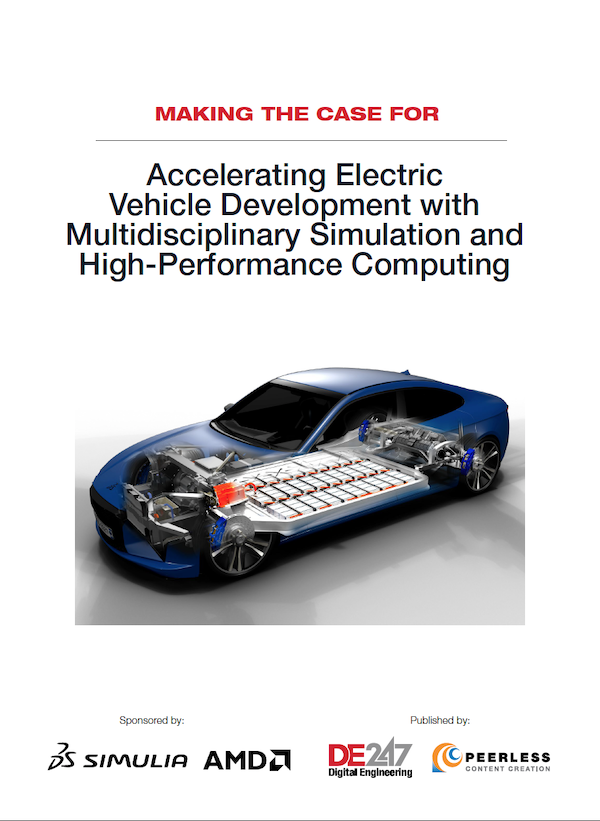
Accelerating Electric Vehicle Development with Multidisciplinary Simulation and High-Performance Computing
In this new Making the Case guide, learn how a unified approach to design and multidisciplinary simulation from Dassault Systèmes, combined with high-performance computing powered by AMD EPYC™ processors, can accelerate EV design.

DE's editors contribute news and new product announcements to Digital Engineering. Press releases may be sent to them via [email protected].
Follow DE






About Us · Contact Us · Editorial Team · Advertising · Privacy Policy · Subscriber Services · © 2026 Digital Engineering 24/7 · Peerless Media