Helping design and engineering professionals discover, evaluate and specify technologies and processes that shorten the design cycle and enable success.



Digital Engineering April 2026
In the latest issue of Digital Engineering, we take a look at the latest innovations in design for additive manufacturing, including the use of natural language inputs, social media cosplayers, and AI integration. The issue also includes a feature…

January Special Focus Issue: Design for Additive
In this Special Focus Issue of Digital Engineering, learn about the latest advancements in design for additive manufacturing, including new software tools, additive in automotive, custom medical devices, and more.
Even though the global movement to reduce greenhouse gas emissions is spurring a shift to renewable sources of energy, fossil fuels still generate 64 percent of today's electricity, according to The Brookings Institution. To meet the need for lower emissions, the energy industry is transitioning from coal and petroleum-based fuels to cleaner-burning natural gas.
This shift is rapidly transforming power plants. Energy producers are revamping existing plants and building new facilities from the ground up. At the core of these new facilities are massive industrial turbines that convert natural gas into electricity. The turbomachinery industry is highly competitive and the marketplace demands increased fuel efficiency, power generation, system reliability with reduced maintenance costs, as well as manufacturing and supply chain efficiency. This fast-paced metamorphosis presents a potent opportunity for manufacturers of gas turbines — yet traditional manufacturing methods can't keep up with the pace of innovation.
Gas turbines necessitate high-requirement superalloys and increasingly intricate shapes. Traditional manufacturing methods require long lead times and produce significant amounts of waste. In addition, they often involve multi-part assemblies that are costly to produce and yield turbines at higher risk for stresses and failures.
Leading-edge turbomachinery manufacturers are overcoming these challenges and accelerating the speed of innovation by pivoting to additive manufacturing (AM), often called 3D printing. Additive manufacturing delivers design flexibility, enhanced system performance and efficiency, greater reliability, faster time to market, and improved supply chain efficiency. AM revolutionizes a variety of applications in the production of turbomachinery components.
Combustors are fundamental to turbomachinery performance. Achieving the greatest possible fuel efficiency and power output depends on internal structures that promote combustion and burn clean. Combustion components require the highest possible quality and are made of strong, heat-resistant superalloys. However, when manufacturers use traditional machining processes to shape these materials, they typically shorten tool life and produce higher levels of waste.
-fuel-nozzle-demo-vertical-72dpi.png)
By contrast, additive manufacturing gives engineers unprecedented flexibility when it comes to designing combustors. Neither geometry nor type of superalloy presents any difficulty. Engineers can develop novel orifice shapes and mixing chambers, optimizing fuel and air mixtures. Replacing multipart assemblies (such as fuel injectors, swirlers, and mixers) with monolithic parts can improve yield, reduce labor costs, and assure the integrity of the component under the highest temperatures and operating pressures.
Inside the so-called "hot zones" of turbomachinery, the compressor and turbine stator vanes withstand intense thermal and structural pressures. Each vane or integrated stator must meet strict requirements for part integrity, accuracy, and quality to ensure the performance of the entire turbine.
The two traditional processes used to manufacture stator vanes present significant challenges. When it comes to investment casting, the major obstacle is time. This decades-old process relies on wax patterns, but the molds to stamp out the patterns are costly to machine and take weeks or months to produce. The other traditional method, manufacturing vanes, and rings from billet, is costly, especially considering the sturdiness of the superalloys required. Furthermore, these complex shapes must then be brazed together, which may sacrifice the strength and longevity of the final component.
With additive manufacturing, it is possible to reduce all these deficiencies by consolidating several parts into one. Consolidating part assemblies increases the manufacturing yield and significantly improves reliability. It also allows designers to build complex internal cooling channels — ones that are too difficult to machine — into these critical parts, improving thermal performance and maximizing efficiency.
Industrial gas turbine impellers are expensive to produce through conventional manufacturing methods. The shapes are complex and the metals extremely challenging to cut, resulting in waste rates as high as 80%. This is especially true with ducted, high-performance impellers, which are more costly to produce due to their closed shapes. Engineers often must make compromises in order to deliver cost-effective designs.
Additive manufacturing allows turbomachinery producers to design sophisticated ducted impellers that are much more efficient at compressing air. Optimizing the topology and applying lattice structure to this critical rotating equipment component also allows engineers to reduce its weight, thereby enabling higher RPM with less energy, and higher total system power output.
In particular, two AM processes offer significant advantages. Switching from machining billet to direct metal printing eliminates constraints involving the complexity of the part while speeding up production and reducing waste. When investment casting is called for — say, with larger impellers or higher-volume parts — 3D-printed wax patterns can be used with any alloy, delivering the flexibility and cost savings of a tool-free workflow.
Proper exhaust gas evacuation is just as important to the efficiency of gas turbines as a generous supply of intake air. Ducting is essential for both — and industrial gas turbines require large, complex casings and ducting that are often customized for the site.
Cutting-edge additive manufacturing processes enable architects and engineers to progress from CAD file to casting in days. Additive manufacturing gives engineers the freedom to create stronger, more reliable investment casting patterns for turbine casings and ducting, improving the efficiency of gas flow. Reducing the number of components also means fewer points of failure, resulting in greater uptime and reliability.
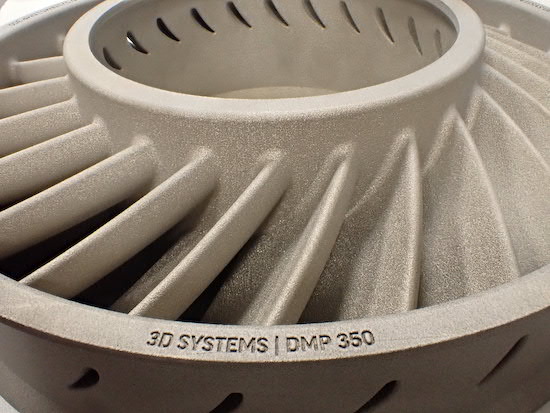
Consolidating multiple part assemblies into a single part increases manufacturing yield and component reliability, while the integration of highly efficient cooling channels improves thermal performance. Image courtesy of 3D Systems.
In the high-tech, competitive turbomachinery industry, increasing the pace of innovation is just as critical as making significant functional improvements. Additive manufacturing speeds up the design cycle by providing the ability to quickly and inexpensively produce complex parts for form, fit, and function testing. Whether you are manufacturing combustors, stator vanes, impellers, or castings, AM produces high-performance gas turbine components that meet or exceed design criteria. The entire power plant will reap the benefits in the form of improved fuel efficiency, lower maintenance costs, and reduced greenhouse gas emissions.


From digitization, design and simulation through manufacturing, inspection and management, our comprehensive portfolio of technologies provides a seamless, customizable workflow designed to optimize products and processes while accelerating…
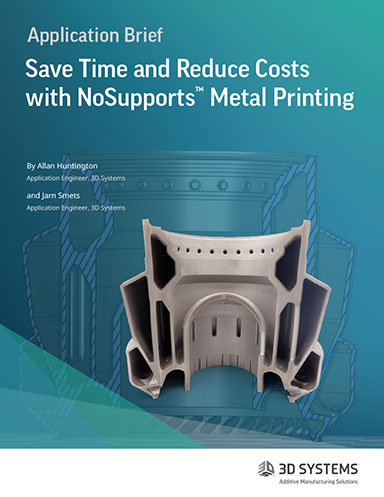
Save Time and Reduce Costs with NoSupports™ Metal Printing
Metal 3D printing is a high energy process in which it is possible for unmanaged heat and stress to build up and impact part quality, this guide presents a step-by-step methodology for how to apply NoSupports to a hot end section of a larger turbomachinery part.

Join over 90,000 engineering professionals who get fresh engineering news as soon as it is published.






About Us · Contact Us · Editorial Team · Advertising · Privacy Policy · Subscriber Services · © 2026 Digital Engineering 24/7 · Peerless Media