Helping design and engineering professionals discover, evaluate and specify technologies and processes that shorten the design cycle and enable success.



May 2026 Special Focus: Artificial Intelligence in Design and Simulation
In this Special Focus Issue, learn about the latest developments in the integration of artificial intelligence into engineering workflows.

April 2026 Special Focus Issue: Generative Design
In this Special Focus Issue, Digital Engineering takes a look at how generative design solutions can be used across different types of design problems and with a variety of manufacturing approaches to accelerate design space exploration, and…
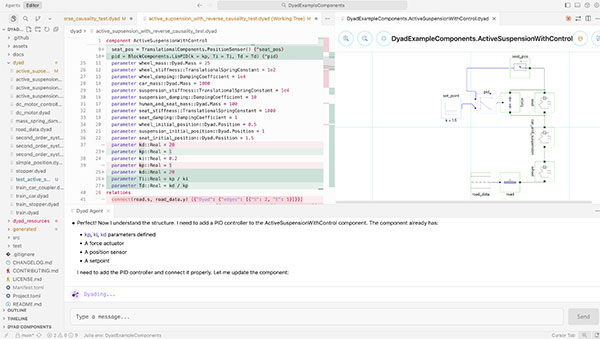
JuliaHub announces Dyad AI, an agentic engineering framework built for real-world physics. Dyad AI brings an AI for Science environment to product development, where agents model and interrogate systems, research formulations, derive governing equations, assemble models, run high-fidelity simulations, and verify physical consistency at each step.
With Dyad AI, engineers review and guide while agents execute the workflow to validate behavior, tune parameters, and refine designs through automated, physics-grounded loops. Dyad follows an engineer-in-the-loop pattern: agents iterate; humans direct system-level decisions.
“Dyad operates at the level of engineering, not code,” says Dr. Viral Shah, CEO and co-founder of JuliaHub. “Most agentic tools stop at producing syntax. Dyad AI engages equations, constraints, and physical laws, integrating simulation, parameterization, performance testing, and automated calibration so agents can co-design systems grounded in real physics. This is where AI for Science is moving, AI collaborating with engineers on models, behavior, and validation to close the loop between intent and verified performance.”
Dyad AI is an agentic environment built for hardware engineering workflows, unifying language, compiler, and simulation engine into one platform designed for AI-driven scientific work. The full generate > simulate > validate > refine loop runs natively inside the environment, enabling agents to continuously test, correct, and improve designs.
Dyad AI offers a physics-aware reasoning substrate: a unified interface, language, compiler, and simulation engine built natively for agentic engineering.The full scientific workflow runs inside a platform designed for AI to think, test, explain its reasoning, and improve.
Dyad AI enables agents to perform engineering tasks end-to-end:
Users provide direction while Dyad AI executes deep computational and scientific work. With this agentic hardware engineering, where modeling, simulation, analysis, and code generation operate inside a single, AI-native physics environment.
Dyad AI embeds scientific safeguards directly into its reasoning stack, including:
JuliaHub develops tools for scientific machine learning (SciML), digital twin modeling, and advanced simulations. Dyad supports high-performance multiphysics modeling, integrating traditional methods with AI-driven approaches to solve complex engineering challenges. JuliaHub, the cloud platform, streamlines Julia program development, deployment, and scaling while ensuring enterprise-grade security, governance, and compliance.
Sources: Press materials received from the company and additional information gleaned from the company’s website.


DE's editors contribute news and new product announcements to Digital Engineering. Press releases may be sent to them via [email protected].
Follow DE
Join over 90,000 engineering professionals who get fresh engineering news as soon as it is published.






About Us · Contact Us · Editorial Team · Advertising · Privacy Policy · Subscriber Services · © 2026 Digital Engineering 24/7 · Peerless Media