Helping design and engineering professionals discover, evaluate and specify technologies and processes that shorten the design cycle and enable success.


Alert!
Digital Engineering ceased publication on July 1, 2026. This website remains available as an archive of engineering content.
For inquiries or information, please email [email protected].

May 2026 Special Focus: Artificial Intelligence in Design and Simulation
In this Special Focus Issue, learn about the latest developments in the integration of artificial intelligence into engineering workflows.

April 2026 Special Focus Issue: Generative Design
In this Special Focus Issue, Digital Engineering takes a look at how generative design solutions can be used across different types of design problems and with a variety of manufacturing approaches to accelerate design space exploration, and…
Swarovski, known for its exquisitely cut crystal-encrusted watches, not only codesigned the Ariana Grande x Swarovski Capsule collection but also codeveloped the all-electric BMW i7’s headlights. It also added the strands of crystals embedded in the Mercedes-Benz S-Class Coupe’s headlights.
Mike Grove, applications engineering manager, Ansys, part of Synopsys, specializes in physics-based optics simulation. “Higher quality glass offers better photometric performance,” he notes. Therefore, crystals from a jeweler like Swarovski “have functional purposes in a car’s headlight but they’re more stylistic, because they give a luxury feel.”
Automotive lighting is not just a functional aspect of the car but part of the brand’s identity itself. In this article, we look at the role of simulation in the art and craft of automotive lighting, from headlights to ambient light.
For headlight design and analysis, Ansys offers Ansys Zemax OpticStudio, originally developed by Dr. Ken Moore, but later acquired by Ansys. Ansys Zemax OpticStudio is “the go-to solution for optical system design, whether it’s for cameras or for automotive projection lighting,” says Grove.
At a higher level, to view how different beams and projections affect the vehicle and its interior, Ansys offers Ansys Speos, a CAD-integrated optical simulation package with a range of dedicated lighting design tools. The company also offers Ansys AVxcelerate, a platform for testing and validating sensors and lighting in real time.
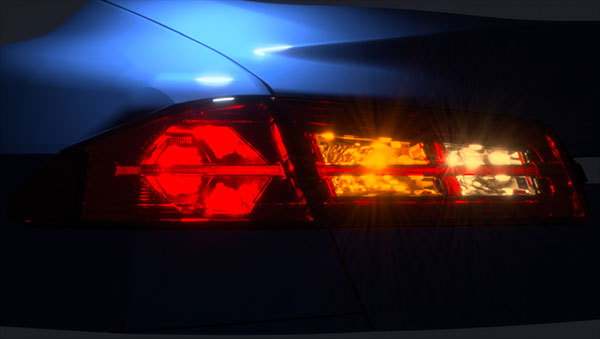
Ansys Speos rendering of a rear lamp showing the tail, stop, turn, and backup light functions activated. Image courtesy of Ansys.
“Once you have designed the light, you can use AVxcelerate to test how it will perform in dynamic virtual environments,” says Grove. “You can get not only illuminance values in lux but also see how it projects lights into the environment, how it illuminates street signs, nearby vehicles, and pedestrians, and its impact on sensor perception.”
Ray tracing is the heart of light simulation, Grove points out. Therefore, most optical simulation benefits from GPU acceleration. “In order to calculate luminance, intensity, or brightness, to see how the light beams travel from the source to the environment, to see how it interacts with complex films and materials, you need to perform ray tracing, in millions, even trillions of light bounces,” he explains. “And the GPU is critical in ray-tracing acceleration.”
Performing ray-traced light simulation inside the vehicle cabin, for example, reveals light propagation uniformity, light leaks, hot spots, and dark spots. “You need to illuminate certain objects for the driver and the passengers. You need the light to be not too bright, not too dark, measurable by luminance. And you want a specific style, like cool white, warm white, or neutral white, or even a certain color.”
For light simulation, space packaging is an important factor, according to Grove. He means the physical space available for the lighting system in the overall vehicle’s design. “Depending on the space available, you have to rule out certain optical technology you can use, often leading to more sophisticated design, which can only be enabled by optical design and simulation,” he explains.
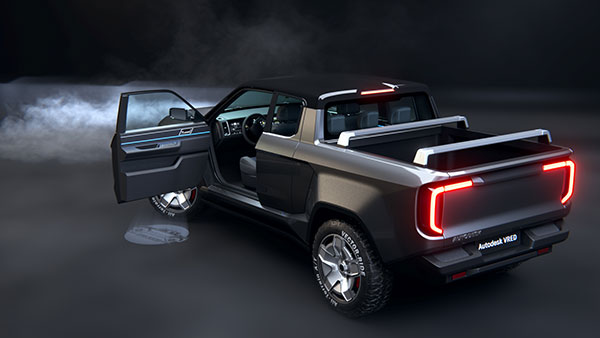
Autodesk Alias, a 3D design package for industrial design, is an industrial standard for automotive designers. For visualization, the company also offers Autodesk VRED, a virtual prototyping and visual simulation package with AR/VR (augmented reality and virtual reality) integration that lets you experience a vehicle before it’s fully built. Together, they enable a very fast, high-quality, and industry-proven automotive design workflow with minimal friction in exchanging data.
“In general, carmakers want to accelerate the vehicle program, to go to market faster with new designs and new products,” says Marek Trawny, director of Product Management, Automotive and Concept Design at Autodesk. “Our sweet spot is [that] we help our customers accelerate their design process from general design, including lighting visualization, to decision making.”
In simulation, input parameters determine the accuracy and reliability of the outcome. In structural mechanics or fluid flow simulation, the parameters may include loads, torque, turbulence, and properties of the liquid and the manufacturing materials. For light simulation, “The biggest black box for users is material properties that cannot be determined visually, such as scattering coefficients, refractive indices, color spectra, or density,” says Pascal Seifert, senior technical product manager, Autodesk.
“Accessing properties of light sources and LEDs, such as luminous flux or color temperature, is somewhat easier because this information is typically provided by the manufacturer. In this context, it is important that the application supports these units as input parameters and processes them correctly,” he adds.
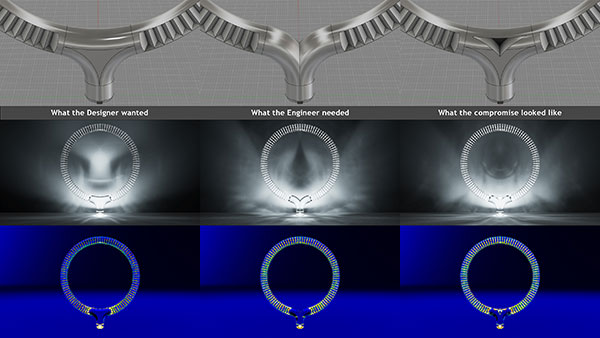
The Autodesk VRED rendering shows how small geometry changes influence simulation results and how it helps engineers study the detailed trade-offs. Image courtesy of Autodesk.
However, material properties are significantly more challenging, especially effects that occur within the volume of the material, such as absorption or imperfections introduced during the injection molding process. “This is why we work closely with manufacturers such as Covestro [a leading polymer material manufacturer], whose Imagio material library provides our mutual customers with measured materials that can be imported directly into VRED,” says Seifert.
As a visualization program, VRED can output standard video and image formats, but conveying the character of light in these forms proves inadequate at times. “[This is] because you’re working with intensities and colors that cannot be displayed on your normal RGB screen,” explains Seifert. “VRED renders light in a wide range of intensity and colors that can’t be displayed. A monitor can never be as bright as a real lamp, so what you see on the screen is usually an approximation and requires some expertise and interpretation, or at minimum an understanding of where these deviations originate.”
Though quantifiable values like brightness, measured in lumens, are important, storytelling is equally important. Vehicle makers want to market their brands to target demographics, known to respond to certain aesthetics. One option, to convey the feel of the car, is to let the customer experience the vehicle’s interior and exterior light immersively with head-mounted AR/VR displays. VRED supports Varjo, HTC Vive, and Meta Quest (formerly Oculus Quest), among others.
“It’s a first-person view of what it feels like to be in the car. In this case, it’s not about accuracy, but the story you want to tell,” says Seifert. For cabin light simulation, a detailed 3D model of the space is an essential component. “You’re designing the light in conjunction with the surrounding geometry, like the door panel or the trunk. So you want to see how light bounces off and reflects on these,” says Seifert. “On things like windshield, you want to avoid certain reflections, like chrome decor, because they could distort the view of the street.”
These potential issues can be addressed through different approaches, such as by employing special coating, using different manufacturing materials, changing the placement of the light source, or even altering the cabin geometry. “In the end, it is often necessary to find a compromise that remains cost-effective while still preserving the design intent,” notes Seifert.
A modern car equipped with sensors is capable of noticing certain things even before the driver does, and can take appropriate action on its own. For example, it can detect rain and activate the windshield wiper as needed. Looking into the future, Grove says, “I can personally foresee that lighting systems might behave that way. Using the same technology seen in smartphones, it might detect the displays are not bright enough and adjust the light for you.”
The increased personalization of consumer goods also suggests a similar trend in automotive. “We’re definitely seeing carmakers striving to deliver a personalized experience for the respective driver,” says Trawny. He says, “So when you’re getting in the car, you’re being recognized by the car, and things are getting adjusted accordingly. For example, the seat moves into the correct position for you. The whole interior of the car will be reshaped to your expectations, from lighting up to interaction with the multimedia devices.”


Autodesk is a world leader in 3D design, engineering, and entertainment software. They produce software for the architecture, engineering, construction, manufacturing, media, and entertainment industries.

Kenneth Wong is Digital Engineering's resident blogger and senior editor. Email him at [email protected] or share your thoughts or suggestions at digitaleng.news/facebook.
Follow DE






About Us · Contact Us · Editorial Team · Advertising · Privacy Policy · Subscriber Services · © 2026 Digital Engineering 24/7 · Peerless Media