Digital Engineering 24/7

Helping design and engineering professionals discover, evaluate and specify technologies and processes that shorten the design cycle and enable success.


Making the Case for CAE Tool Consolidation

Can integrating multiple simulation disciplines enhance the speed and efficiency of your product design and development process?

Making the Case for CAE Tool Consolidation
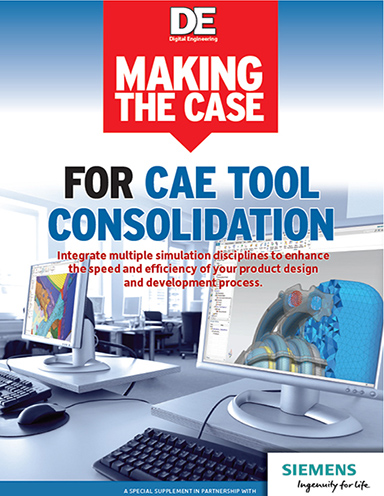
The complimentary white paper “Making the Case for CAE Tool Consolidation,” produced by DE editors in collaboration with Siemens, explores how you can unite and streamline a multidisciplinary product development process.||The complimentary white paper “Making the Case for CAE Tool Consolidation,” produced by DE editors in collaboration with Siemens, explores how you can unite and streamline a multidisciplinary product development process.

By Anthony J. Lockwood  

September 4, 2018

Dear DE Reader:

Because common wisdom has told you to get the best tool for the job, you built your workflows around a slew of disparate simulation tools. Data exchange is a drag, and multidisciplinary collaboration an aspiration. Tools with specialized algorithms help data exchange along. Collaboration remains a goal.

There are two complicating factors. One, while your decade-old process chugs along, clients want delivery last week. Two, product complexity today is a Mahler-like symphony of a thousand components — electrical and mechanical controls, embedded apps, sensors and assorted doodads — and you don't have a conductor.
 
“Making the Case for CAE Tool Consolidation,” produced by DE editors in collaboration with Siemens, argues that a “consolidated approach that provides a streamlined multi-discipline environment that is still open and flexible is needed to address the challenges of modern product design and development.” It cites such benefits as a reduced number of tools, decreased licensing costs, easier model reuse across disciplines, better collaboration and faster iterations. Does it convince? Yes.
 
This paper explains what's in Siemens' Simcenter 3D CAE environment for you. The dime tour is that Simcenter 3D is a scalable, open integration CAE solution. It enables a unified, shared platform across simulation disciplines. It integrates with your CAE and CAD choices. It can help make workflows more productive and results more consistent. Since it's available as a stand-alone solution as well as a platform geared to the Siemens CAD/CAE offerings, you don't switch out your third-party CAD or CAE solvers.

After a brief introduction, the paper steps through four major benefits of the Simcenter 3D consolidation approach: open integration, improved efficiency, streamlined collaboration and flexible licensing. As you can tell, the concerns of the hands-on engineer as well as corporate, engineering and IT managers are considered and detailed. An excellent part of this paper is all about how you can achieve buy-in for each of these constituencies.

The paper backs its assertions with three, quite interesting real-world case studies. Each covers gnarly problems that Simcenter 3D helped resolve. The imagery accompanying these reports is fabulous.

Chugging along erodes your competitiveness, and true multidisciplinary collaboration is a must if you want to be a player. “Making the Case for CAE Tool Consolidation” presents a forceful argument that you can run more simulations faster, accelerate design iterations and improve both collaboration and quality in a unified CAE environment. Hit today's Check it Out link to download your complimentary copy.

Tony LockwoodThanks, Pal. – Lockwood

Anthony J. Lockwood

Editor at Large, DE


From our Sponsors

Meltio Takes Metal Additive to the Next Level
Meltio's DED technology enables industries to tailor and customize their solutions to create & repair metal parts.
Easing the Transition from ETO to CTO with Configuration Lifecycle Management
Manufacturers are discovering that the Configure-to-Order (CTO) model provides significant benefits when it comes to customization.
Siemens + Altair = The Next Chapter in Design and Simulation
With its acquisition of Altair, Siemens creates a unified simulation portfolio combining generative design with high-performance computing and AI workflows.