Helping design and engineering professionals discover, evaluate and specify technologies and processes that shorten the design cycle and enable success.



Digital Engineering April 2026
In the latest issue of Digital Engineering, we take a look at the latest innovations in design for additive manufacturing, including the use of natural language inputs, social media cosplayers, and AI integration. The issue also includes a feature…

January Special Focus Issue: Design for Additive
In this Special Focus Issue of Digital Engineering, learn about the latest advancements in design for additive manufacturing, including new software tools, additive in automotive, custom medical devices, and more.
No longer just an expensive and obscure technology relegated to the big behemoths or an over-sized toy for printing trinkets, additive manufacturing (AM) is finally making inroads as a prototyping workhorse and for production-grade applications. Yet even as reduced costs and accessibility features put the hardware technologies squarely within reach, organizations have continued to struggle with perfecting AM workflows due to the lack of software to help streamline and automate what has remained difficult or many manual processes.
Those hurdles are beginning to subside thanks to the release of new AM applications. 3D printer manufacturers and software providers are beginning to ramp up delivery of a range of new applications designed to make production-level AM easier and thus more accessible to mainstream workflows. 3D printing leader Stratasys and global giant Siemens Digital Industries Software are the latest companies to jump into the mix, each releasing a product with a different take on how to streamline AM.
For its part, Stratasys, building on its acquisition of cloud-based CAD company GrabCAD, rolled out a new work order management package aimed at enterprises with centralized 3D printing services. The new GrabCAD Shop, currently in beta test and slated for release in first quarter 2020, targets the very specific problem of managing 3D printing orders—a process that to date, has largely been handled via email, spreadsheets, whiteboards, and paper.
According to Stratasys, approximately 15% of work hours in a typical 3D print shop are wasted trying to track down work order requirements and manually communicating status updates to engineers, designers, and operators. GrabCAD Shop streamlines the process by organizing print work requests, CAD files, and project specs all in one space in the cloud. The software automatically sends status updates to shop operators and engineers via the platform and through email. While the software is pre-populated to support Stratasys printers and materials, it can be configured to work with additional third-party 3D printers as well as traditional fabrication technologies, Stratasys officials said.
Doug VanWaart, print manager at Schneider Electric, one of the companies beta testing the software, is testing the use of GrabCAD Shop in lieu of a Word-based forms to file print requests. “GrabCAD Shop’s simple set-up makes it a lot quicker to create print orders, and easier for me to manage them through the process,” said VanWaart, in a press release. “We also like how the jobs are stored in the cloud so we can always go back and reprint an old job if needed.”
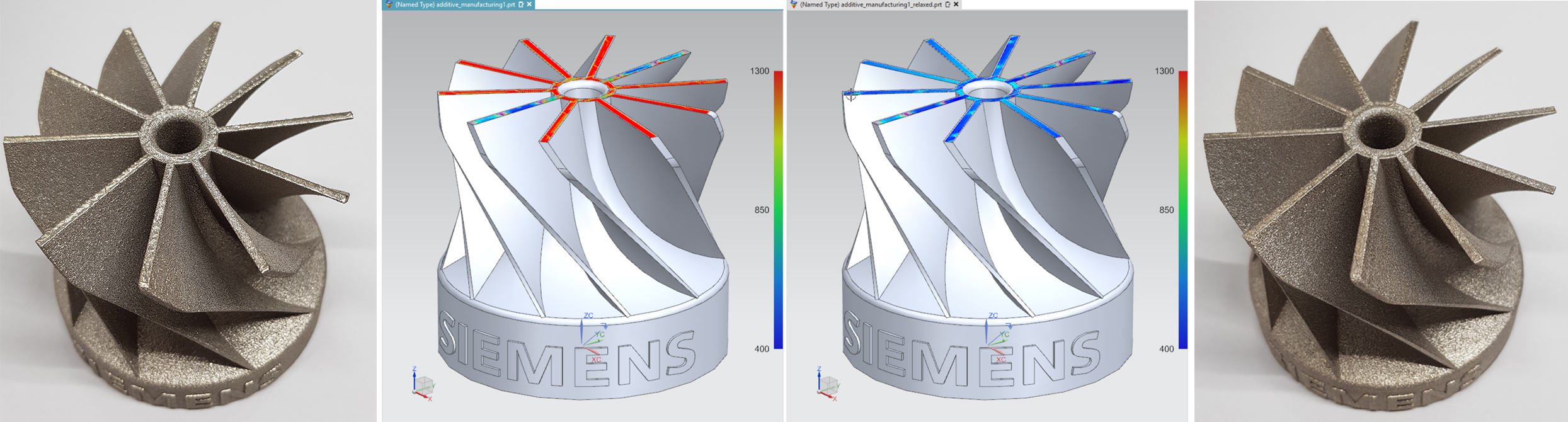
Taking aim at a different AM-related workflow problem, Siemens Digital Industries Software recently announced its Additive Manufacturing (AM) Path Optimizer, new beta technology integrated in NX, designed to solve overheating challenges associated with metal AM. The software, slated for release by the end of 2020, leverages simulation horsepower to maximize the production yield and quality of powder bed fusion manufactured parts, helping to reduce scrap and building on the company’s vision for a digital thread of manufacturing processes.
Scrap in metal AM has multiple root causes, which can be mitigated through process simulation, notes Omar Fergani, technology manager for Siemens Digital Industries Software. “With [Simcenter 3D AM], we have addressed the macro challenges related to residual stress and distortion,” Fergani explains. “Localized defects due to a bad combination of geometry and process parameters can lead to overheating. With the AM Path Optimizer, we are predicting those defects and addressing them at the origin.”
Given the complexity of the problem—there are thousands of layers and millions of vectors with AM components—a traditional finite element approach will not suffice, Fergani says. “That is why we have introduced this novel approach where we are training a machine learning algorithm on synthetic data (meaning data generated from a selected number of representative volume elements). In that way, we speed up the simulation by a factor of 10 to 7.”
To learn more about GrabCAD Shop, watch this video.


Simcenter™ software, from Siemens Digital Industries Software, uniquely combines system simulation, 3D CAE and test to help you predict performance across all critical attributes earlier and throughout the entire product lifecycle. By combining…

Making the Case for Artificial Intelligence and Machine Learning in Engineering
In this paper, Siemens Digital Industries Software and Digital Engineering will provide an overview of how AI/ML-enabled software can improve design workflows, while also addressing common questions and concerns around implementing this technology in an engineering organization.

Beth Stackpole is a contributing editor to Digital Engineering. Send e-mail about this article to [email protected].
Follow DE
Join over 90,000 engineering professionals who get fresh engineering news as soon as it is published.






About Us · Contact Us · Editorial Team · Advertising · Privacy Policy · Subscriber Services · © 2026 Digital Engineering 24/7 · Peerless Media