Helping design and engineering professionals discover, evaluate and specify technologies and processes that shorten the design cycle and enable success.


Sponsored

Cut Retrieval-Augmented Generation (RAG) Hallucinations by 50%
Most teams hit the same wall with enterprise AI: LLMs that hallucinate, pipelines that don’t scale, and infrastructure that’s harder to design than the models themselves.

What Is Intelligent BOM Management? A Guide to Smarter Product Development
Learn how intelligent Bill of Materials (BOM) management helps teams collaborate, reduce errors, and bring innovative products to market faster with cloud-based PLM tools.
 It’s easy to get obsessed with engineering computer specifications when you’re trying to boost the speed of product development. The more megahertz, cores and gigabytes the better, right? Not necessarily. While faster hardware is important, it’s only part of the solution. The best product design workflow matches the right hardware with the software you use.
Threading Through Design
3D design, simulation, visualization and rendering applications do not equally make use of the same hardware. Think of the tasks you do on your workstation: checking email, rotating a CAD model, changing a simulation parameter and more. All of those tasks are comprised of individual instructions, or threads, that are executed by the processor. Multicore systems are capable of executing different threads concurrently in parallel, but they can’t do that if the software itself isn’t multi-threaded.
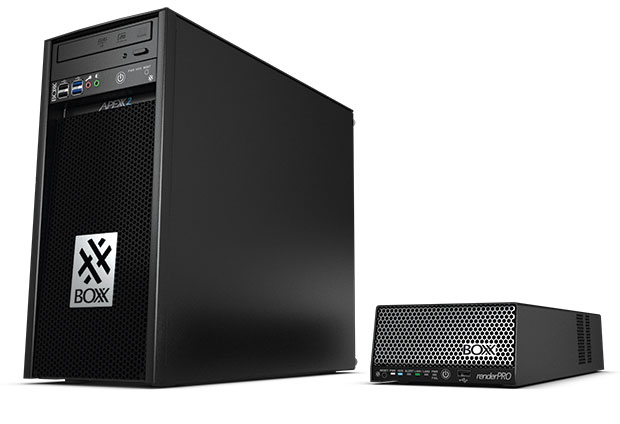
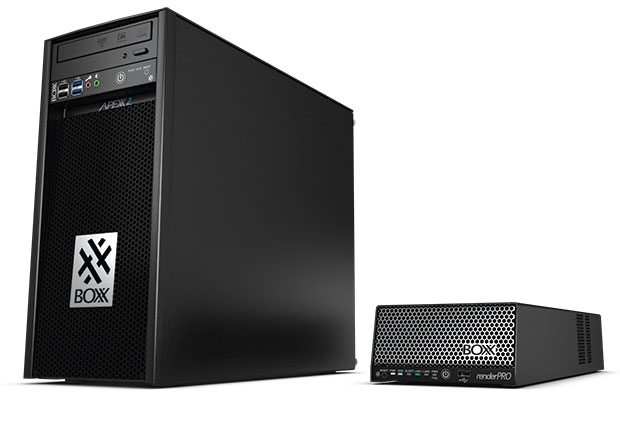 The APEXX line of workstations together with the renderPRO from BOXX Technologies enable a fast overclock and offload oriented design engineering workflow.
Software for tasks like modeling, animating and texturing are predominantly single threaded, so having more cores won’t complete them any faster. For those applications, you want the fastest CPU available. Even a more advanced graphics card won’t make up for a slower CPU because the card still needs to wait for instructions from the CPU.
On the other hand, tasks like rendering and simulation visualization are often multi-threaded, so they can take advantage of multiple cores. The more CPU cores you have at your disposal, the shorter your rendering time will be. However, multi-threaded tasks can quickly consume the compute power in a typical multi-core engineering workstation. That not only slows your 3D model interactivity to a crawl, it also, for example, makes it difficult or impossible to adjust a CAD model while running a simulation.
To overcome these common engineering computing bottlenecks, BOXX Technologies recommends an overclocking and offloading workflow.
A safely overclocked processor, like those available in workstations from BOXX Technologies, allows for peak productivity with single-threaded applications. The company has shipped thousands of safely overclocked systems and guarantees their overclocked performance for the life of the warranty. For example, BOXX overclocks the APEXX 2 Model 3402 and APEXX 4 Model 7402 with 8-core Intel® Core™ i7 processors to 4.125GHz. That provides increased performance in single threaded applications vs. the processor’s stock clock speed of 3GHz.
To boost rendering and simulation speeds without compromising your workstation’s functionality, you can offload those multi-threaded processes to a BOXX renderPRO. Configurable with up to two Intel Xeon processors for a total of 28 cores (56 threads), the renderPRO enables you to render or simulate without bogging down your other work and without the cost or complexity of a render farm. The renderPRO simply requires power and a network connection. It’s small and quiet enough to sit on your desk, yet powerful enough to significantly enhance your workflow when paired with an overclocked workstation.
For more information on the BOXX workflow, visit boxxtech.com/workflow.


Join over 90,000 engineering professionals who get fresh engineering news as soon as it is published.






About Us · Contact Us · Editorial Team · Advertising · Privacy Policy · Subscriber Services · © 2026 Digital Engineering 24/7 · Peerless Media