Helping design and engineering professionals discover, evaluate and specify technologies and processes that shorten the design cycle and enable success.



Cut Retrieval-Augmented Generation (RAG) Hallucinations by 50%
Most teams hit the same wall with enterprise AI: LLMs that hallucinate, pipelines that don’t scale, and infrastructure that’s harder to design than the models themselves.

What Is Intelligent BOM Management? A Guide to Smarter Product Development
Learn how intelligent Bill of Materials (BOM) management helps teams collaborate, reduce errors, and bring innovative products to market faster with cloud-based PLM tools.
Arithmetica describes Pointfuse as offering a powerful modeling engine that delivers a fast, precise and flexible way of converting large point-cloud data sets generated by laser scanners or photogrammetry into high-fidelity vector models. Pointfuse uses advanced statistical techniques to create vector models that can be manipulated using any industry-standard CAD system.
Among the enhancements debuting in Pointfuse V3 are “selectable surfaces” functionality and changes to the user interface as well as to its data processing algorithms that improved performance. Additionally, V3 has been optimized to reduce data size through reduced polygon counts.
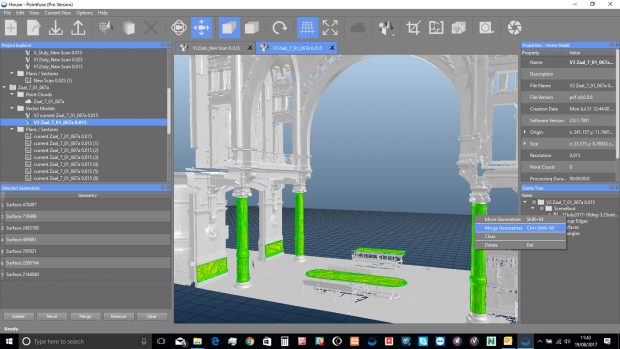 Arithmetica has announced the impending release of version 3 of its Pointfuse software for converting point-cloud data to 3D models. Image courtesy of Arithmetica Ltd.
Pointfuse V3's selectable surfaces functionality, explains Arithmetica, provides a unique approach for categorizing objects within a 3D scene. This functionality enables surfaces within 3D models to be identified, grouped and classified within a mesh. This, the company adds, brings workflow efficiencies to a project that is not possible when working with point clouds or traditional mesh models.
The changes to the user interface and data processing algorithms make Pointfuse V3 faster than previous versions of the software. These changes are said to make converting point clouds to high-fidelity models a matter of minutes and simpler through one parameter, one-button processing.
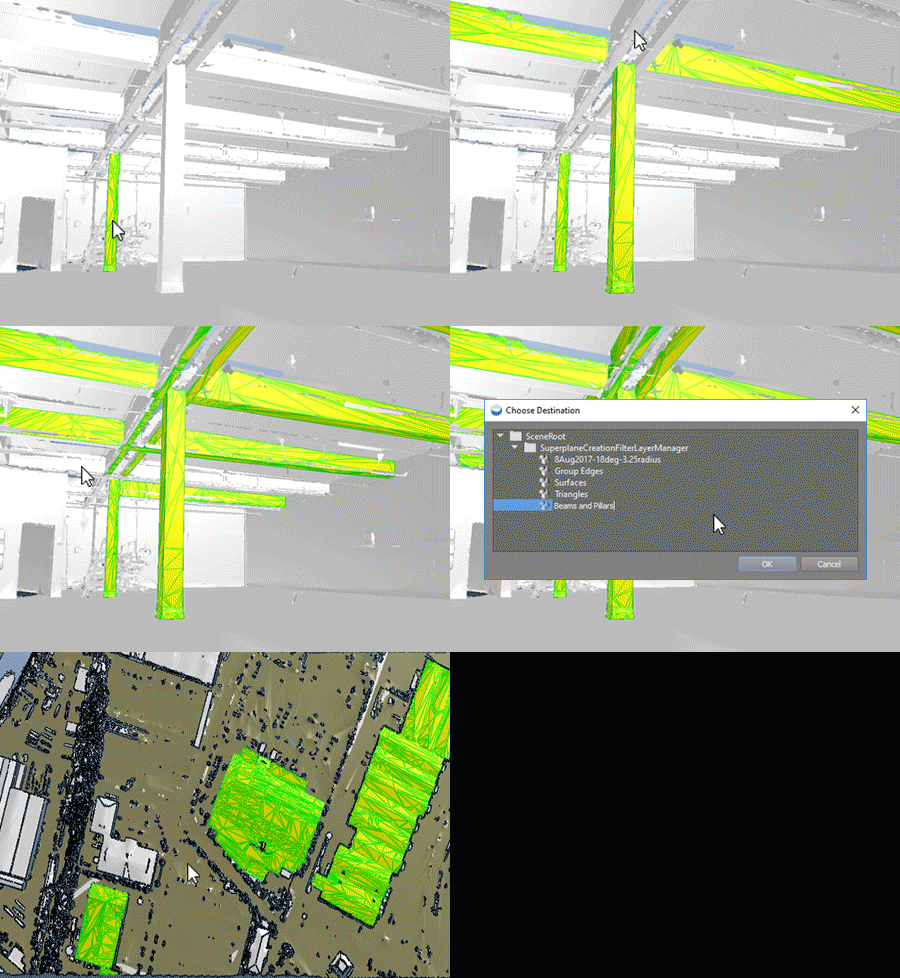 Pointfuse V3 introduces a selectable surfaces functionality that allows surfaces within 3D models to be identified, grouped and classified within a mesh. Image courtesy of Arithmetica Ltd.
Arithmetica reports that Pointfuse V3 significantly trims down the file size of 3D models created from point clouds while maintaining model fidelity by reducing the data density within each surface. This results in a reduction in model size by a factor of 10, making ongoing use of the model easier, faster and more efficient.
Pointfuse can import point-cloud data in common formats, and it can export 3D vector files in industry-standard formats as well as 2D files in DXF format. It can display point-cloud data in color and with textures. It also has a tool for measuring lines, polylines and polygons. Measurements are viewable on the model and can be exported into a CSV file.
“We have been working on Pointfuse V3 for some time, and the feedback from user testing is that the new functionality and features on offer are eagerly awaited, with some projects even being put on hold until it becomes available in the next few weeks,” commented Mark Senior, business development manager at Arithmetica, in a press statement.
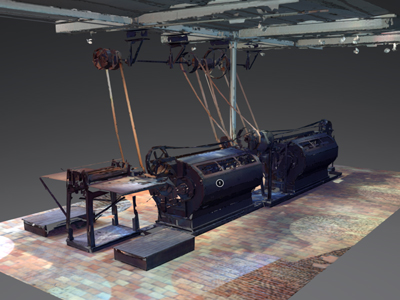 Point-cloud data of this turbine was converted into a 3D textured model using Pointfuse software. RealVisuals image courtesy of Arithmetica Ltd.
Pointfuse point-cloud conversion software runs on 64-bit Windows workstations. Beginning with the introduction of V3 Pointfuse Arithmetica will offer a new monthly licensing option for those requiring Pointfuse's capabilities on a project-by-project basis. Pointfuse remains available with an annual licensing option as well.
Click here for further details.
Peruse an interactive gallery of scan data converted to 3D by Pointfuse.
Check out a Pointfuse user guide for granular details on features.
Download a trial version of Pointfuse.
See why DE's Editors selected Pointfuse V3 as their Pick of the Week.
Sources: Press materials received from the company and additional information gleaned from the company's website.


Anthony J. Lockwood is Digital Engineering's founding editor. He is now retired. Contact him via [email protected].
Follow DE
Join over 90,000 engineering professionals who get fresh engineering news as soon as it is published.






About Us · Contact Us · Editorial Team · Advertising · Privacy Policy · Subscriber Services · © 2026 Digital Engineering 24/7 · Peerless Media