Helping design and engineering professionals discover, evaluate and specify technologies and processes that shorten the design cycle and enable success.



Digital Engineering April 2026
In the latest issue of Digital Engineering, we take a look at the latest innovations in design for additive manufacturing, including the use of natural language inputs, social media cosplayers, and AI integration. The issue also includes a feature…

January Special Focus Issue: Design for Additive
In this Special Focus Issue of Digital Engineering, learn about the latest advancements in design for additive manufacturing, including new software tools, additive in automotive, custom medical devices, and more.
Headquartered at the Picatinny Arsenal in New Jersey, The U.S. Army Armament Research, Development and Engineering Center (U.S. Army ARDEC) is the primary research and development group for the US Army’s armament and munitions systems. The ARDEC team works on advanced materials and technologies with a focus on material properties. This effort led ARDEC to expand into additive manufacturing, specifically, to identify the types of materials that can be used in AM equipment to meet the needs of the US Army.
Matthew Brauer, a scientist for the Advanced Materials Branch of ARDEC, said that with approximately 25 3D printers in their lab, ranging from small, $500 hobby-class desktop machines to large $500K+ industrial-class additive manufacturing equipment, they are always looking for the latest equipment to test and use for their unique applications in the field, where soldiers need spare parts and custom tools on demand.
For functional use in the field, 3D printers must be easy and safe enough for soldiers to operate on temporary or permanent field bases and able to withstand the rigors of various and sometimes harsh environmental conditions. The materials must also be safe given the strict storage and disposal regulations of many countries around the world and the parts must meet performance requirements.
Rize caught the attention of the AMTB team (Advanced Materials & Technology Branch within ARDEC) for its unique hybrid Augmented Deposition process that enables the simultaneous extrusion of engineering-grade thermoplastic and the jetting of functional inks from print heads for traceability. They were also impressed with Rize’s minimal post processing after printing.
“It’s easy to peel away supports from intricate geometries, and that provides a faster part in the soldier’s hand.
-Matthew Brauer, Scientist, Advanced Materials Branch of ARDEC
James Zunino, Materials Engineer at ARDEC, added how useful Rize’s simple and clean post-processing can be in regions where water resources can’t be wasted for post-processing parts. They were also impressed with the Z-strength of Rize parts, which is important for the Army’s wide variety of functional part applications.
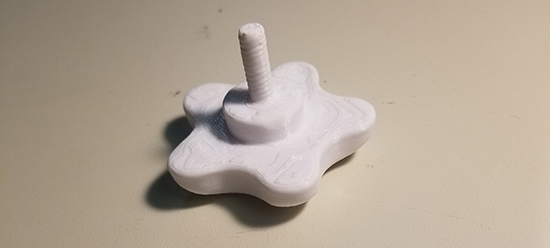
AMTB’s Rize One 3D printer is used to produce spare parts, such as robot wheels and vehicle parts. For example, soft skin Humvee window knobs and handles break off easily, preventing soldiers from getting in and out of the vehicle. They needed a way to quickly and easily manufacture new ones on the fly. They reverse engineered the originals and print them on Rize One. Previously they printed these parts on an extrusion technology, but the parts needed to soak in a caustic solvent for 4-6 hours following printing before they could be used. Using Rize One, the parts are available for installation immediately after printing. This amounts to a savings of up to 6 hours per part; which can mean the difference between getting the part in one day vs. two days.
“A system can go down because of one missing part and something like 3D printing can get you back in the fight. That’s a huge benefit to the Army,” said James. “If a handle is broken on purge pump or wheel is damaged on an EOD robot, you can print a new one.”
ARDEC also uses Rize One to produce a wide range of tools needed in the field. For example, 55-gallon drums are used to store chemicals. Unaware that there is a specific tool for removing the drum cap, new soldiers often try use whatever is handy – screwdrivers and other sharp instruments - that can cause them injury and destroy the cap. A replica was reverse engineered using SOLIDWORKS and ARDEC printed the tool with Rize One, enabling easy and safe removal of the cap. If the tool is misplaced or left behind during a move, a new one can quickly and easily be printed on the fly in less than one day.
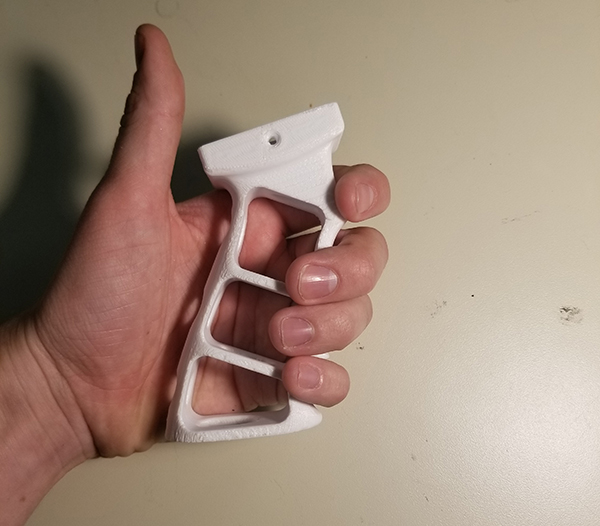
Another tool that ARDEC prints with Rize One is a generator wrench that is easily lost during moves. Using 3D Scanners, they reverse engineered the wrench and print electrically neutral replacements on demand with Rize One. Rize One is also used for mission critical applications, including forward grips that mount to the picatinny rail on rifles. ARDEC downloads the publicly available files, customizes them as needed and prints them on Rize One. Soldiers prefer the unique and custom rifle grips and having ARDEC produce them with Rize One enhances their performance.
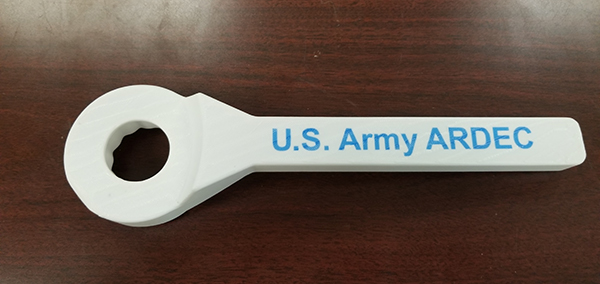
Rize’s digitally augmented parts add traceability and an extra layer of confidence in the Army’s 3D printed parts. This capability is used to embed serial numbers and QR codes into parts that create a secure digital thread back to the ARDEC database for detailed part information, such as the printer operator, operator training, print parameters, room conditions, part specifications and use and much more.
“I think having accountability and provenance of a part is huge in the general acceptance of AM parts,” said James. “A lot of it is trust in the new technology and this really helps build some of that trust.”
“Considering one of the assets that could be 3D printed is a grenade launcher, knowing that an experienced technician made it (and not a first-year grunt) is something a field commander would want to know. Would you buy a vehicle if it didn’t have a VIN on it? You’d probably question it."
—James Zunino, materials engineer, ARDEC.


Join over 90,000 engineering professionals who get fresh engineering news as soon as it is published.






About Us · Contact Us · Editorial Team · Advertising · Privacy Policy · Subscriber Services · © 2026 Digital Engineering 24/7 · Peerless Media