Helping design and engineering professionals discover, evaluate and specify technologies and processes that shorten the design cycle and enable success.



April 2026 Special Focus Issue: Generative Design
In this Special Focus Issue, Digital Engineering takes a look at how generative design solutions can be used across different types of design problems and with a variety of manufacturing approaches to accelerate design space exploration, and…

Electrum utilizes the 3DEXPERIENCE platform on the cloud to develop their new electric motorcycle
Electrum, a new brand of electric motorcycles, utilizes the 3DEXPERIENCE platform. Their mission is to support Indonesia’s shift to low-carbon, sustainable transport and to ultimately help the country’s government achieve its vision of net…
Siemens has released D-Cubed 2D DCM version 75.0. D-Cubed 2D components are integrated by software developers to add functionality to the sketching environment of CAD/CAM/CAE and architecture, engineering and construction software applications. These applications are used to design, analyze, visualize and manufacture products from consumer goods to aircraft engines and commercial buildings.
D-Cubed 2D DCM (2D Dimensional Constraint Manager) is a 2D geometric constraint solver. In addition to driving the sketcher in many CAD products, 2D DCM is used in CAM, CAE and other geometry-based applications. A few of the enhancements introduced in version 75.0 of D-Cubed 2D DCM are described here.
The 2D DCM enables engineers to apply rules of symmetry in their designs, so that any two defined collections of geometry will remain precisely reflected about a given axis of symmetry, while any other aspects of the wider sketch are being modified. This higher level ability to “mirror” arbitrary components in a sketch is an important capability in productive design applications.
Version 75 also introduces alignment control for the normal constraint. A normal constraint can be applied between a curve and line that intersect, or between two curves that intersect. At the point of intersection, the tangent direction of the curve is constrained perpendicular to the direction of the line, or to the tangent direction of the other curve.
2D DCM supports advanced constraint types such as symmetry as well as linear or circular patterns of repeated elements. This release further improves performance for constraints that are often used with large, simple symmetric sketches and pattern arrays.
In another recent product update, Siemens released D-Cubed 3D Components and shared its highlights.
D-Cubed 3D components are integrated by software developers to add 3D modeling capabilities to CAD/CAM/CAE and AEC software applications. These applications are used to design, analyse, visualize, and manufacture products from consumer goods to aircraft engines and commercial buildings.
D-Cubed 3D DCM (3D Dimensional Constraint Manager) is a geometric constraint solving software component. Supporting a range of geometries, dimensions and constraints, 3D DCM enables 3D parametric sketching, part shape control using direct modeling, assembly part positioning and kinematic motion simulation. Key enhancements introduced in version 60.0 of D-Cubed 3D DCM are described below.
New functionality enables a dimension or coincident constraint to apply directly between a point and the planar component of a circle or torus.
3D DCM supports grouping of geometry into a set, which can be used to define a rigid 3D part. This provides a method for positioning a 3D part using geometric constraints, while ensuring constraints will not affect the part’s shape. To mitigate against any potential loss of solving accuracy when positioning sets over large distances, the latest version enables applications to specify the transformation of the set in which geometry has been grouped.
When dimensions and constraints are used to position 3D parts in assemblies, they remove the parts’ degrees of freedom. In the absence of any positioning constraints, 3D parts have no unique location along X, Y and Z axes, and no unique rotation about those same axes. This usually results in 6 degrees of freedom for any given part.
For more details on D-Cubed 3D DCM Version 60.0 and D-Cubed CDM version 60.0, click here.
Sources: Press materials received from the company and additional information gleaned from the company’s website.


Simcenter™ software, from Siemens Digital Industries Software, uniquely combines system simulation, 3D CAE and test to help you predict performance across all critical attributes earlier and throughout the entire product lifecycle. By combining…
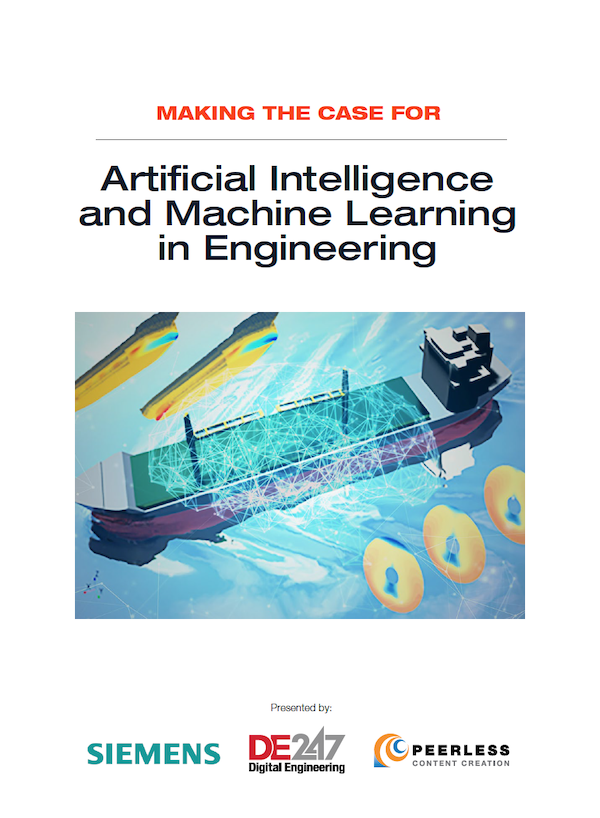
Making the Case for Artificial Intelligence and Machine Learning in Engineering
In this paper, Siemens Digital Industries Software and Digital Engineering will provide an overview of how AI/ML-enabled software can improve design workflows, while also addressing common questions and concerns around implementing this technology in an engineering organization.

DE's editors contribute news and new product announcements to Digital Engineering. Press releases may be sent to them via [email protected].
Follow DE
Join over 90,000 engineering professionals who get fresh engineering news as soon as it is published.






About Us · Contact Us · Editorial Team · Advertising · Privacy Policy · Subscriber Services · © 2026 Digital Engineering 24/7 · Peerless Media