Helping design and engineering professionals discover, evaluate and specify technologies and processes that shorten the design cycle and enable success.



April 2026 Special Focus Issue: Generative Design
In this Special Focus Issue, Digital Engineering takes a look at how generative design solutions can be used across different types of design problems and with a variety of manufacturing approaches to accelerate design space exploration, and…

Electrum utilizes the 3DEXPERIENCE platform on the cloud to develop their new electric motorcycle
Electrum, a new brand of electric motorcycles, utilizes the 3DEXPERIENCE platform. Their mission is to support Indonesia’s shift to low-carbon, sustainable transport and to ultimately help the country’s government achieve its vision of net…
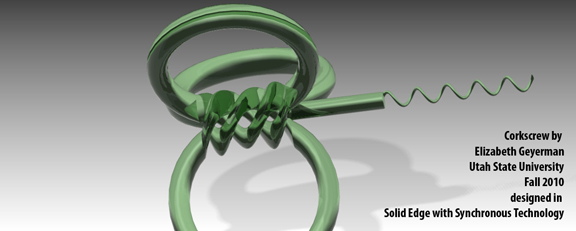
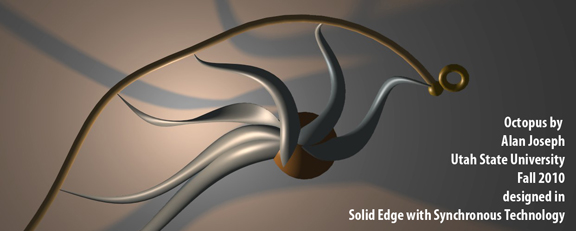
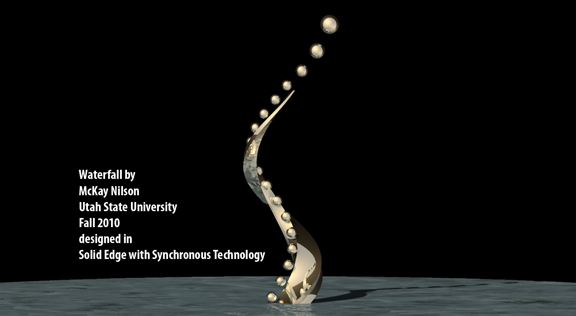
A symptom of an uninspired working life: You begin to think inside the box. In design and engineering, if you've been repeatedly told to risk as little as possible, to always conform to a set of aesthetic standards, and to reuse as many preexisting components as possible, sooner or later you'll lose your creative edge (most likely, sooner).
Many of us think of mechanical CAD packages as tools for designing devices with electromechanical functions. When we begin a project, we already have in mind a rough idea of the standard components we'll be using. We draw inspiration from existing objects, from last season's bestsellers. Naturally, we end up designing variations of the same.
That's why my encounter with the students from professor John Devitry's class (Utah State University, Mechanical and Aerospace Engineering) served as a reminder that we should all strive to hold on to the spirit of experimentation. Devitry didn't bother telling his students what they couldn't do with a mechanical CAD program. Consequently, his students turned out designs that many of us wouldn't even think of attempting in such software.
The work featured in this blog post and video report come from Elizabeth Geyerman, Alan Joseph, and McKay Nilson, all from Devitry's CAD class. They used Solid Edge with Synchronous Technology, but their designs could easily fool untrained eyes into thinking they come from 3ds Max, Maya, and Rhino -- programs better suited than mechanical CAD for form exploration.
In my interviews with them, I learned something I'd nearly forgotten: You gotta have art.
"Well, art is a big part of engineering," said Geyerman. "I mean, if something doesn't have aesthetic appeal, no one is going to want to use it or buy it. When I started learning this program [Solid Edge with Synchronous Technology] I thought not only is it practical, it could also be a medium of art."
If you're suffering from idea block (the designer's equivalent of writer's block), Joseph suggested, "Go to an art museum ... try and feel the creativity, doodle ... Yes, you can make this assembly or this faucet works, then you can take the outside of that and maybe give it a sort of sculptural look. It's not just a faucet -- it's a piece of modern art."
Professor John Devitry is an Adjunct Faculty of Mechanical and Aerospace Engineering at Utah State University. He's the CAD administrator at the Space Dynamics Lab. Previously, he worked for UGS PLM Solutions (now known as Siemens PLM Software) as the Western U.S. Regional Lead Application Engineer.
For more, watch the video report below:


Kenneth Wong is Digital Engineering's resident blogger and senior editor. Email him at [email protected] or share your thoughts or suggestions at digitaleng.news/facebook.
Follow DE
Join over 90,000 engineering professionals who get fresh engineering news as soon as it is published.






About Us · Contact Us · Editorial Team · Advertising · Privacy Policy · Subscriber Services · © 2026 Digital Engineering 24/7 · Peerless Media