Helping design and engineering professionals discover, evaluate and specify technologies and processes that shorten the design cycle and enable success.



Digital Engineering April 2026
In the latest issue of Digital Engineering, we take a look at the latest innovations in design for additive manufacturing, including the use of natural language inputs, social media cosplayers, and AI integration. The issue also includes a feature…

January Special Focus Issue: Design for Additive
In this Special Focus Issue of Digital Engineering, learn about the latest advancements in design for additive manufacturing, including new software tools, additive in automotive, custom medical devices, and more.
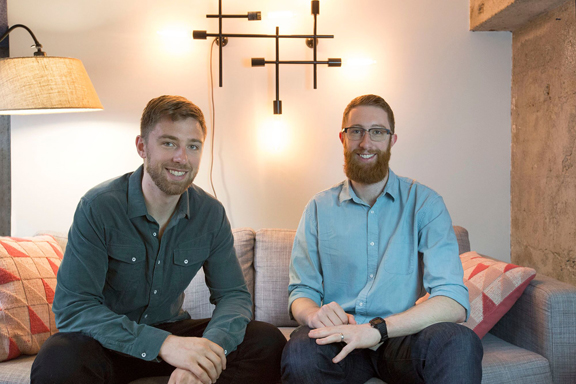
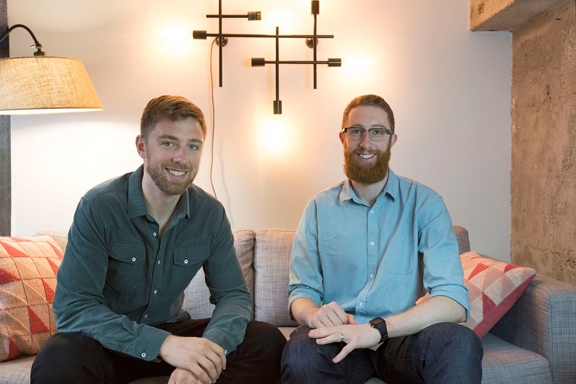 Dave (left) and Nate (right) Evans, cofounders of Fictiv, believe anyone with an internet connection should have access to production-grade manufacturing machines (image courtesy of Fictiv).
Dave and Nate Evans, cofounders of Fictiv, run what they describe as "a manufacturing platform" from a small office in San Francisco's Civic Center. Walking inside, you come across whiteboards with scribbles and doodles, staffers squinting at Macs and PCs, and a friendly, fluffy golden retriever that belongs to an employee. What you don't see are rows and rows of 3D printers and CNC (computer numeric controlled) machines cranking out parts.
How, then, does Fictiv deliver on its promise to produce your 3D printed parts in 24 hours and machined parts in three days? The answer rests with the way Fictiv harnesses its network of manufacturing partners.
Dave, a Stanford-trained mechanical engineer and one of the earliest employees of Ford's Research Lab in Palo Alto, is Fictiv's CEO. Nate, a designer, artist, and entrepreneur with a master's degree in Chinese, is Fictiv's Chief Experience Officer. (Nate's title is abbreviated as CXO, thus the awkwardness of having two CEOs is averted.)
"Fictiv is the most efficient way for manufacturers and industrial designers to fabricate their parts," said Nate. His vision is, "anyone with an internet connection should have access to the kind of production-grade machines Ford or Tesla would use."
Fictiv built the software infrastructure to submit digital files, get quotes, and place orders. Users get a series of technology and material options relevant to the production method they've specified (for example, inexpensive PLA parts, strong ABS parts, or transparent parts in 3D printing).
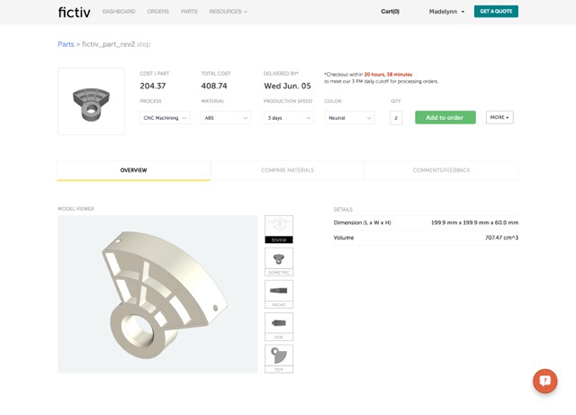 Fictiv's online ordering system automatically inspects the submitted part to ensure it can be made (image courtesy of Fictiv).
A key component of Fictiv's browser-based software is the automated design for manufacture (DFM) analysis. Dave explained, "When you upload a part, the software is looking at it to see if the part can be produced."
If the geometry is flawed or unsuitable for machining, the customer gets instant feedback, with suggested remedies. In the preliminary estimate, the analysis is software-driven. But once the customer requests a full quote, a mechanical engineer on Fictiv's staff inspects the file in person.
While some crowd-funded startups may have no qualms about uploading their concepts to a cloud-hosted software, many in traditional manufacturing, such as automotive and aerospace, still wrestle with the security concerns of the cloud. Dave said, "That's why we sign a lot of NDAs," but also pointed out the concerns may be disproportionate to the real risk.
"When you're emailing your design to get quotes, you don't know what happens to those file attachments," he said. "With our system, only the vendor who's going to produce the part will get to see the file -- nobody else."
The actual production is done by its manufacturing vendors, who are recruited, vetted, and brought on board with rigor and diligence. The vetting process takes two weeks, Dave revealed.
"Machine shops go through ebbs and flows," Dave pointed out. "So we leverage the idle machines to produce parts on demand. We bundle a lot of orders from different customers and drive business to a vendor, so we have a lot of purchasing power."
Currently, Fictiv targets startups, innovators, inventors, and designers who need parts produced in quantities of 500 or lower.
With the ability to produce low-volume parts at a reasonable cost, 3D printing empowers a whole new wave of makers, innovators, and inventors who would not otherwise be able to turn their ideas into reality. However, most 3D-printed parts do not have the same strength as machined metal parts. Metal parts are easy to produce in CNC, but the technology favors large volume production. The fact that Fictiv's platform offers both choices for low or moderate volume is significant.
Stratasys, a 3D printing machine maker, offers on-demand manufacturing services through its Stratasys Direct Manufacturing division. Production options include PolyJet, stereolithography, laser sintering, and CNC machining.
Another on-demand additive manufacturing vendor, CloudDDM, gets its speed advantage by building its operations close to the UPS distribution center in Louisville, Kentucky. The company offers single-day turnaround for 3D-printed parts. Makers, inventors, and engineers may also turn to 3D Hubs, a site that lists 3D printing service providers by region, to produce their prototypes.
For small and midsize businesses that do not have onsite production facility, on-demand manufacturing service providers fill a critical need. They become the remote manufacturing arm, an extension of the in-house design team.

Fictiv was founded in 2013 to eliminate a major bottleneck in new product development: custom mechanical part sourcing.

Kenneth Wong is Digital Engineering's resident blogger and senior editor. Email him at [email protected] or share your thoughts or suggestions at digitaleng.news/facebook.
Follow DE
Join over 90,000 engineering professionals who get fresh engineering news as soon as it is published.






About Us · Contact Us · Editorial Team · Advertising · Privacy Policy · Subscriber Services · © 2026 Digital Engineering 24/7 · Peerless Media