Helping design and engineering professionals discover, evaluate and specify technologies and processes that shorten the design cycle and enable success.



Digital Engineering April 2026
In the latest issue of Digital Engineering, we take a look at the latest innovations in design for additive manufacturing, including the use of natural language inputs, social media cosplayers, and AI integration. The issue also includes a feature…

January Special Focus Issue: Design for Additive
In this Special Focus Issue of Digital Engineering, learn about the latest advancements in design for additive manufacturing, including new software tools, additive in automotive, custom medical devices, and more.
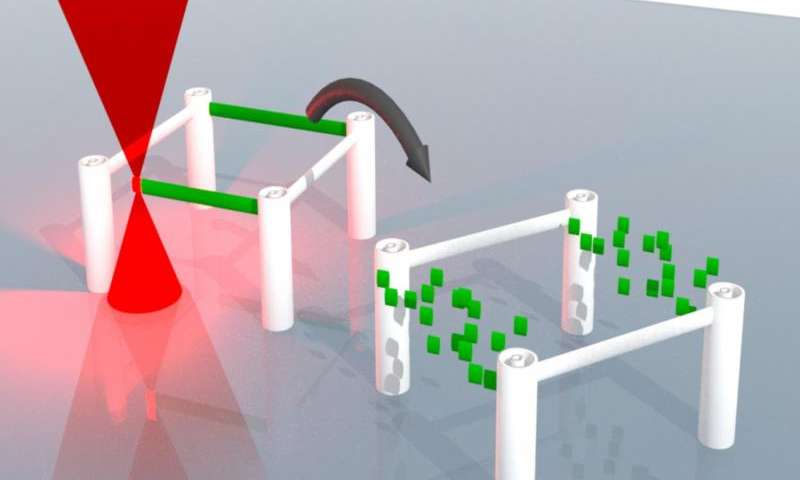
Computers have made that whole process unnecessary for regular printing, but what about for 3D printing? If there’s an error in a structure, you pretty much have to start the build over again. That’s the problem that researchers at the Karlsruhe Institute of Technology (KIT) appear to have solved by creating a method to “erase” a direct laser written structure up to 100 nm in size and then rewrite it repeatedly.
The ink the researchers developed has reversible bonding, so the printed structure can be erased by immersing it in a chemical solvent. A new structure can then be rewritten at the same point.
The structures are formed via direct laser writing irradiation of a phenacyl sulfide linker. Exposing the material to dithiothreitol cleaves the bonds and erases the structure.
"The ink with defined breaking points can be used for a variety of applications," doctoral student and first author Markus Zieger said.
Structures written with this erasable ink can be integrated into other structures made of non-erasable ink. For example, support constructions can be produced by 3D printing and then later removed via erasing. According to the researchers, it is also possible to further develop 3D designer petri dishes for use in biology applications.
It would also be feasible to create reversible wire bonds from erasable conducting structures in the future.
The research appeared in the journal Angewandte Chemie in a paper titled “Cleaving Direct Laser Written Microstructures on Demand.”
Source: Science Daily


Brian Albright is the editorial director of Digital Engineering.
Contact him at [email protected].

Join over 90,000 engineering professionals who get fresh engineering news as soon as it is published.






About Us · Contact Us · Editorial Team · Advertising · Privacy Policy · Subscriber Services · © 2026 Digital Engineering 24/7 · Peerless Media