Helping design and engineering professionals discover, evaluate and specify technologies and processes that shorten the design cycle and enable success.



Digital Engineering April 2026
In the latest issue of Digital Engineering, we take a look at the latest innovations in design for additive manufacturing, including the use of natural language inputs, social media cosplayers, and AI integration. The issue also includes a feature…

January Special Focus Issue: Design for Additive
In this Special Focus Issue of Digital Engineering, learn about the latest advancements in design for additive manufacturing, including new software tools, additive in automotive, custom medical devices, and more.
Researchers at Columbia University’s Irving Medical Center have leveraged 3D printing to literally create a new “hair raising” process. The group has used a 3D printer to create plastic molds that can function as a microenvironment for hair follicle growth. The process could be a way to facilitate the growth of human hair follicles in a laboratory to slow or prevent hair loss.
According to team leader Angela Christiano, the Richard & Mildred Rhodebeck Professor of Dermatology at Columbia university Vagelos College of Physicians and Surgeons, growing human hair from cell cultures has historically been difficult.
While rat and mice hairs have been grown in a dish using cell cultures, but human hair cultures have never produced reliable results.
"Cells from rats and mice grow beautiful hairs," Christiano said. "But for reasons we don't totally understand, human cells are resistant."
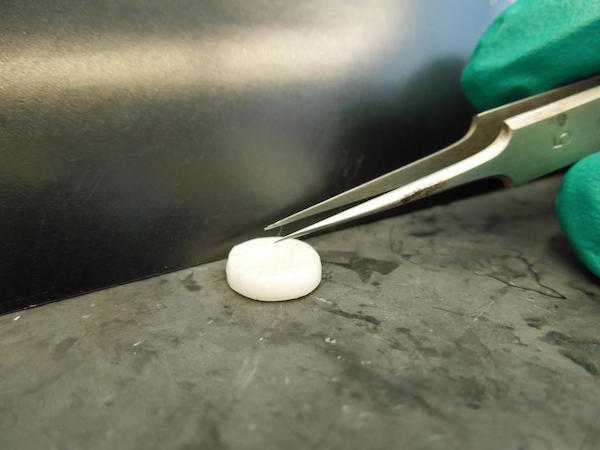
In a new study, the researchers 3D printed a microenvironment with plastic molds that include thin extensions that half a millimeter wide. "Previous fabrication techniques have been unable to create such thin projections, so this work was greatly facilitated by innovations in 3D printing technology," said Erbil Abaci, PhD, first author of the study.
Human skin was engineered to grow around the mold, and hair follicle cells from human volunteers were placed into the deep wells and topped by cells that produce keratin. The cells were fed growth factors to stimulate hair growth. Follicles appeared and began growing hair after three weeks.
Potentially, this process could provide hair follicles for people undergoing robotic hair restoration treatment. The surgery usually requires the transfer of thousands of follicles from the back of the head to the front and top. Not all patients qualify for this surgery, however, because they don’t always have enough available follicles.
"What we've shown is that we can basically create a hair farm: a grid of hairs that are patterned correctly and engineered so they can be transplanted back into that same patient's scalp," Christiano said. "That expands the availability of hair restoration to all patients--including the 30 million women in the United States who experience hair thinning, and young men whose hairlines are still receding. Hair restoration surgery would no longer be limited by the number of donor hairs."
The engineered follicles could also be used for pharmaceutical testing.
The research was published in Nature Communications this year.
Source: Columbia University


Brian Albright is the editorial director of Digital Engineering.
Contact him at [email protected].

Join over 90,000 engineering professionals who get fresh engineering news as soon as it is published.






About Us · Contact Us · Editorial Team · Advertising · Privacy Policy · Subscriber Services · © 2026 Digital Engineering 24/7 · Peerless Media