Helping design and engineering professionals discover, evaluate and specify technologies and processes that shorten the design cycle and enable success.


Alert!
Digital Engineering ceased publication on July 1, 2026. This website remains available as an archive of engineering content.
For inquiries or information, please email [email protected].

Digital Engineering April 2026
In the latest issue of Digital Engineering, we take a look at the latest innovations in design for additive manufacturing, including the use of natural language inputs, social media cosplayers, and AI integration. The issue also includes a feature…

January Special Focus Issue: Design for Additive
In this Special Focus Issue of Digital Engineering, learn about the latest advancements in design for additive manufacturing, including new software tools, additive in automotive, custom medical devices, and more.
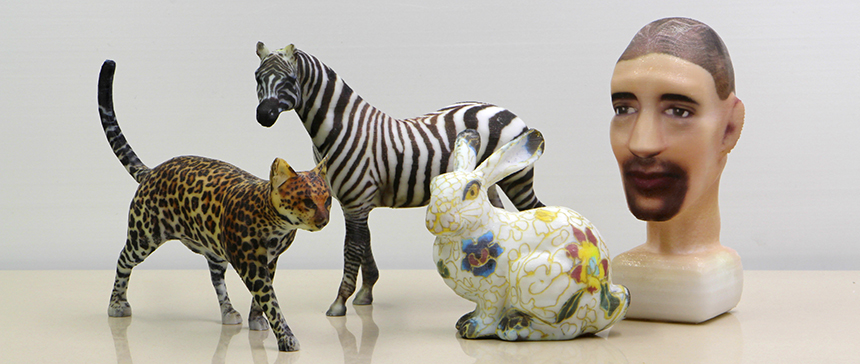
One solution is hydrographic printing, which uses PVA film suspended in water to "wrap" a pattern around a 3D object. This process is used to put repeating patterns on objects, and while it's relatively inexpensive it is nearly impossible to align the image on the film to the object. That's why most companies use single patterns on the films.
Researchers at Zhejiang University and Columbia University have solved that problem, coming up with what they call computational hydrographic printing, which allows precise alignment of the film with the 3D object. In a video demonstration (which you can view below) they are able to align a mask print onto a 3D printed mask, as well as using multiple processes to put the image of a cheetah onto a three-dimensional cat figure.
The hydrographic process involves placing a PVA film on top of a container of water, spraying it with an activator chemical, and then dipping the object onto the film. The film wraps the surface of the object. Previously, it was impossible to align the image and the object, and the films could sometimes tear.
Using the computational process, the object is held by a gripper at the end of a rod. A 3D vision system (Microsoft Kinect) measures the location and orientation of the object with respect to the film. The computational model the researchers came up with is used to simulate the color film distortion during the process and creates a "texture map" to guide the object onto the film.
The system relies on Kinect and KinectFusion to construct a point cloud of the 3D object already attached to the gripper, as well as obtaining the exact location of the film on the water using 3D markers on the sliding bar.
The result: a nearly perfect match between the image and the object, even when multiple "dips" are required to place several films on the item.
Source: Columbia University


Brian Albright is the editorial director of Digital Engineering.
Contact him at [email protected].

Join over 90,000 engineering professionals who get fresh engineering news as soon as it is published.






About Us · Contact Us · Editorial Team · Advertising · Privacy Policy · Subscriber Services · © 2026 Digital Engineering 24/7 · Peerless Media